


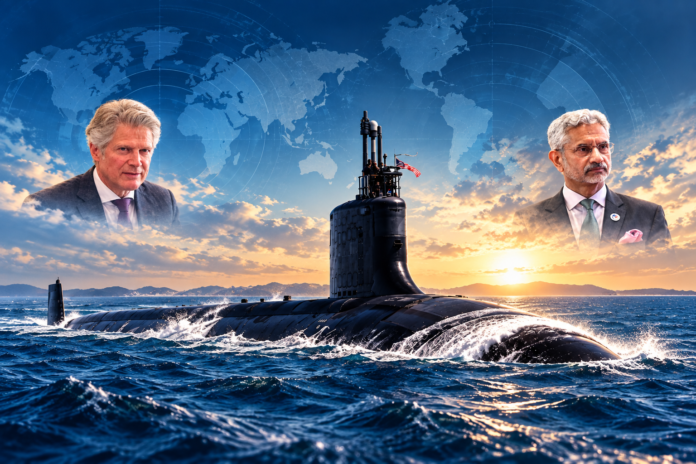
New Delhi. Germany has cleared the way for an estimated $8-billion agreement with India to jointly build six conventional submarines, German ambassador Jasper Wieck said in New Delhi on September 23. The proposed government-to-government pact is close to completion, although India’s final approval and formal signature are still pending. Wieck said Berlin could sign the agreement immediately, signalling that the remaining decision rests with New Delhi.
The project is expected to bring together Germany’s Thyssenkrupp Marine Systems (TKMS) and India’s state-owned Mazagon Dock Shipbuilders. The submarines would be built in India under the country’s Strategic Partnership model, which links domestic defence manufacturers with foreign original-equipment makers for advanced military production and technology transfer.

The vessels are expected to use air-independent propulsion, or AIP, a technology that allows diesel-electric submarines to remain underwater for substantially longer periods without surfacing or relying more frequently on their batteries. That capability improves stealth and endurance, particularly during surveillance and patrol missions in contested maritime areas. The submarines would also feature modern weapons, sensors and countermeasure systems.
The agreement would mark one of India’s most significant foreign-assisted naval programmes and could provide a long-term boost to the country’s submarine-building ecosystem. Local construction would require the integration of a wide range of imported and Indian-made components, creating opportunities for domestic suppliers, shipyard workers and defence technology companies. It could also open the door to future cooperation in weapons, sensors, unmanned systems, cyber capabilities and missile technology.
India has been seeking to expand and modernise its underwater fleet as its older Russian-origin submarines approach the later stages of their service lives. New Delhi is also attempting to reduce its historical dependence on Moscow for defence equipment, particularly as Russia’s war in Ukraine has exposed risks involving supply chains, maintenance and the availability of spares. A German partnership would give India another major defence supplier while strengthening its links with Europe.
The deal also reflects a shift in Berlin’s approach to defence cooperation with New Delhi. Ambassador Wieck said Germany had made what he described as a “180-degree shift” in its defence-export policy towards India, becoming more willing to approve licences and transfer technology. Berlin now views India as a trusted strategic partner, particularly amid a more unsettled security environment in Europe and the Indo-Pacific.

Both countries have cited Russia’s war in Ukraine, the growing role of unmanned systems and the wider deterioration in the geopolitical environment as reasons to invest more heavily in their armed forces. Germany and India have expanded military engagement through air and maritime exercises, while Germany has posted a liaison officer to the Indo-Pacific Information Fusion Cell in New Delhi to improve maritime awareness across the Indian Ocean.
For India, the submarine programme fits Prime Minister Narendra Modi’s broader effort to increase domestic defence production. The country has set ambitious targets for locally manufactured military equipment and has expanded capabilities in warship construction, aircraft carriers, submarines, helicopters and long-range missiles. Building the German-designed boats in India could therefore serve both an operational and industrial purpose.

However, the agreement will not immediately resolve India’s underwater-capability gap. Submarine construction is technically complex and typically involves lengthy testing, certification and delivery schedules. The final contract, production timetable, technology-transfer terms and division of responsibilities between TKMS and Mazagon Dock will determine how quickly the programme strengthens the Indian Navy.
Still, the proposed pact represents a strategic breakthrough. It would deepen India-Germany defence ties, diversify New Delhi’s military partnerships and give Berlin a larger role in the Indo-Pacific’s evolving security architecture.






