


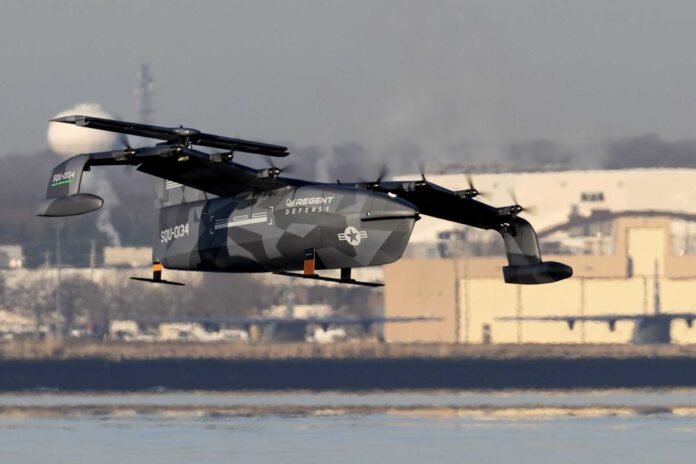
The agreement is Regent’s first production contract for its Squire, a hybrid-electric, wing-in-ground-effect craft designed to operate across water and air. Regent chief executive Billy Thalheimer announced the deal in November, but did not identify the government customer, disclose the fleet size or contract value, or specify where in the Middle East the vehicles will operate. The mission has been described as “underwater perception” and multi-domain sensing.
The Squire is designed to float, use hydrofoils to rise out of the water, then skim above the surface in ground effect. At that low altitude, it uses the cushion of air between its wing and the water to generate lift. The concept is intended to combine efficient movement with the ability to launch and recover without a runway or specialised aircraft facilities. Regent says it can operate autonomously and continue sensing as it moves between locations.

The company lists a top speed of up to 70 knots, a planned range exceeding 100 nautical miles and a configurable payload of up to 50 pounds. These are manufacturer-stated specifications, and the range is described as planned rather than a confirmed operational result. Regent’s stated mission possibilities include intelligence, surveillance and reconnaissance, logistics, search and rescue, and anti-submarine warfare. The government customer’s confirmed tasking is narrower: the public announcement points to underwater or maritime perception, without revealing the specific sensors or operational concept.
A craft that can remain on the water and then reposition quickly could offer a different option from a conventional unmanned aircraft or surface vessel. A surface vehicle may be able to stay in an area, but repositioning across a wide maritime zone can take time. An aircraft can cover distance quickly but may need a runway or other launch-and-recovery support. Squire’s proposed combination of afloat sensing and low-altitude flight is meant to bridge those roles. Its value in practice will depend on factors such as sea conditions, endurance, payload performance and the reliability of its autonomous controls.
Regent says Squire can connect with mission-management and multi-asset coordination systems, including TAK and Anduril’s Lattice. The company has also reported testing the vehicle in electronic-warfare scenarios. In August, it said Squire participated in the US Navy-led Silent Swarm event, which tested uncrewed systems in operationally relevant conditions involving electronic-spectrum operations. These demonstrations indicate that development has moved beyond basic vehicle design, but they do not establish that every proposed capability has been validated in the Middle East deployment environment.
The reported contract arrives amid expanded US investment in uncrewed systems for the US Central Command area of responsibility. However, CENTCOM has not said that Squire will be assigned to a particular task force or operation. The deployment should not be confused with an announced role in a named campaign: the buyer and precise mission remain undisclosed.

Squire is also distinct from Regent’s larger Viceroy Sea glider, a crewed or optionally autonomous craft in development for carrying passengers or cargo. Regent has worked with the US Marine Corps Warfighting Laboratory on the larger platform; that separate collaboration is not the Squire production contract. The Squire deal instead marks a step from development and demonstrations toward delivery of a small operational fleet.
The 2027 deployment will provide a practical test of whether the compact craft can combine persistent sensing with rapid movement between maritime locations. For the customer, the central question will be whether Squire can deliver useful coverage and reliable operations at sea, not simply whether it can fly close to the water. Until more details emerge, the fleet’s size, sensors, basing arrangements and performance in service remain unknown.








