


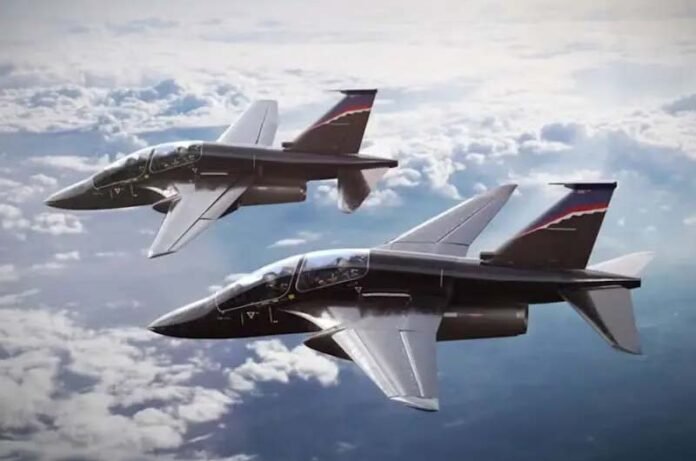
Korea Aerospace Industries (KAI) has received the Indian Air Force’s (IAF) request for information (RFI) on a proposed purchase of approximately 150 advanced jet trainers and is reviewing the opportunity internally, according to a report citing a company official. KAI’s supersonic T-50 Golden Eagle could be a contender, but the process remains at an early information-gathering stage, not a formal competition or confirmed bid.
The proposed aircraft would take over the IAF’s Stage III (F) training role, the final phase before pilots move to operational fighter squadrons. India’s Hawk Mk-132 trainers have served in the advanced-training slot since 2008. The new fleet is intended to prepare pilots for increasingly complex aircraft and missions, including networked operations and the use of modern sensors and weapons.

The RFI seeks information from potential Indian and international suppliers on available aircraft, technical capabilities, production and delivery plans, and local industrial participation. The Ministry of Defence is also looking beyond the aircraft itself: the requirement encompasses a connected training system, including simulators and live-virtual-constructive training capabilities. That approach would let pilots practice simulated combat scenarios alongside live flying, rather than relying only on aircraft sorties to rehearse every task.
The technical demands described in reporting include fly-by-wire controls, a glass cockpit, embedded virtual avionics and electronic-warfare simulation. The aircraft and simulators are expected to connect through data links, while the training system would support simulated air-to-air and air-to-ground scenarios. Together, these features would help the IAF assess how well a proposed platform can bridge the gap between classroom and simulator instruction and the demands of a modern fighter cockpit.
KAI’s T-50 is a plausible candidate in part because it is already an operational supersonic advanced trainer. The company describes the aircraft as designed to train the next generation of fighter pilots, and says T-50 variants are in service with South Korea and export customers. Its engine, the GE F404-GE-102, belongs to the same F404 family as the GE F404-IN20 used in India’s Tejas Mk-1. That relationship could offer maintenance or supply-chain advantages, but it does not establish that the two engines or their support arrangements are interchangeable.
The Korean aircraft would face competition from other established and proposed platforms. Reporting identifies Italy’s Leonardo M-346 and the Boeing-Saab T-7 among potential foreign candidates, while India’s Hindustan Aeronautics Limited has presented the HLFT-42 as a domestic option. The field is not yet settled: an RFI response expresses a supplier’s interest and provides information for the customer’s planning; it is not a binding offer or evidence that a manufacturer has qualified for the final contest.

Industrial terms could prove as important as flight performance. The IAF’s procurement approach emphasises domestic production and technology transfer, with suppliers expected to explain how Indian industry could participate and how the aircraft would be maintained over time. For KAI, a credible local manufacturing and support plan may therefore be central to any future proposal. Reports have raised possible Indian partnerships, but no confirmed agreement between KAI and an Indian company has been established.
The RFI response deadline has been extended twice, most recently to December 14, 2026. A formal request for proposals is tentatively expected in December 2027, leaving the IAF time to refine its requirements before a competitive procurement. Any reported programme valuation, about $6 billion, based on an indicative estimate of roughly $40 million per aircraft, should be treated as provisional: the final price would depend on the aircraft configuration, simulators, support, local production and contract terms.

The immediate development is thus KAI’s review of the opportunity, not a selection or award. The eventual decision will shape more than the IAF’s trainer fleet: it will determine how India trains fighter pilots and how much of the associated production, technology and long-term support can be anchored domestically.







