


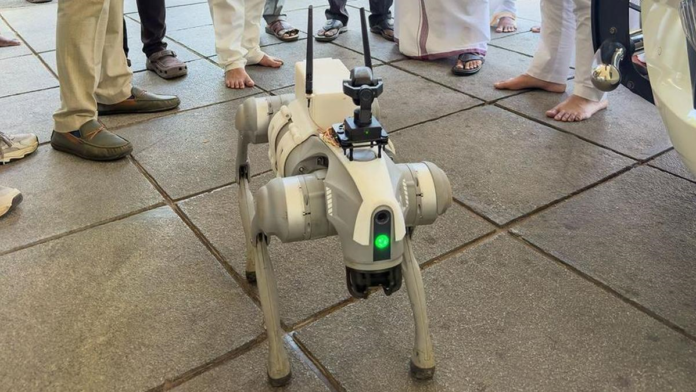
Bengaluru. A quadruped robot race ahead of the inaugural session of the 29th Bengaluru Tech Summit turned a technology showcase into a live test of speed, balance and autonomous movement. General Autonomy Pvt Ltd.’s Param took first place, completing the circuit at a reported top speed of 4.3 metres per second.
The demonstration brought together four-legged robots developed by Indian companies. Each machine had to complete one lap of a specially designed track and return to the starting line; the fastest to finish was declared the winner. Karnataka Deputy Chief Minister DK Shivakumar was among those watching the event, held before the summit’s opening session on November 17.

Organisers positioned the race as a showcase of progress in robotics, autonomous intelligence and “Physical AI”, systems that can sense their surroundings and act in the physical world. The competition offered a visible illustration of the challenge: a robot must not only move quickly, but also maintain control while navigating a course outside the predictable conditions of a laboratory.
Param, developed by General Autonomy, is designed to handle difficult terrain, with potential applications in defence and entertainment, according to the company information cited in reports. General Autonomy describes itself as a Physical AI firm working on quadruped and humanoid robots, with a primary focus on defence applications. Its race win provided a high-profile demonstration, though a single-track performance does not establish how the robot would perform in every operational environment.
Xterra Robotics presented Dhav, a quadruped designed for industrial and security work, including surveillance in hard-to-reach locations. The robot can collect different kinds of data and detect events such as open doors or movement in monitored areas. For construction settings, its functions include producing three-dimensional site maps, tracking work progress and identifying possible defects such as cracks.
Strider Robotics’ M3 placed third. The robot was incubated at the Indian Institute of Science in partnership with the defence sector and was initially developed for defence applications. It is now being adapted for industrial surveillance, construction monitoring, and safety and security tasks. Reports cite a payload capacity of about 45 kilograms for M3; they also note that newer-generation Dhav models offer comparable capacity.

The machines point to a broadening effort to apply mobile robots beyond controlled factory floors. Quadrupeds can potentially reach uneven or hazardous locations that are difficult for people to inspect, helping with surveillance, data collection and site monitoring. Such tasks remain application-specific: the usefulness of a robot depends on its reliability, sensors, autonomy, communications and ability to operate safely in the setting where it is deployed. The race itself demonstrated locomotion and control, rather than validating every use case described by the developers.
The event formed part of the summit’s wider AI and Robotics Pavilion at the Bangalore International Exhibition Centre. The official programme described a 50,000-square-foot arena featuring 101 AI and robotics showcases, with quadruped races among demonstrations spanning humanoids, drones, autonomous mobility and aquatic robotics. The summit ran from November 17 to 19 under the theme “AI & Beyond”.

The race’s significance, then, lay less in a finish line than in a public demonstration of Indian-built machines operating in motion. With defence, industry, infrastructure and security among the applications being explored, the next test for these systems will be whether they can translate impressive demonstrations into dependable performance in real-world work.







