

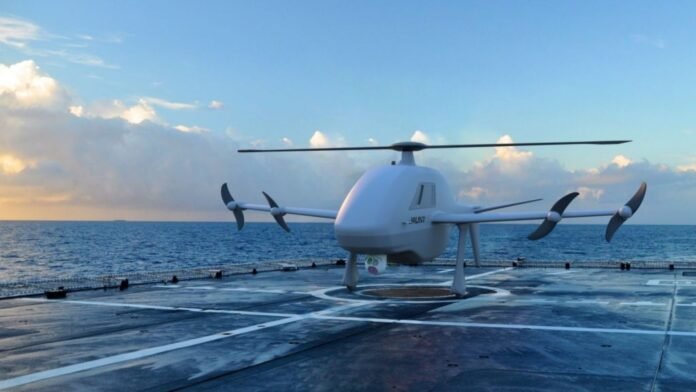
The morning mist still clung to the tarmac at the AUVSI XPONENTIAL 2026 defence exposition, but the crowd gathered around the center stage was entirely focused on the sleek, full-scale silhouette emerging from the shadows. The AIRO Group, alongside its specialised electric air mobility division Jaunt Air Mobility, had just pulled back the curtain on its next-generation heavy-lift autonomous aircraft platform. This wasn’t just another drone – it was an engineering blueprint for the next decade of aerial deployment.
By blending vertical take-off capability with a highly specialised hybrid-electric propulsion system and an innovative rotary design, AIRO has effectively shattered the constraints that have long held traditional unmanned aerial vehicles (UAVs) back.

Bridging the Mobility Gap
For years, aerospace engineers faced an unyielding trade-off. Fixed-wing autonomous aircraft boasted impressive range and speed but required vulnerable, sprawling runways. Conversely, traditional multi-rotor drones could launch from any tight pocket of land but sputtered out after short distances, crippled by heavy battery weights and aerodynamic drag.
AIRO’s newly unveiled platform bridges this historical divide. Designed to operate autonomously in infrastructure-deficient, austere, and highly contested environments, the aircraft relies on a cutting-edge “slowed-rotor” architecture. During vertical lift-off, the heavy-lift rotary wing functions like a helicopter, allowing it to rise cleanly out of dense urban environments or rugged, unprepared outposts. Once airborne, however, the vehicle transitions seamlessly into highly efficient forward flight. By significantly slowing the main rotor speed mid-air, the aircraft drastically reduces aerodynamic drag while utilising its unique architecture to sustain lift – combining the flexibility of a rotorcraft with the endurance of a plane.
Dual Configurations: From Supply Lines to Secret Skies
The dual-use platform is split into two distinct configurations built upon a unified architecture, targeting both critical government logistics and tactical defence missions:
- The JC250 (Cargo Variant): Optimised to redefine “middle-mile” military logistics and emergency humanitarian relief. It features an advanced, detachable cargo pod system engineered for rapid loading and unloading, ensuring that critical supplies, blood plasma, or ammunition can be delivered and swapped on the ground in seconds without keeping the aircraft exposed in hazardous zones.
- The JX250 (ISR Variant): Tailored specifically for long-range intelligence, surveillance, and reconnaissance. Stripped of the cargo pod and optimised for sustained aerodynamic endurance, this variant achieves a staggering range of up to 1,000 miles (1,609 kilometers) and can stay aloft for an unprecedented 16 hours of continuous operation.
A Masterclass in Modern Engineering
What makes these numbers possible is the hybrid-electric powertrain. By coupling high-torque electric motors with an internal combustion power generator, the platform achieves both the explosive vertical thrust required for heavy-lift operations and the fuel efficiency needed for deep-penetration scouting missions.

Remarkably, the engineering team revealed that development is progressing faster than internal projections. Utilising highly advanced digital twin engineering and accelerated simulation loops, AIRO has successfully validated key subsystems while staying well below its projected research and development cost targets.
As geopolitical landscapes shift and remote operational demands surge, the need for scalable, independent aviation has never been more urgent. AIRO’s full-scale reveal serves as a tangible promise to defence and commercial logisticians alike. With a first prototype flight officially scheduled for the end of 2026, the company anticipates full commercial rollout and field deployment by 2027. The era of the endless-reach, hybrid rotary drone has officially arrived.







