


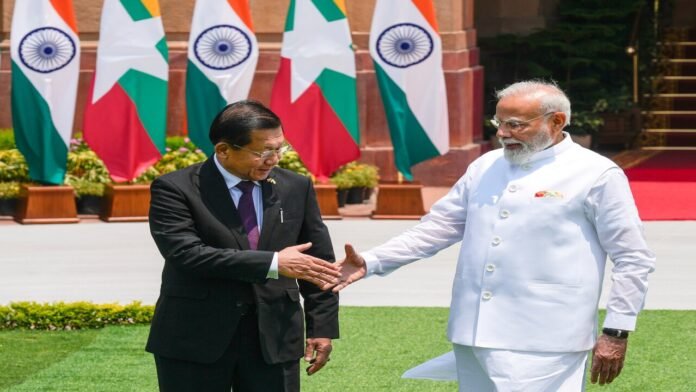
When India’s Foreign Secretary Vikram Misri confirmed on June 1, 2026, that critical minerals and rare earths had figured in the talks between Prime Minister Narendra Modi and Myanmar’s President U Min Aung Hlaing, the language was deliberately restrained. India and Myanmar agreed to maintain close engagement on critical minerals and rare earths, with both countries aiming to take bilateral cooperation forward in these strategic sectors. No contract was signed, no offtake volumes disclosed. Yet in the grammar of diplomacy, the elevation of rare earths from technical back-channels to a leaders’ summit is itself the news. It tells us that New Delhi has decided Myanmar matters to its industrial future, and it is worth asking plainly: what does India actually stand to gain?
The Dependency India is Trying to Escape
The honest starting point is vulnerability. China controls an estimated 85 to 90 percent of global rare earth refining and processing capacity, and that grip extends well beyond mining into separation, alloying, and magnet manufacturing. The consequence is that even countries sitting on domestic ore frequently route it through Chinese facilities to turn rock into usable industrial material. For India, this is not an abstraction. Its electric-vehicle ambitions, its expanding indigenous defence production, and its renewable-energy build-out all depend on heavy rare earth elements that today flow predominantly through supply chains Beijing can throttle at will.

Heavy rare earths are the crux. Elements such as dysprosium, terbium, and holmium cannot be easily substituted in the high-performance permanent magnets that power EV drivetrains and military guidance systems. A motor without adequate dysprosium risks demagnetisation at operating temperatures; a missile guidance package cannot simply swap in a cheaper input. This is what makes the geography of heavy rare earths a genuine strategic chokepoint rather than a commodity-market footnote, and it is precisely the category in which India is most exposed.
Myanmar’s Kachin state is one of the very few places on earth offering the same heavy-rare-earth profile that gives China its leverage, and it lies on India’s doorstep rather than China’s
Why Myanmar, Specifically
India is courting rare earth partners across several continents at once, but Myanmar offers something the others cannot. Myanmar offers a specific combination of geographic proximity, heavy rare earth element composition, and potential for land-based logistics that is not easily replicated by more distant sources. The Lithium Triangle in South America has lithium, but not the rare earths India is short of. Australian rare earth projects are typically light-rare-earth dominant. Myanmar’s geology fills the exact hole in India’s portfolio.
That geology sits in the country’s far north. Kachin State hosts ion-adsorption clay deposits, a geological formation type that has become strategically critical precisely because of its heavy rare earth composition. These deposits are prized for two reasons: the rare earths can be extracted at relatively low cost using simple leaching methods, and the deposit type is disproportionately rich in heavy rare earths compared to other ore types. They share their character with the famous deposits of southern China’s Jiangxi Province. In other words, Kachin is one of the very few places on earth offering the same heavy-rare-earth profile that gives China its leverage, and it lies on India’s doorstep rather than China’s.
The scale is not trivial. By some industry estimates, Myanmar had become the world’s largest supplier of heavy rare earth ore to Chinese processing facilities, surpassing China’s own domestic heavy rare earth production in volume terms during peak years. India is not eyeing a marginal source; it is eyeing the feedstock that has quietly underpinned China’s own dominance.

The Opening Created by Conflict
What makes the moment ripe is also what makes it fraught. The Kachin Independence Army’s territorial control has disrupted Chinese extraction operations, restricted transport routes, and created a security environment that makes large-scale commercial operations extremely difficult to sustain. That disruption has tightened Chinese feedstock availability, and for India, the displacement of Chinese commercial interests represents a structural opening, but one that comes attached to the same security constraints that are impeding Chinese operators.
Myanmar became the largest supplier of heavy rare earth ore to Chinese processing facilities, surpassing China’s own domestic heavy rare earth production. India is eyeing the feedstock that has quietly underpinned China’s own dominance
This is the central irony of India’s bid. The vacuum it hopes to step into exists only because the territory is contested by a non-state armed group. Any durable arrangement would have to reckon with the KIA as a de facto gatekeeper over the richest zones, a variable that conventional bilateral diplomacy is poorly equipped to manage. The prize and the peril are inseparable.

The Concrete Gains for New Delhi
Strip away the geopolitics and India’s interest rests on three converging pressures. The first is electric mobility: permanent magnet motors, which require heavy rare earth inputs, dominate the drivetrain architectures of mainstream EV platforms, and India’s domestic sector is scaling fast. The second is defence: India’s indigenisation programme for advanced systems, including missile guidance, radar, and electronic warfare equipment, creates sustained institutional demand for heavy rare earths that cannot easily be sourced through open commercial markets. The third is resilience itself: India’s broader diversification strategy explicitly targets the reduction of single-source dependency, with engagement on Myanmar sitting alongside parallel initiatives involving Australia, Argentina, and partners in Africa.
The deeper prize, however, is not the ore but the chance to climb the value chain. The stage where Chinese dominance is most entrenched is processing, not mining. A mature India-Myanmar pipeline would route raw rare earth material to Indian processing facilities to reduce dependence on Chinese value-added refining, culminating in long-term offtake agreements that deliver certified non-Chinese inputs to Indian EV, defence, and renewables manufacturers. If India can build that refining capacity at home and feed it from across a friendly land border, it does not merely buy minerals; it acquires a measure of strategic autonomy that imported finished magnets can never confer.
India’s broader diversification strategy explicitly targets the reduction of single-source dependency, with engagement on Myanmar sitting alongside parallel initiatives involving Australia, Argentina, and partners in Africa
There is a diplomatic dividend too. Myanmar’s military government, isolated since the 2021 coup, has every incentive to dilute its dependence on Chinese patronage. Rare earth cooperation with India offers Naypyidaw a way to diversify without a wholesale reorientation of its foreign policy, and it gives New Delhi a foothold in a neighbour where Chinese influence has long run unchallenged. For a country pursuing its “Neighbourhood First” and “Act East” doctrines, that strategic positioning is a gain in its own right.
The Gap Between Ambition and Cargo
Honesty demands acknowledging how far this is from reality. No formal supply contract or binding mineral cooperation agreement had been publicly confirmed as of mid-2026; the partnership remains at the consultation, sampling, and feasibility assessment stage—early-stage strategic outreach, not operational procurement.
The hardest obstacle is physical. Moving feedstock from landlocked, conflict-ridden Kachin to Indian refineries requires infrastructure that does not yet function. The Kaladan Multi-Modal Transit Transport Project, designed to connect India’s northeastern states to Myanmar’s Sittwe port, has faced repeated delays attributable to security conditions, with progress only in areas where the safety of construction workers could be verified. The India-Myanmar-Thailand trilateral highway remains long delayed and operational only in limited safe zones. Myanmar offered assurances at the summit, but assurances from a government with incomplete territorial control carry inherent limitations.
The risks are real: an unstable counterpart, a non-state gatekeeper, absent regulation, and infrastructure hostage to a war neither government fully controls. But the cost of inaction is a permanent dependence on a single rival for the materials that power India’s transport, defence, and energy futures
Analysts are sober about timing. Most place realistic commercial-scale achievement in the 2028 to 2035 window, with the timeline heavily contingent on conflict resolution in Kachin State and progress on connectivity infrastructure. This is a medium-to-long-term play, not a fix for next year’s magnet shortage.
A Bet Worth Placing
So what does India gain? Not a single tonne of dysprosium yet. What it gains today is optionality — a credible, proximate, heavy-rare-earth-rich alternative to Chinese supply that it can develop on its own timeline, anchored within a broader relationship that the two governments have agreed to deepen across defence, trade, connectivity and capacity building, alongside the repatriation of trafficked Indian nationals. The mineral dialogue does not stand alone; it is woven into a relationship with multiple registers of mutual interest.
The risks are real: an unstable counterpart, a non-state gatekeeper, absent regulation, and infrastructure hostage to a war neither government fully controls. But the cost of inaction is a permanent dependence on a single rival for the materials that power India’s transport, defence, and energy futures. Measured against that, a patient, clear-eyed bid for Myanmar’s buried advantage is not opportunism. It is prudence — provided New Delhi treats it as the decade-long project it genuinely is, and resists the temptation to mistake a summit communiqué for a supply chain.

The writer is an independent researcher. The views expressed are of the writer and do not necessarily reflect the views of Raksha Anirveda





