


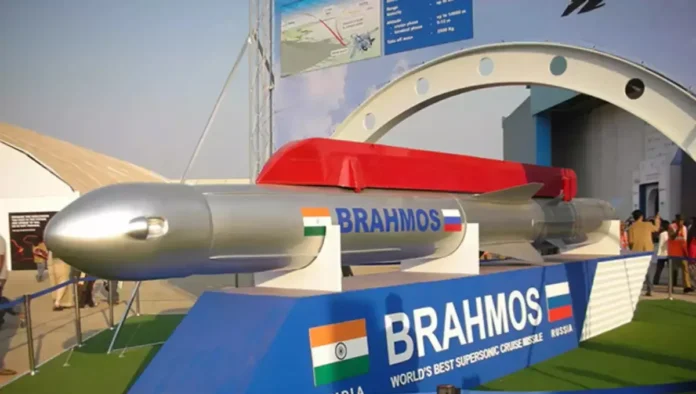
Something interesting has happened in the world of defence, and it tells us a big story about how far India has travelled. The BrahMos Aerospace company, which is a joint venture between India and Russia, has said that it is fully ready to supply BRAHMOS supersonic cruise missiles to the Russian military, if Russia ever decides to place an order.
This statement was made by Alexander Maksichev, the Russian Co-Managing Director of BrahMos Aerospace, while speaking to Russian news agency TASS during the Fleet-2026 International Maritime Defence Show. He said the company already has the factories, the production facilities, and the manufacturing capacity needed to supply these missiles whenever such a need arises. In simple words, he is saying, “We are ready. Just give us the order.”

According to Maksichev, the company can fulfil any order from Russia, whether the missiles are needed by the Russian Navy or by the Russian Ground Forces. He also stressed that BrahMos Aerospace understands exactly what kind of performance and requirements Russia would expect from such a weapon.
Newer versions of BRAHMOS have ranges of over 450 kilometres, and some variants reportedly reach up to 800 kilometres. It has better guidance and targeting systems. It can be fired from more platforms than the Oniks, namely ground launchers, naval warships, submarines, and even fighter aircraft, making it very versatile
Now, why is this such a big deal? To understand that, we must look at the history. The BRAHMOS missile was jointly developed by India and Russia, and it was originally based on Russia’s own P-800 Oniks missile technology, which is also marketed abroad under the name “Yakhont.” So both missiles share the same family roots. For Russia, the Oniks is a fully domestic missile. But over more than two decades, BRAHMOS has grown into a far more advanced and capable weapon than its parent.
So how exactly is BRAHMOS better? After joining service, it received many upgrades. Newer versions have ranges of over 450 kilometres, and some variants reportedly reach up to 800 kilometres. It has better guidance and targeting systems. It can be fired from more platforms than the Oniks, namely ground launchers, naval warships, submarines, and even fighter aircraft, making it very versatile. India has invested heavily in its own seekers, software, navigation systems, and mission computers. Modern BRAHMOS versions reportedly resist enemy jamming better and offer more flexible mission options. India is even developing BRAHMOS-NG, a smaller, lighter, and smarter version, for which Russia has no direct equal in service yet.
Until now, although BRAHMOS is a joint project, the missile has mostly been used by the Indian Army, Navy, and Air Force on different platforms. In recent years it has also entered the export market, with the Philippines becoming the first foreign buyer, while several other countries have shown interest too.

Modern BRAHMOS versions reportedly resist enemy jamming better and offer more flexible mission options. India is even developing BRAHMOS-NG, a smaller, lighter, and smarter version, for which Russia has no direct equal in service yet
From Maksichev’s point of view, BRAHMOS is not a foreign missile at all. It is a product of an Indo-Russian company. So offering it to Russia is simply offering a joint venture product to one of its own parent nations. Russia might be interested in specific BRAHMOS features that have matured separately, such as land-attack ability, mobile coastal defence systems, air-launched versions, and improved electronics. Rather than spending money and years recreating these, Russia could simply buy what already works.
There may also be a practical reason. The ongoing war in Ukraine has forced Russia to use up huge quantities of precision weapons. Even if Russia has its own equivalents, an extra production line through BrahMos Aerospace could be helpful for Moscow.

But here we must be careful and honest. The person making this statement is not from the Russian Defence Ministry. He is a director of BrahMos Aerospace, and part of his job is to promote the missile and expand its customer base. Saying that BRAHMOS is available even for Russia sends a strong marketing message. It may also be a quiet message to Western countries that a missile which recently proved its effectiveness against Pakistan could potentially serve Russia too.
Whatever the real intention, one thing is crystal clear. It shows how far India has come. Twenty-five years ago, India was basically importing Russian missile technology. Today, a senior official of an Indo-Russian venture can publicly say that Russia itself could buy the finished product.
Russia might be interested in specific BRAHMOS features that have matured separately, such as land-attack ability, mobile coastal defence systems, air-launched versions, and improved electronics
Now comes the big question, would India even allow this? India is a co-owner, contributes technology, and manufactures many components in India. So export decisions have always involved both sides. If Russia wanted hundreds of BRAHMOS missiles, it could not happen without Indian government approval. Would India object? Probably not, though it would weigh the diplomatic risks, especially with Western sanctions and the Ukraine conflict. Russia, for its part, has always protected its defence ties with India, so it is unlikely to push a deal that harms India’s interests.
So for now, these words should be seen mainly as messaging. There are no Russian military officials actually discussing BRAHMOS requirements. Without those signs, we cannot conclude that Russia is genuinely seeking to buy BRAHMOS right now.

-The writer is an award-winning science communicator and a Defence, Aerospace & Geopolitical Analyst. He is the Managing Director of ADD Engineering Components India Pvt. Ltd., a subsidiary of ADD Engineering GmbH, Germany. You can reach him at: girishlinganna@gmail.com. The views expressed are personal and do not necessarily carry the views of Raksha Anirveda





