


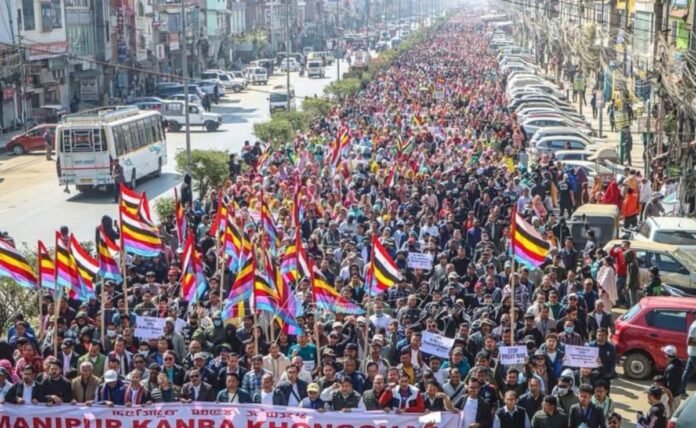
A Conflict That Continues to Challenge the Indian State: More than three years after ethnic violence erupted in Manipur, the state remains trapped in a cycle of mistrust, displacement and political uncertainty. Despite the deployment of thousands of security personnel and repeated efforts by the central government to restore normalcy, peace remains elusive. What initially appeared to be a conflict between the Meitei and Kuki communities has gradually evolved into a far more complex crisis involving Naga political interests, cross-border security challenges, immigration concerns and the potential exploitation of local grievances by external actors.
The continuing unrest has transformed Manipur from a state facing sporadic ethnic tensions into one of India’s most serious internal security challenges. The crisis today is no longer simply about law and order. It encompasses questions of identity, land ownership, political representation, territorial integrity, border security and governance. The growing complexity of these interconnected issues demands a comprehensive political solution rather than a purely security-centric response.

Historical Roots of a Divided Landscape
The origins of the present crisis lie in Manipur’s unique geography and demographic composition. The state is divided between the Imphal Valley and the surrounding hill districts. The valley, which constitutes a small percentage of the state’s geographical area, is predominantly inhabited by the Meiteis, who form the largest ethnic community. Conversely, the hills are populated primarily by tribal groups, including the Kukis and the Nagas.
This geographical division has historically shaped political and economic realities. The Meiteis dominate state politics because of their demographic concentration and electoral influence, while tribal communities enjoy constitutional protections over land ownership in the hill districts. Over decades, competing perceptions of political dominance and economic marginalisation generated deep-seated grievances. 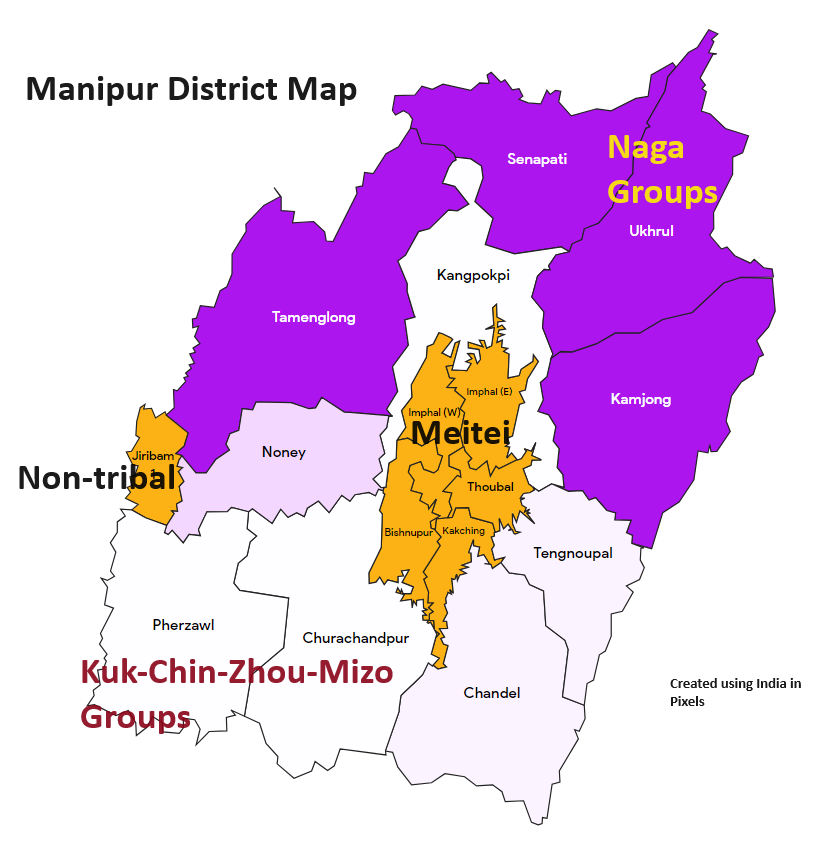 The immediate trigger for the violence emerged from disputes surrounding demands for Scheduled Tribe (ST) status for the Meitei community. Tribal groups viewed the proposal as a potential threat to their constitutional safeguards and land rights. What began as a political disagreement rapidly escalated into widespread violence, causing deaths, the destruction of property, and the displacement of tens of thousands of people.
From Meitei-Kuki Conflict to a Multi-Dimensional Crisis
As the conflict persisted, communities became increasingly segregated along ethnic lines. Areas that were once ethnically mixed transformed into zones of exclusive control. Economic activity suffered, educational institutions were disrupted and normal administrative functioning became difficult.
The prolonged nature of the violence created opportunities for different political actors to advance long-standing demands. What initially appeared to be a binary conflict gradually evolved into a contest over the future political structure of Manipur itself. This evolution has brought the Naga question back into the centre of political discourse.

The Emerging Naga Dimension
The Nagas represent one of the largest tribal populations in Manipur and occupy significant portions of the hill districts. Historically, Naga political movements have pursued varying degrees of autonomy and have advocated the recognition of the distinct political identity of Naga-inhabited regions.
Force can effectively contain immediate street violence, but it remains fundamentally powerless to eliminate the deep-seated structural and political grievances that sustain cross-community conflicts
As discussions intensified regarding separate administrative arrangements and enhanced autonomy for Kuki-dominated areas, Naga organisations began expressing concern that their interests might be overlooked. Many Naga groups fear that any settlement negotiated exclusively between the government and Kuki representatives could adversely affect Naga-inhabited territories and political aspirations.

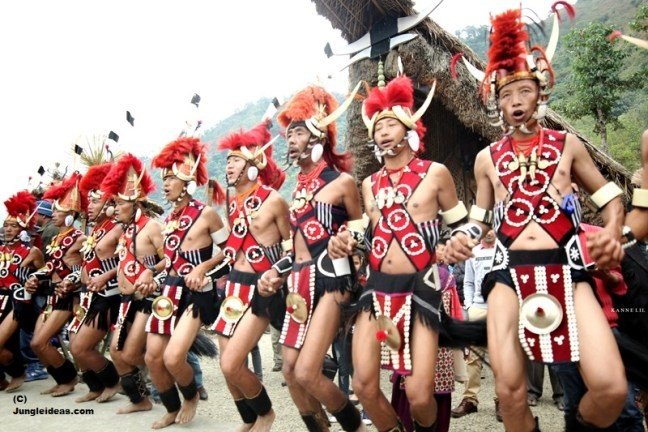
The emergence of this dimension significantly complicates peace efforts. A settlement acceptable to Meitei and Kuki stakeholders may not necessarily satisfy Naga concerns. Historical tensions between Naga and Kuki communities further complicate the search for consensus. Consequently, the conflict can no longer be viewed solely through a Meitei-Kuki lens. Any durable solution must include Naga participation and consent.
Foreign Actors and the Externalisation of the Conflict
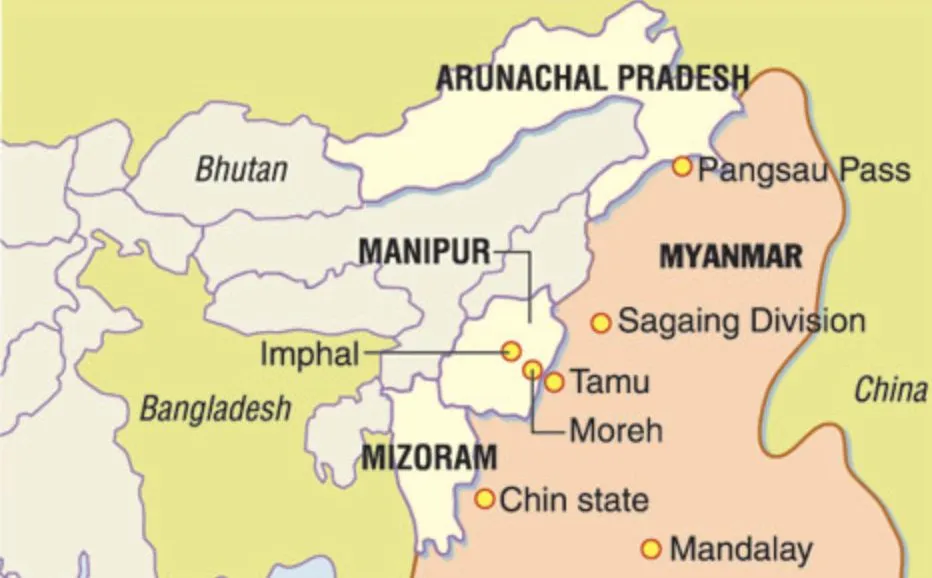
An increasingly important aspect of the Manipur crisis is the influence of external factors. While the roots of the conflict are undeniably domestic, the state’s location along the India-Myanmar border exposes it to broader regional dynamics.
The military takeover in Myanmar in 2021 and the subsequent civil conflict fundamentally altered the security environment along India’s eastern frontier. Large areas adjacent to Manipur witnessed the weakening of governmental authority, creating opportunities for armed groups, criminal networks and illicit trafficking organisations to operate with greater freedom.
Security agencies have expressed grave concerns regarding the movement of weapons across the porous border. The appearance of sophisticated firearms during the Manipur violence has highlighted the role of transnational smuggling networks. Such networks increase the lethality of local conflicts and make disarmament efforts considerably more difficult.
The information domain has emerged as another battleground. Social media platforms have enabled the rapid dissemination of rumours, inflammatory content and disinformation. In many instances, narratives originating outside the state have amplified ethnic tensions and deepened mistrust between communities.
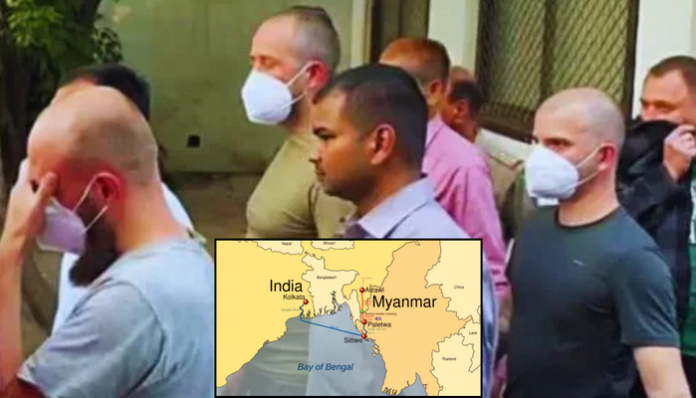
Although definitive evidence of direct foreign state involvement remains limited in the public domain, the possibility of hostile external actors exploiting ethnic divisions cannot be ignored. Throughout history, foreign intelligence services and geopolitical rivals have often sought to leverage internal fault lines within strategically important regions. The prolonged instability in Manipur creates precisely such vulnerabilities.
Immigration and Demographic Anxiety
The issue of immigration has become one of the most politically sensitive aspects of the Manipur crisis. The conflict in Myanmar has resulted in the movement of refugees and displaced persons across the border into India’s northeastern states.
Many tribal communities share ethnic and familial ties with populations residing across the frontier and view those fleeing violence through a humanitarian lens. However, significant sections of the Meitei population have expressed concern regarding the demographic implications of uncontrolled migration.
These concerns are not merely about numbers. They intersect with broader fears regarding land ownership, political representation and cultural identity. As a result, immigration has become deeply intertwined with the state’s ethnic politics.
The challenge for policymakers is to balance humanitarian obligations with legitimate security and demographic concerns. Failure to achieve this balance risks intensifying existing tensions and creating new sources of conflict.
Border Management: The Weakest Link
The crisis has exposed longstanding weaknesses in border governance along the India-Myanmar frontier. Unlike many international borders, large stretches of the Manipur-Myanmar boundary remain difficult to monitor effectively due to rugged terrain, dense forests and longstanding cross-border ethnic linkages.
Traditional arrangements that facilitated movement among border communities were designed for a different security environment. The deterioration of conditions in Myanmar has prompted renewed debate regarding the adequacy of existing mechanisms.
Unless the international boundary is secured with unified intelligence and updated surveillance infrastructure, the unchecked flow of weapons and illegal migrants will continue to disrupt domestic peace
Effective border management today requires a combination of physical infrastructure, technological surveillance, intelligence integration and diplomatic coordination. Border security cannot be viewed solely as a military responsibility. It must be integrated with economic development, local governance and community engagement.
Unless the border is managed more effectively, the flow of weapons, narcotics and illegal migrants will continue to complicate efforts to restore stability within Manipur.
Implications for National Security
The significance of the Manipur crisis extends far beyond the state itself. Manipur occupies a strategic location within India’s Act East framework and serves as an important gateway to Southeast Asia.
Persistent instability threatens infrastructure projects, trade corridors and regional connectivity initiatives. It also diverts security resources and creates opportunities for insurgent and criminal networks to strengthen their presence.
More importantly, the crisis raises broader questions regarding the management of ethnic diversity, federal governance, and border security in sensitive frontier regions. The outcome of the Manipur crisis will therefore carry significant implications for India’s wider national security strategy.
Towards a Sustainable Political Settlement
The experience of the past three years demonstrates that security operations alone cannot resolve the crisis. Force can contain violence, but it cannot eliminate the underlying political grievances that sustain conflict.
To construct a durable paradigm, several vital actions must proceed in unison. First and foremost, the primary requirement is an inclusive political dialogue involving Meitei, Kuki, and Naga stakeholders, as any attempt to negotiate a settlement while excluding one of the principal communities is unlikely to succeed. Second, key confidence-building measures must focus on the safe return of displaced populations, the rehabilitation of affected communities, and the restoration of inter-community economic interactions. Third, strategic governance reforms should explore mechanisms that address tribal aspirations while preserving the territorial integrity of the state, utilizing decentralisation, enhanced local autonomy, and institutional safeguards to help bridge competing demands. Fourth, regional border management must be strengthened through a combination of surveillance technology, intelligence cooperation, and coordinated action against trafficking networks. Fifth, a clear national policy is required regarding refugees, illegal immigration, and demographic management in border regions, as continuous ambiguity on these issues risks perpetuating suspicion and political polarisation. Finally, comprehensive development initiatives should prioritise the hill districts as well as the valley, effectively reducing disparities that have historically contributed to resentment and alienation.
Takeaways
The Manipur crisis has evolved into one of the most complex challenges facing contemporary India. What began as a dispute over identity and land rights has expanded into a multidimensional conflict involving Meitei-Kuki tensions, Naga political aspirations, cross-border migration, porous borders, transnational criminal networks and concerns regarding external interference.
The growing involvement of Naga organisations demonstrates that the conflict is entering a new phase in which multiple stakeholders seek to shape the future political architecture of the state. Simultaneously, developments in neighbouring Myanmar and vulnerabilities along the international border continue to influence events within Manipur.
A lasting solution will require New Delhi to address both the internal and external dimensions of the crisis. Political reconciliation among communities, strengthened border governance, effective immigration management and sustained economic development must proceed simultaneously. Only such a comprehensive approach can prevent Manipur from becoming a permanent fault line in India’s northeastern frontier and instead transform it into a bridge linking India with Southeast Asia.

-The author retired as Major General, Army Ordnance Corps, Central Command, after 37 years of service. A management doctorate and expert on defence modernisation, he is the author of four books, including the Amazon bestseller “Breaking the Chinese Myth,” and a frequent media commentator. He is affiliated with several leading defence and strategic studies institutions in New Delhi. The views expressed are of the writer and do not necessarily reflect the views of Raksha Anirveda





