


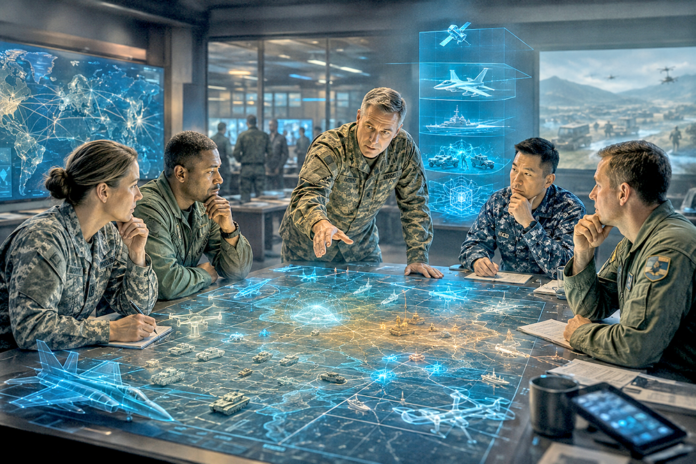
By the category of usage, wargames can be classified into primarily training and analytical games. Objectives of the former is not scientifically precise prediction of battlefield outcomes, but professional military education and cultivation of skills, such as operational planning, running command-and-control echelons such as the operations room or Fire Direction Centre (FDC), or learning how to observe a battle intelligently and take prudent decisions, even in an atmosphere of incomplete information or possible incertitude.
Analytical wargames do not imply the same wargames with a lot of analytical products (which is often assumed), but games whose primary purpose is exploration of plans, operational concepts, doctrinal methods, and capability interactions; for example, exploring conditions under which plans or concepts may succeed or fail. To illustrate, an analytical wargame would help create a well-synchronised mobilisation and induction matrix by quickly testing various options, but a training game on the same scenario would teach players how to make a mobilisation plan, and identify and respond to contingencies during execution, by playing a situation.

Analytical games have lesser requirement of closure and realistic gaming interfaces than training games which must have strictly filtered information and realistic interfaces. The ongoing wars are being watched and scrutinised by the military leaders and thinkers in their respective expertise domains. Important issues should be coalesced with wargame objectives to make them relevant in a contemporary perspective, so that maximalist gains ensue.
It is important that a well-planned structure for a modern customised joint wargame computerised centre is designed by experts and it is imperative that it must have requisite portals for the other all arms and services concept to be connected to facilitate activation of the entire project, so that due evocative lessons can be elucidated from the same.
Generic All-purpose Gaming and Specific Staff Gaming
Each wargame can be orchestrated with a general purpose, i.e., able to model most aspects of warfighting at the same level of concept. Some wargames can be specific to any one of the operational aspects, for instance, air defence (AD) or logistics, which are modelled in detail. It must be understood that even specific wargames cannot be modelled in isolation—an AD wargame cannot be a simple contest between AD weapons and aircrafts, but must also have notional armoured/ mechanised manoeuvre operations in the background for all arms and services, even if injected by the Control, which will incontrovertibly insert due pragmatism into the ecosystem and build a realistic comprehensive scenario to provide better understanding of the war situation mosaic with weapon platform postulations.
There has to be a staff checks planning wargame, which must be complementary to the main wargame, as brilliant student officers would like to be mentored and incorporated in the syndicates, having natural propensities for a specific operation of war, notwithstanding their regimental affiliations and allegiances. Specific ‘Staff Gaming’ mandates vital orchestration of a very explicit secret operation to be conducted, which cannot be divulged to the entire student/ staff body, attributed to the nature of clandestine operations.

Separate folders and human resources have to be allocated for such special operations to be conducted, it must not be discouraged, but encouraged to leverage the lessons and end game results. Meticulous planning is imperative to ensure that such wargames are not counterproductive and also ensures the manifold lessons are highlighted to all students of the Indian tri-services, and the foreign students benefit remarkably by attending such wargames.
Wargaming for Staff Training in Modernised Weapons
Wargames can be specifically constructed to focus on staff training, wherein staff officers can rehearse meticulously their specific roles and procedures with greater accuracy and professionalism; staff estimates, planning, aiding commanders in decision-making, coordination between headquarters and various echelons, and also other services.

At the DSSC, land-oriented wargames tend to manually run mega-games arranged into a series of seminar-style sessions interspersed with detailed staff planning, presentations, and briefings. As players make and justify decisions and anticipate adversary responses in these sessions, the Control conducts staff checks, updates game-states, and evolves combat to support the director in progressing the narrative. However, there is a tendency to make game-states follow predetermined paths, negating consequences of player actions. At the DSSC, it was realised that there is relatively less institutional memory of the existence of a rulebook for mountain wargame that was in use two decades ago. The outcome is that despite the high trajectory for overall learning value of wargames desired to be run at the DSSC, in the staff education, they have a propensity to be more like ‘staff planning’ exercises rather than having an ideal wargames perspective.
The ‘Brahmos’ missile and its variants were effectively optimised during Operation ‘Sindoor’, which could be included in these wargames, so that the military strategies get further evolved and the enhanced destructive impact of the weapon system is understood by students. The enemy in our western neighbourhood would once again test Indian tenacity and resolve, strategic maturity and military acumen in the face of relentless provocation to have a prolonged conflict with the assistance of its allies to pull down India economically.
I must mention some of the advanced technologies that could be used in computerised land wargames, in providing challenging multifaceted tasks as units of land forces are continually dynamic, like the newly established RUDRA BRIGADE and the BHAIRAV units with its associated force multipliers, which must be known to student body. These would enhance their military erudition levels considerably, understanding the skills and dexterity in its employment and optimised deployment.
Staff officers must learn to make critical decisions amid uncertainty, incomplete information and operational friction. Wargaming provides a realistic framework for developing these essential command competencies
The use of some of indigenised DRDO developed latest technologies can be incorporated in the wargames in consultation with Chairman DRDO, like loitering ammunitions mounted on battle tanks (Drones, Kinetic Projectile Launchers, Direct Energy Weapons of LASER & MASER weapons, Graphene (anti IR) coated armoured tanks n mechanised vehicles, Robotics, Stealth technologies of weapon systems on land, sea and air, reinforced metallurgies, 30 KW Surya Laser based weapon systems to neutralise aerial threats, and fully Autonomous and amphibious light battle tanks (25 Tons) for high altitude areas, THOR anti swarm drone Directed Energy Weapon Systems (DEWS), Laser Developed Atmospheric Lens (LDAL), UGVs, ASVs, Autonomous Battle tanks equipped with high EMP Maser 100 KW/1 MW Systems, Miniature Cruise Missiles, Quantum Radars, LiDAR and LADAR, Radar Obscurant cloaks, Underwater Unmanned Vehicles (UUVs) etc.
The list of weapon systems and platforms is very exhaustive and therefore it is recommended that suitable technical representatives, with high technical credentials could form part of the composition of expert scientists and technologists of the Wargaming Cell to strengthen weaponisation of missile/ gun systems, advanced climate control system, integration of UAV launch and recovery system and the advanced thermal management system, Quantum Cryptography, Ultra-Wideband (UWB), Artificial Intelligence and Cognitive Radio. The core group must convene series of conferences under the illustrious Commandant and be an eminent and suitably selected scientist, providing the best technical leadership from the DRDO. All officers and bandwidth of scientists must be under oath of the Official Secrets Act (OSA), as the information of weapon platforms/ systems would be highly ‘Secret’ for induction into the Indian Armed Forces, in the present volatile environment.
In contrast, air and naval wargames are comparatively easier to design due to relatively greater cogency of forces and homogeneity of environment. It is also seen that the computerised air wargame used at the DSSC, based on the legacy of ‘Deep Blue’ system, acts as a large mission-planner and simulator, which could consider more staff and coordination aspects of air operations of the contemporary hybrid warfare environment and could be continually upgraded by the concerned IAF wargame software designers under the guidance of CI Air.
The aspects of escalation control and optimisation of PGMs against critical strategic targets must be incorporated and is also significantly being pursued to ensure that adversary’s brinkmanship does not upset the planning process for operationalisation of the strategic plans. The series of naval wargames being prepared and deployed at various naval and joint training establishments addresses several issues of resolution constructively.
However, the progress of the wargame is deterministic at the aggregated level with adequate consideration of complexity amidst uncertainty, while it also takes into consideration the detailed mechanics of naval engagements. Indian Navy operates a large fleet of over 140 frontline war ships and submarines with 74,000 personnel. A version of this game considers naval logistics too, but it is to be seen how effectively it models staff interactions, assessments, and resilience of plans, in addition to vital aspects of jointness.
Emerging technologies such as drones, artificial intelligence and precision-guided weapons are transforming both warfare and military simulations. Modern wargames must reflect these changes to remain relevant and effective
The problem is that such wargames are often designed generically, without adequate familiarity with all aspects of modelling and interfaces. Specific wargaming approaches for staff education must, among other things, focus on vital planning, operational estimates, intelligence interpretation, coordination of manoeuvre, support, and logistics echelons, commander-staff interaction, and prioritisation of conflicting requirements, under friction and incomplete information. They must also demand proper staff work, viz., preparation of move instructions or logistics orders, whose superior qualitative edge should impact the conduct of the wargame. This is discussed ahead.
Training or Analytical Wargames
Before examining aspects of modelling for wargames specific to staff training, it must be understood that staff education would require both training and analytical wargames. To explain with a specific example, a training wargame for officers to learn about divisional casualty evacuation chains would require a player to deploy various nodes and links of such a chain on the map and distribute resources—medical personnel, vehicles, lifesaving resources—between them. During wargames, the system generates casualties out of the background operations and then processes their evacuation along the chain as per planning parameters. Players would learn “the hard way”, i.e., during the game, of the efficiency of the chain, necessity of readjusting nodes or redistributing resources during the simulations, or taking other measures to keep the evacuation function.
In contrast, players in an analytical wargame would not need to be actually playing the game from closed vantage points, but observe the simulation, detect where casualties accumulate and where resources are lying idle, readjust and replay repeatedly till a semblance of optimality is attained.
Both forms are valuable for staff education as they expose officers to doctrinal experimentation, capability assessment, and operational problem-solving. It is also seen that the background operations must also be modelled—to generate the casualties, develop threat to the evacuation chain (overrunning of a node, delays on a route)—so that learnt lessons in training wargames, or optimality attained plans in analytical wargames, are holistic, not in isolation, and not disturbed by other events on the battlefield.
Analytical and training wargames enable military planners to test concepts, refine doctrines and evaluate operational options. The lessons derived can strengthen preparedness long before a conflict actually begins
Here, the background operations need not be competitively played but injected by Control directives, while casualties need not be based on detailed combat modelling, but on historically observed and doctrinally expected distributions. Incidentally, the Pakistan army, due to its proximity with western nations and proclivities with other nations, has direct access to the computerised wargame Joint Theatre Level Simulation—Global Operations (JTLS-GO) with those nations, which perceivably gives it a certain advantage in PME.
Drone Warfare is assuming greater significance for disproportionate destruction in warfare, whether it is the Russia- Ukraine War or the current Iran- USA War. Drones are giving a multi-dimensional effect to destruction capabilities of military assets and equipment in a cost-effective manner and is now creating a new revolution with destructive outcomes in battles, since the quadcopter days, intimidating aircraft carriers, Leander frigates of the navy, armoured vehicles, multiple launcher rockets systems, artillery and howitzer systems etc.
‘Quantum Drones’ (all types) require to be co-opted in military planning and their high quotient of success in destructive capabilities must be known. It’s the incredible cost-effective drones being used to destroy tanks, aircraft carriers and attack helicopters, as also huge military infrastructures, port facilities, airports, oil terminals etc, which is dreadfully accurate used in precision strikes and hence feared by soldiers, sailors and airmen alike.
Modern staff training demands simulations that incorporate technology, jointness, uncertainty, and operational art. Future-ready military education depends upon this evolution.

Lt Gen S K Gadeock is a distinguished military leader, global strategist, and scholar who served as the Commandant of the Defence Services Staff College. A decorated veteran and former Logistics Advisor to the Botswana Defence Force, he has held numerous high-ranking appointments including Director General of the Amity Institute of Defence & Strategic Studies. Serving on the Advisory Board of Raksha Anirveda, he is a prolific writer and motivational speaker.





