


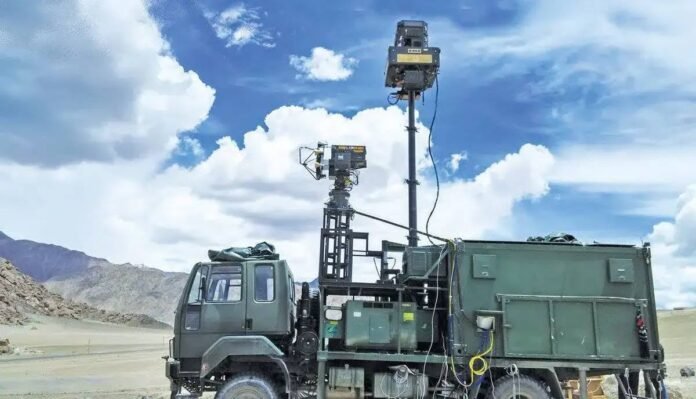
New Delhi: The Defence Acquisition Council (DAC) has approved the induction of the ₹5,150 crore Dharashakti Integrated Electronic Warfare (EW) System, a landmark indigenous capability that can jam multiple enemy airborne early warning and control systems (AEWCS), fighter radars, synthetic aperture radars (SAR), encrypted communications, and navigation networks.
Critically, it now provides the Indian Army with the ability to jam and neutralise Pakistani UAVs and UCAVs at ranges of up to 150 kilometres, significantly enhancing India’s spectrum dominance.

The Dharashakti EW system represents a decisive leap in India’s electronic warfare preparedness. Entirely indigenously developed, it integrates both communication (COM) and non-communication (Non-COM) segments. The COM segment intercepts and analyses radio frequencies, ensuring secure and encrypted battlefield communications even under hostile jamming.
The Non-COM segment is designed to detect, disrupt, and neutralise enemy radar emissions, surveillance systems, and guidance networks, thereby degrading adversary situational awareness and air defence capabilities.
The system is optimised for deployment in desert and plain terrains such as the Samaghat and Shatrughat sectors, where long-range visibility and high signal clarity are critical. Mounted on rugged, all-terrain mobile platforms, Dharashakti can be rapidly deployed and sustained for extended operations, giving commanders flexibility in both offensive and defensive roles.
Its Electro-Optical (EO) suite, equipped with high-resolution visual and infrared sensors, provides real-time imaging, target recognition, and surveillance even in adverse conditions such as night operations, dust storms, or fog.

A defining feature of Dharashakti is its ability to jam and neutralise hostile UAVs and UCAVs at ranges of up to 150 kilometres. This capability directly addresses the growing threat posed by Pakistani drone incursions and loitering munitions, which have been used to target Indian positions and infrastructure.
By interfering with control links and satellite navigation systems, Dharashakti can force hostile drones to lose guidance or abort missions, offering a cost-effective alternative to kinetic interception.

Beyond drones, the system can jam multiple enemy AEWCS platforms, fighter radars, and synthetic aperture radars, thereby blinding adversary surveillance and strike capabilities. Its encrypted communication jamming capability ensures that hostile forces lose connectivity, while its navigation disruption functions can compromise precision-guided munitions and aircraft operations.
These features make Dharashakti a comprehensive tool for spectrum dominance, capable of shaping the battlefield before kinetic engagements begin.
The approval of Dharashakti by the Defence Acquisition Council underscores India’s commitment to Aatmanirbharta in defence production. With a project value of ₹5,150 crore, it represents a major investment in indigenous technology and a strategic step towards reducing reliance on foreign systems.
Defence officials have emphasised that Dharashakti will provide a decisive edge in sensitive border areas, particularly along the western and northern fronts where electronic warfare capabilities are increasingly critical.
In the broader context of modern warfare, control of the electromagnetic spectrum is now a core enabler of combat superiority. Systems like Dharashakti not only protect India’s own communication networks but also allow the Army to degrade and disrupt adversary networks, thereby enhancing survivability and operational effectiveness.
Its induction marks a significant milestone in India’s journey towards building a technologically advanced, self-reliant military force capable of meeting future challenges.






