


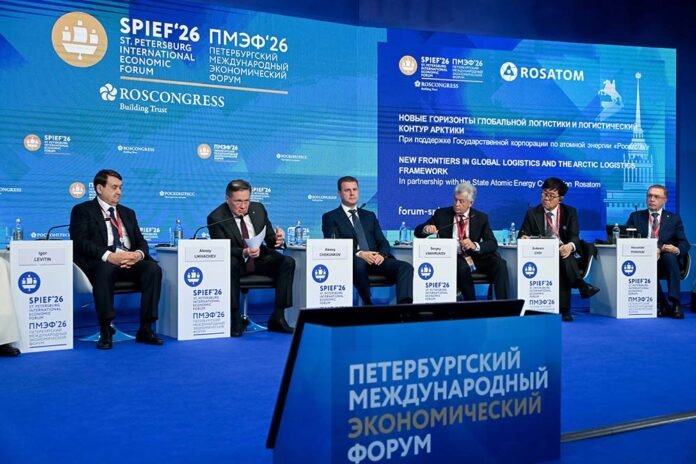
Mumbai: On June 5, at the St. Petersburg International Economic Forum (SPIEF), Director General of Rosatom State Corporation Alexey Likhachev participated in the session “New Horizons for Global Logistics and the Arctic Logistics Framework.”
The discussion brought together Presidential Adviser and Special Representative of the President of the Russian Federation for International Transport Cooperation Igor Levitin; Minister for the Development of the Russian Far East and the Arctic Alexey Chekunkov; Deputy Chairwoman of the State Duma Irina Yarovaya; Head of the Presidential Administration Directorate for National Maritime Policy Sergei Vakhrukov; Minister of Transport and Logistic Services of the Kingdom of Saudi Arabia Saleh bin Nasser Al-Jasser; and other participants.

The discussion focused on developing the financial and economic model for the operation of the Trans-Arctic Transport Corridor (TATC). This work is being carried out pursuant to instructions issued by the President of Russia with the involvement of relevant ministries and agencies.
”Russia is facing ambitious national goals. By 2030, we are to increase freight volumes along international transport corridors by at least 50%, raise fixed capital investment by 60%, and boost exports of non-resource, non-energy products by two-thirds,” Alexey Likhachev said.
The “first concrete” pouring for the reactor building’s foundation marks the transition of the facility into a status of under construction in accordance with the IAEA standards. This milestone marks the beginning of a key stage in implementing Uzbekistan’s integrated NPP project and represents a logical continuation of the long-standing cooperation between Russia and Uzbekistan in nuclear technologies. As part of the ‘first-concrete’ stage, specialists will pour 133 cubic metres of concrete mix, while the total volume of concrete required for the project will amount to 10,000 cubic metres.
According to the Rosatom chief, development of the financial and economic model has been divided into three stages and incorporates two scenarios. The first stage, extending through 2030, envisages increasing cargo traffic to 70–109 million tonnes. The second stage (2031–2035) involves transitioning to year-round navigation along the Northern Sea Route based on a convoy model. The third stage (through 2040) envisages establishing a sustainable year-round operating model and systematically increasing eastbound cargo flows. This phased approach will make it possible to respond systematically to emerging challenges, adapt to changing global conditions, and lay the groundwork for two additional development options.

Under the baseline scenario, cargo traffic is expected to reach 150 million tonnes by 2035. However, provisions must also be made for a surge scenario involving at least a doubling of transportation volumes
“We must be prepared to switch from the scenario currently being implemented to one that is substantially more ambitious,” Alexey Likhachev emphasised.

Once the proposed approaches have been agreed upon, the next task will be to develop the infrastructure required under either scenario. We are talking not only about icebreakers, Arctic-class cargo ships and port facilities, but also about pipeline infrastructure, railroads and highways, expansion of inland waterways, etc.
During the session, participants also proposed creating a new depoliticised international platform for economic and infrastructure cooperation in the Arctic. It was noted that the existing forums are based primarily on the geographical principle and in the current conditions are not are unable to fully accommodate the interests of non-regional countries prepared to engage in practical cooperation along the Northern Sea Route and throughout the Arctic.
The Trans-Arctic Transport Corridor (TTC) is a new international route that is being established by order of the President of the Russian Federation following the Murmansk Forum. The corridor is intended to improve the efficiency and competitiveness of logistics through the integration of rail, road, river and maritime infrastructure into a unified system linked to the Northern Sea Route (NSR).
The Northern Sea Route is the shortest maritime route running through the Arctic Ocean along Russia’s Arctic coastline and linking Europe with the Asia-Pacific region. It is a historically established national transport artery of Russia. The length of the Northern Sea Route is about 5,600 km. Six major seaports are located along the NSR in the Arctic zone of the Russian Federation: Sabetta, Dickson, Dudinka, Khatanga, Tiksi and Pevek. The Arctic shortens the route from Asia to most European ports, compared to traditional southern routes.
The Northern Sea Route has great potential for multifaceted cooperation in various areas, from expanding cargo traffic and infrastructure development to scientific cooperation in the field of ecology and environmentally sustainable Arctic navigation. In recent years, the route has developed dynamically: cargo traffic along the NSR has consistently exceeded 37 million tons over the past two years. International transit interest is also growing: during the 2025 summer-autumn navigation season, some 400,000 tons of containerised cargo passed along the route, i.e. 2.3 times more than in 2024 (176,000 tons).
The St. Petersburg International Economic Forum (SPIEF) is one of the most important economic events in the CIS region. Held annually since 1997, the forum has been attended by the President of the Russian Federation since 2006. The SPIEF has gained a reputation of a key global event with action-oriented discussion of modern economic problems facing Russia, emerging markets and the world as a whole; making practical decisions; launching innovative large-scale projects; and new approaches to adapting the global economy to modern conditions taking tangible shape. Forum participants discuss key issues of the global economy, share best global practices and competencies to ensure sustainable development.
The comprehensive development of Russia’s Arctic territories is a strategic priority for the Russian State. Increasing cargo traffic along the Northern Sea Route is essential for achieving national objectives in transportation and freight delivery. The development of this logistics corridor is supported by the establishment of regular shipping services, construction of new nuclear-powered icebreakers and modernisation of related infrastructure. Rosatom’s enterprises are heavily contributing to this endeavour.






