


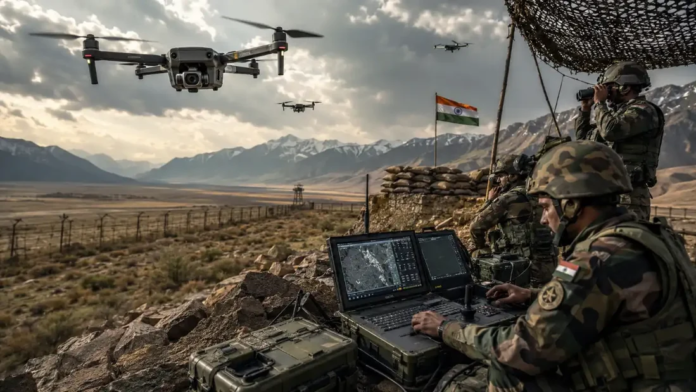
This August, the Indian Army raised its first Baaz Battalion on the western front. A unit built around drones says more about where the Army is heading than any single purchase order could. Buying equipment is a budget decision. Reorganising around drones is something else.
It changes who sees the battlefield, who interprets what is seen, who decides, and how quickly that decision reaches the soldier who has to act on it. That is a doctrinal change, not simply an organisational one.

Doctrine is where armies usually stumble. A formation can have the right platforms and still fight the wrong war. The harder test is what happens when the radio goes silent, satellite navigation becomes unreliable, and the drone operator can no longer see the target clearly.
Whether the new structure can still generate useful combat power under those conditions is the real question behind the raising of Baaz.
Two experiences drove the change. Long standoffs along the Line of Actual Control showed how urgently the force needed persistent surveillance at altitude, where thin air limits helicopters and soldiers on ridgelines cannot watch everything.
Then came Operation Sindoor in May 2025, after which the Army began what it describes as a wider transformation. Official accounts of any operation are selective, so the finer claims warrant caution.

The broader lesson, however, predates both events. Nagorno-Karabakh and Ukraine had already demonstrated that the battlefield was becoming saturated with inexpensive sensors, persistent surveillance and expendable strike systems.
The advantage no longer lies simply in owning better platforms. It increasingly lies in finding, deciding and acting before the adversary can do the same.

The push comes from the top. General Upendra Dwivedi, the former Chief of the Army Staff, has directed that drones be treated as a soldier’s personal weapon, under a philosophy reported as “Eagle on the Arm”.
The idea’s significance goes beyond the phrase. It shifts the drone from a specialist asset held by a few units to an ordinary part of the soldier’s battlefield toolkit.
Reorganising units like the Baaz Battalion redefines battlefield decision-making, turning drones into standard personal arms through top-down initiatives like the “Eagle on the Arm” philosophy
Reported measures include training about 500,000 personnel over five years, placing a drone platoon in every infantry battalion, and allowing each Army Command to build or assemble up to 5,000 tactical drones.
If sustained, this could change not only how units fight but also how they train, maintain equipment and generate replacements during a prolonged conflict.
The design is layered. At the bottom are Ashini platoons inside infantry battalions. These are teams of about 20 specialists with quadcopters and short-range loitering munitions, and nearly all infantry battalions had received them by late 2025.
They do what a forward observer once did with binoculars, only faster and from a safer spot.
One rung up, the artillery is inducting Divyastra batteries and planning Shaktiban regiments, which pair longer-range detection with loitering munitions that can wait over a target before striking. The Armoured Corps is experimenting with Shaurya squadrons so tank formations can look ahead of a manoeuvre.
The key change is not the number of drones at each level, but the distribution of sensing and striking across the formation. A platoon can see locally, a brigade can combine those observations, and a higher headquarters can build the wider picture.
From infantry-level Ashini platoons to artillery Divyastra batteries and heavy operational hubs, drones are being woven directly into combined-arms warfare rather than operated as isolated specialist fleets
The challenge is to make those layers work as a single system rather than as separate drone fleets.
Baaz sits as a centralised hub for operational-level surveillance, deep reconnaissance and data exploitation. Its fleet is meant to be mixed: Heron and Hermes from Israel, the American MQ-9B that India is buying and Indian-made systems.
The DRDO’s Ghatak stealth design is mentioned as a possible future addition, but it remains a hope rather than a fielded system. Around this sit other new structures, including Bhairav battalions, Rudra all-arms brigades and division-level control centres meant to run both offensive drones and defend against hostile ones.
The challenge will be to ensure that the centre does not become a bottleneck. The logic is a nervous system, with reflexes at the edge and awareness at the centre.
The case for this transformation is well established. Drones reduce the cost of surveillance and, for some missions, of attack. More importantly, they alter the economics of battlefield exposure.
A commander can place a sensor above a ridge, road or objective without immediately deploying a soldier there. That does not make the battlefield safer. It makes it more observable, more transparent and potentially more lethal.
Persistent awareness along the western and northern borders could strengthen the Army’s kill web, but only if information can move quickly enough from sensor to decision to shooter.
The restructuring also addresses a management problem that intensifies with scale. Inventory is estimated to have jumped from a few hundred systems to tens of thousands in about two years, with plans for tens of thousands more loitering munitions.
If every battalion buys, trains and maintains its own machines, the result is incompatible systems, uneven skills and video that never reaches anyone who can use it. The answer is therefore not simply more drones, but an architecture that can deploy, sustain, repair and exploit them as a coherent combat system.
Sceptics raise points that are hard to answer. The first is sustainment. Raising one battalion is the easy part. Keeping a huge fleet flying requires trained operators, spares, repair chains and constant software updates. Small drones are lost quickly, so resupply never ends.
The ultimate test of this transformation is resilience against heavy jamming, lost satellite navigation and cyber warfare, requiring systems designed to operate when networks inevitably fail
The second is the electromagnetic contest. Any opponent has studied recent wars as closely as India has, and jamming, spoofing and cheap counter-drone systems will appear in the first hour.
Ukraine shows how fast an edge fades. A tactic works for weeks, then an answer arrives. A force that leans on radio links and satellite navigation must plan for losing both.
The implication is uncomfortable but important. The drone force must be designed to fight degraded, not ideal, networks. Autonomy, alternative navigation, low-signature communications and the ability to revert to simple local control are therefore not technical extras. They are conditions for combat survival.
The third is data. A video feed is not intelligence. Turning footage into a targeting decision within minutes requires analysts, software and clear authority to act. The real bottleneck may therefore move from collection to cognition.
An army that can generate ten thousand feeds but cannot decide which ten matters, has not solved the information problem; it has multiplied it.
The fourth is supply. Many small drones rely on foreign motors, cameras and chips, and those supply chains can be cut in a crisis. Claims of indigenous production should be tested against what is actually inside the airframe.
Managing tens of thousands of new airframes demands robust repair chains and automated data analysis; generating thousands of video feeds is useless without the cognitive capacity to identify key targets instantly
Indigenisation must therefore be measured not by the label on the finished drone, but by control over the components, software, batteries, communications, repair ecosystem and ability to modify the system when the threat changes.
Defence deserves as much attention as offence. The economics of the drone battlefield can punish a force that relies on expensive interceptors against inexpensive threats.
The answer cannot be a single counter-drone weapon. It has to be layered: detection, electronic attack, deception, hard-kill systems, and, where appropriate, directed-energy or other emerging technologies.
The objective is not to make every drone impossible to penetrate. It is to make the overall system too difficult, costly and unreliable for the adversary to sustain.
A structure that prioritises striking while treating counter-drone work as an afterthought leaves camps, supply hubs and vehicle columns exposed. Border districts already contend with drones used for smuggling, so the problem is not theoretical. Soldiers must also relearn how to hide from the sky, an old skill that has suddenly become relevant again.
A quieter risk remains: over-correction. Drones are excellent at surveillance and, increasingly, at striking, but they do not hold ground. Ukraine shows that drones have made movement dangerous, yet positions change hands only when soldiers take them.
True capability relies on controlling core components, software and batteries rather than relying on foreign assemblies that leave forces vulnerable to supply disruptions during a crisis
An army that reads the lesson as fewer soldiers and more drones would make a mistake. The better reading is that drones change how infantry, armour and artillery fight together.
The future formation is therefore not an infantry formation with drones, an armoured formation with drones or an artillery formation with drones. It is a formation in which drones are woven into the combined-arms battle itself.
Command culture matters as well. A live feed that reaches a general invites interference with junior commanders, and the tactical layer needs room to act on what it sees.
A human element underlies all this technology. A young commander accustomed to viewing the battlefield through screens can become dangerously dependent on what the network shows him.
The opposite danger is equally real: a commander who has learned to distrust the network may ignore information that could save lives. Training must therefore produce officers and soldiers who can use technology without becoming its prisoners.
The ultimate test of a drone-enabled force is not how much information it receives, but whether its people can still make sound decisions when that information is incomplete.
Three tests will show whether the reform has produced capability rather than simply new structures. The first is exercises that deliberately degrade communications and navigation, with results reported honestly.
The second is whether lessons from the first Baaz Battalion are shared and applied rather than reported upward as successes. The Army has not said how many such units it will raise, and that restraint is probably wise.
The third is money. Training hours, spares and repair capacity are less glamorous than new platforms, but they determine how many drones fly on any given day.
Modern commanders must leverage live digital feeds without falling into micromanagement or becoming overly reliant on screens when tactical situations require immediate, autonomous action
For India, the objective should not be to build a “drone Army”. It should be to build an Army in which unmanned systems are so deeply integrated that the distinction between a drone unit and a conventional combat unit becomes less important.
Every tactical formation should be able to sense, share, decide, strike and defend across the electromagnetic spectrum, while higher headquarters provide the wider picture without taking decisions away from the lowest level capable of making them. That is the true measure of transformation.
The Army is right to treat the drone as far more than an accessory, and the layered structure is a logical response to a battlefield that is becoming increasingly transparent and contested.
But an organisation chart is a plan, not a capability. Capability will come from training, sustainment, resilient networks, indigenous supply chains, and commanders who know how to fight when those networks fail.
The real test will not come at a raising ceremony or in a procurement figure. It will come on a bad day, with jamming on, navigation degraded, and the network down, when a young commander must decide what to do with whatever remains visible. That is when the drone transformation will either prove itself or reveal how much work remains.

The writer, a PVSM, AVSM, VSM has had an illustrious career spanning nearly four decades. A distinguished Armoured Corps officer, he has served in various prestigious staff and command appointments including Commander Independent Armoured Brigade, ADG PP, GOC Armoured Division and GOC Strike 1. The officer retired as DG Mechanised Forces in December 2017 during which he was the architect to initiate process for reintroduction of Light Tank and Chairman on the study on C5ISR for Indian Army. Subsequently he was Consultant MoD/OFB from 2018 to 2020. He is also a reputed defence analyst, a motivational speaker and prolific writer on matters of military, defence technology and national security. The views expressed are personal and do not necessarily carry the views of Raksha Anirveda





