


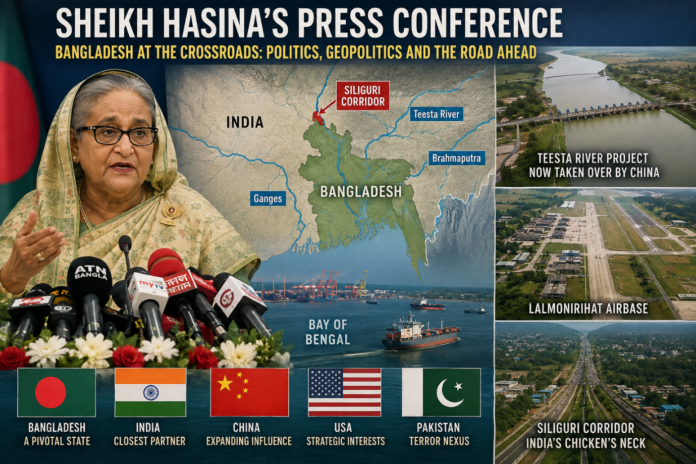
Sheikh Hasina’s latest press conference was far more than an interaction with the media. It represented a carefully calibrated political intervention intended to reclaim the national narrative after months of intense political upheaval, institutional uncertainty and mounting international scrutiny. Coming at a time when Bangladesh continues to grapple with questions of political legitimacy, governance, economic recovery, and foreign influence, the event has implications that extend well beyond domestic politics. It also carries strategic consequences for India, South Asia and the wider Indo-Pacific.
The press conference sought to reassure supporters, challenge allegations from political opponents, defend the legacy of the Awami League government, and present Sheikh Hasina as the only experienced leader capable of restoring political stability. Whether it succeeds in altering Bangladesh’s political trajectory remains uncertain. However, it has undoubtedly reopened the debate regarding her political future, the future of the Awami League, and Bangladesh’s geopolitical orientation.

For India, developments in Bangladesh have never been viewed merely through the prism of bilateral relations. Bangladesh occupies one of the most sensitive geopolitical spaces in South Asia. It sits astride India’s vulnerable northeastern corridor, dominates access to the Bay of Bengal, and has emerged as an arena where India, China and increasingly the United States compete for influence. Pakistan too views political instability in Bangladesh as an opportunity to gradually rebuild networks that had significantly weakened during Sheikh Hasina’s tenure.
Why the Press Conference Became Necessary
Political leaders rarely hold major press conferences without strategic purpose. Sheikh Hasina’s decision was driven by multiple considerations:
The first was the need to consolidate her political constituency. Months of political uncertainty had created confusion among Awami League supporters. Rumours regarding her political future, legal challenges and the possibility of permanent exile had begun affecting party morale. The press conference attempted to reassure supporters that she remained politically active and intended to continue leading the movement.
Secondly, she sought to challenge the dominant political narrative that had emerged following the dramatic changes in Bangladesh’s political landscape. Political narratives often become accepted realities if left uncontested. By addressing the media directly, she attempted to place her version of events before both domestic and international audiences.

Thirdly, the press conference was directed towards the international community. Bangladesh today occupies an important position in global supply chains, maritime security and Indo-Pacific geopolitics. Western governments, international financial institutions and regional powers continue to monitor developments closely. Sheikh Hasina sought to portray herself as a victim of political destabilisation rather than as a leader rejected by the electorate.
Equally important was the attempt to reassure the Awami League organisation that its political struggle would continue through constitutional and democratic means. Political parties facing periods of adversity often require symbolic leadership as much as organisational direction.

Finally, the timing suggested an effort to influence ongoing debates regarding future elections, democratic restoration and possible political reconciliation.
Highlights of the Press Conference
Several themes dominated Sheikh Hasina’s address. She defended her government’s economic achievements, pointing to Bangladesh’s remarkable transformation over the past decade. Under her leadership, Bangladesh witnessed sustained GDP growth, major infrastructure improvements, rapid expansion of garment exports, significant reductions in poverty and rising per capita income. She argued that these gains should not be overlooked because of current political turbulence.
She rejected allegations questioning her government’s legitimacy and reiterated that constitutional governance remained the only acceptable path for Bangladesh.
A major emphasis was placed upon combating extremism. Throughout her tenure, Sheikh Hasina consistently projected herself as the strongest political barrier against Islamist radicalisation. She reminded both domestic and international audiences that her government had dismantled numerous extremist organisations and maintained close intelligence cooperation with India and other partners.
Sheikh Hasina sought to reassure supporters, defend the legacy of the Awami League government, and present herself as the only experienced leader capable of restoring political stability in Bangladesh. Whether she succeeds remains uncertain, but she has undoubtedly reopened the debate regarding her political future and Bangladesh’s geopolitical orientation
She also accused political opponents of encouraging instability and warned against allowing forces opposed to Bangladesh’s secular constitutional identity to regain influence.
Another important element involved foreign interference. Although diplomatic language remained cautious, her remarks suggested concerns that external actors had attempted to influence Bangladesh’s internal political developments.
Perhaps the most closely watched aspect was her refusal to indicate any intention of retiring from politics. Instead, she projected determination and resilience.
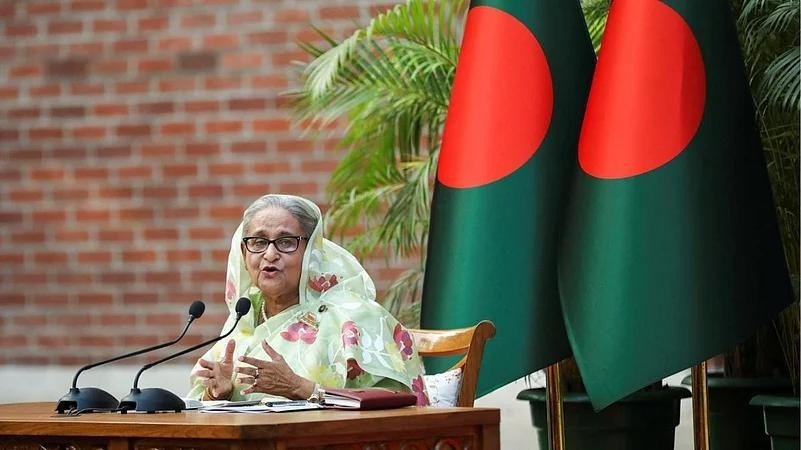
Impact on Bangladesh’s Political Landscape
The press conference has immediate and long-term political implications.
In the short term, it re-establishes Sheikh Hasina as the central political figure within the Awami League. Leadership uncertainty is often more damaging than electoral defeat. By publicly reaffirming her role, she has reduced internal speculation regarding succession.
The opposition, however, is unlikely to soften its position. Bangladesh remains deeply polarised between competing political narratives. Supporters of Sheikh Hasina continue to emphasise economic development, secularism and political stability, while opponents accuse her administration of democratic backsliding and excessive centralisation of power.
The press conference therefore reinforces political polarisation rather than reducing it. Institutionally, Bangladesh faces an equally significant challenge. Political legitimacy ultimately depends upon credible electoral processes accepted by all major stakeholders. Unless future elections are viewed as transparent and inclusive, political instability may continue irrespective of which party governs.
The younger generation also represents an important political variable. Many younger Bangladeshis did not directly experience the instability of the 1970s or the rise of Islamist terrorism during earlier decades. Their political priorities increasingly revolve around employment, inflation, governance, digital freedoms and opportunities rather than historical political loyalties.
Whether Sheikh Hasina can successfully reconnect with this demographic remains uncertain.
India-Bangladesh Relations Under Stress
India’s relationship with Bangladesh represents one of the most successful diplomatic partnerships in South Asia over the past fifteen years. Security cooperation expanded dramatically under Sheikh Hasina’s leadership. Anti-India insurgent groups operating from Bangladeshi territory were systematically dismantled. Intelligence cooperation improved significantly. Border management mechanisms became more effective. Connectivity projects expanded through railways, inland waterways, ports and energy cooperation.
Trade volumes increased substantially while power-sharing arrangements deepened economic interdependence. The political uncertainty in Bangladesh therefore creates genuine concerns in New Delhi. India’s principal concern is not necessarily the identity of any particular government but the continuity of strategic cooperation. Should future governments adopt policies less favourable towards India, several sensitive issues could re-emerge.
Cross-border terrorism could receive indirect encouragement through weakened law enforcement. Illegal migration may increase if economic instability worsens. Border management could become more complicated.
Connectivity projects linking India’s Northeast through Bangladesh may face political delays. Maritime cooperation in the Bay of Bengal may become more uncertain. New Delhi therefore closely monitors political developments while publicly maintaining that Bangladesh’s internal affairs should be resolved by its own democratic institutions.
Can Sheikh Hasina Return to Power?
This remains the most important political question. Political history offers numerous examples of leaders returning after periods of exile or apparent political defeat. The possibility cannot be dismissed outright. Several factors would influence such an outcome. The organisational strength of the Awami League remains considerable despite current challenges.
Bangladesh’s bureaucracy, business community and sections of civil society retain institutional memories of economic stability during her tenure. If future governments fail to address inflation, unemployment and governance challenges, public opinion could gradually shift. Conversely, legal proceedings, political restrictions and changing electoral dynamics may significantly reduce the prospects of an immediate return. The answer ultimately depends less upon personal ambition and more upon the evolution of Bangladesh’s democratic institutions.
China’s Expanding Strategic Interests
China has steadily expanded its influence in Bangladesh over the past decade through infrastructure financing, defence cooperation and economic investment. Bangladesh occupies an important location within China’s broader Indian Ocean strategy. Chinese investments include bridges, highways, industrial parks, energy infrastructure and port development. China has also emerged as Bangladesh’s largest supplier of military equipment, including naval vessels, submarines, fighter aircraft, armoured vehicles, missiles and radar systems.
Although Bangladesh has generally avoided joining any formal strategic bloc, expanding Chinese economic presence inevitably generates strategic implications. Beijing seeks a stable Bangladesh that remains receptive to Chinese investment while avoiding overt alignment with any anti-China coalition. Political instability complicates these objectives but also creates opportunities for Beijing to expand economic leverage through financial assistance and infrastructure investment. China’s long-term objective appears centred upon maintaining sustained influence irrespective of which political party governs.
American Interests in Bangladesh
The United States approaches Bangladesh through a different strategic framework. Washington views Bangladesh as an important Indo-Pacific partner, a major contributor to United Nations peacekeeping missions and a critical manufacturing hub within global supply chains. American concerns increasingly focus upon democratic governance, labour rights, human rights and electoral credibility.
Simultaneously, the United States recognises Bangladesh’s growing importance in balancing Chinese influence across the Bay of Bengal. The apparent tension between strategic competition with China and promotion of democratic governance creates a complex American policy framework.
Washington therefore seeks stable democratic institutions while avoiding excessive Chinese strategic penetration. Any future government capable of balancing these competing expectations is likely to receive constructive American engagement.
Pakistan’s Renewed Strategic Calculations
Perhaps the least discussed but strategically significant dimension concerns Pakistan. Relations between Bangladesh and Pakistan never fully recovered from the trauma of 1971.
Under Sheikh Hasina, Bangladesh pursued war crimes trials against individuals associated with atrocities committed during the Liberation War, generating repeated diplomatic friction with Islamabad. Pakistan consequently lost considerable political influence.
Political instability, however, creates new opportunities. Islamabad may attempt to gradually rebuild political contacts, religious networks and intelligence relationships. Such efforts would likely remain indirect rather than overt.
Relations between Pakistan’s intelligence establishment and sections of Islamist political organisations have historically provided Islamabad with channels of influence across South Asia. Although Bangladesh’s political culture, national identity and state institutions differ fundamentally from Pakistan’s, periods of political uncertainty invariably create spaces that external actors seek to exploit. Pakistan’s strategic objective would be to weaken India’s influence in Dhaka, reduce Bangladesh’s strategic alignment with New Delhi, and gradually normalise political and security engagement that had significantly diminished during Sheikh Hasina’s tenure.
India-Bangladesh security cooperation expanded dramatically under Sheikh Hasina’s leadership; anti-India insurgent groups operating from Bangladesh were dismantled, intelligence cooperation improved, and border management mechanisms became more effective. Connectivity projects expanded through railways, inland waterways, ports and energy cooperation
An important concern for Indian security planners is the possibility of renewed networking between Pakistan’s intelligence apparatus and transnational extremist organisations operating across the region. During the 1990s and early 2000s, several insurgent groups active in India’s Northeast exploited Bangladeshi territory for logistics, training and safe havens. These networks were dismantled through unprecedented cooperation between Indian and Bangladeshi security agencies after Sheikh Hasina assumed office. Any weakening of counterterrorism cooperation, even if unintended, could encourage dormant networks to revive.
The Emerging Terrorist Nexus
The concern is not that Bangladesh itself is transforming into a terrorist state; rather, the risk lies in the exploitation of political instability by extremist organisations. Bangladesh has, over the past two decades, witnessed the activities of groups such as Jamaat-ul-Mujahideen Bangladesh (JMB), Ansarullah Bangla Team, and other radical networks inspired by transnational jihadist ideologies. Successive security operations under Sheikh Hasina substantially degraded their operational capabilities, but the ideological ecosystem has not disappeared.
There are also concerns regarding linkages between Pakistan-based organisations such as Lashkar-e-Taiba and Jaish-e-Mohammed with sympathisers across the region. Publicly available evidence has periodically pointed to attempts by extremist groups to exploit porous borders, refugee flows, forged documentation and digital propaganda to expand recruitment. While Bangladesh’s security agencies have remained active against such threats, prolonged political instability could divert state capacity away from counterterrorism towards internal political management.
The Rohingya refugee camps in southeastern Bangladesh add another layer of complexity. The overwhelming majority of refugees are victims of conflict and have no connection with militancy. Nevertheless, international security assessments have repeatedly cautioned that criminal syndicates and extremist recruiters may seek to exploit the camps if governance weakens. Such developments would have implications not only for Bangladesh but also for India, Myanmar and the wider Bay of Bengal region.
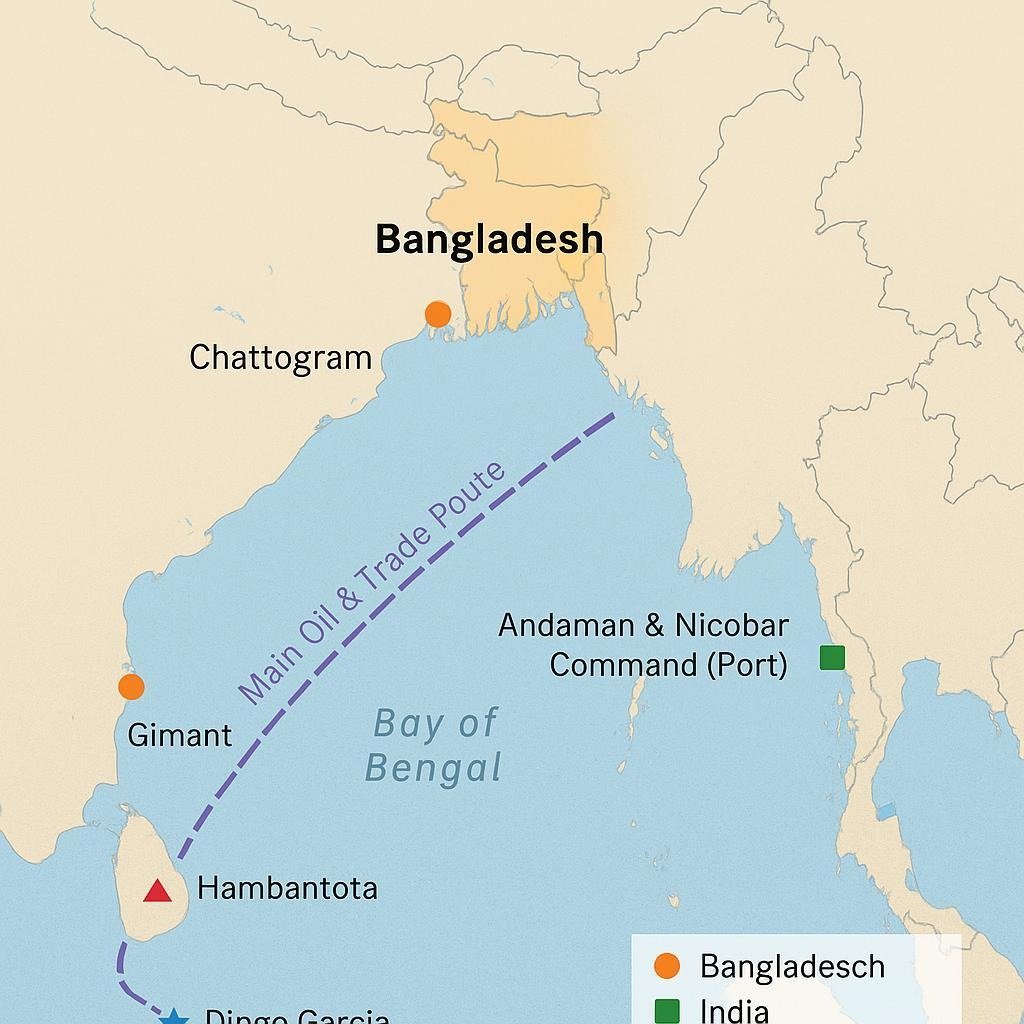
Bangladesh’s Geography: The Foundation of Its Strategic Importance for India
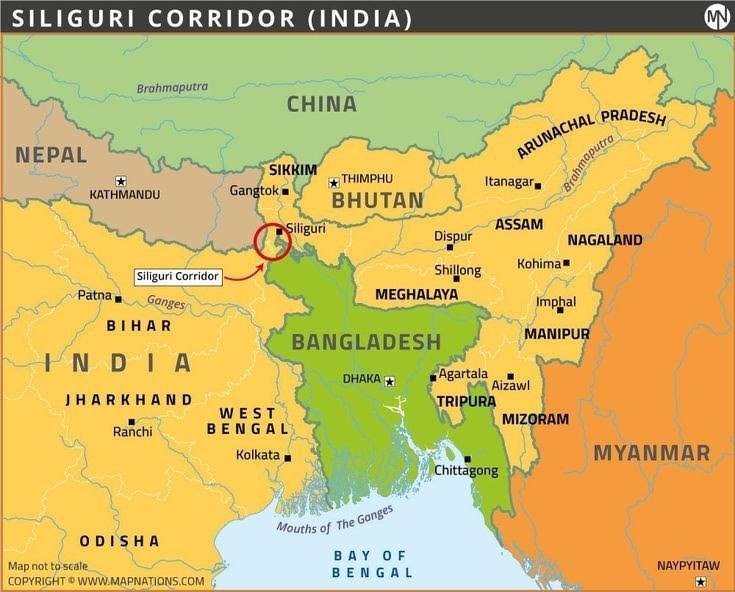
Geography has made Bangladesh one of India’s most consequential neighbours. Sharing a land border of over 4,000 kilometres — the longest that India shares with any country — Bangladesh is surrounded on three sides by the Indian states of West Bengal, Assam, Meghalaya, Tripura and Mizoram, while its southern coastline opens into the Bay of Bengal. This unique geographical configuration gives Bangladesh immense strategic significance for India’s national security, economic connectivity and regional diplomacy. The country lies adjacent to India’s narrow Siliguri Corridor, the 20–25-kilometre-wide land bridge connecting the Indian mainland with the eight Northeastern states, making stability in Bangladesh a vital component of India’s territorial security. Bangladesh also provides the shortest transit routes between mainland India and the Northeast through an expanding network of roads, railways, inland waterways and coastal shipping agreements, substantially reducing logistics costs and travel time. The major transboundary rivers — the Ganga (Padma), Brahmaputra (Jamuna), Teesta, Feni, Manu, Kushiara and several others — bind the two countries through a shared hydrological ecosystem, making cooperation on water management, flood control and climate resilience an indispensable strategic necessity. From India’s perspective, Bangladesh is not merely a neighbouring state but the geographical gateway to Southeast Asia under the Act East Policy, a critical partner in securing the Bay of Bengal, and an indispensable pillar of regional connectivity through initiatives such as BIMSTEC, BBIN and the India–Middle East–Europe connectivity architecture. Consequently, any political instability or geopolitical realignment in Bangladesh has direct implications for India’s internal security, economic integration, maritime strategy and overall regional balance of power.
Teesta River, Lalmonirhat Airbase and the Siliguri Corridor: The New Strategic Triangle
Perhaps the most significant geopolitical development in the evolving India-Bangladesh relationship is the growing convergence of Chinese strategic interests around the Teesta River basin, northern Bangladesh and infrastructure development close to India’s vulnerable Siliguri Corridor. While each project may appear developmental in isolation, collectively they have altered the strategic calculus of South Asia.
The proposed Chinese participation in the Teesta River Comprehensive Management and Restoration Project has generated considerable debate in strategic circles. Originally envisaged as an ambitious river training, flood control, irrigation and land reclamation project, the Teesta initiative goes far beyond water management. The river originates in the eastern Himalayas, flows through the Indian state of Sikkim and North Bengal before entering Bangladesh, making it one of the most politically sensitive transboundary rivers between the two countries. Beijing’s willingness to finance and execute such a strategically located infrastructure project has naturally attracted scrutiny in New Delhi.
For China, the project represents another opportunity to deepen its economic footprint under its broader regional connectivity strategy. Large-scale infrastructure investments inevitably translate into long-term technical presence, engineering support, financial leverage and political goodwill. Chinese state-owned enterprises executing such projects remain present for years through maintenance contracts, technology transfer and associated development activities. Consequently, what begins as a civil engineering project often acquires long-term strategic significance.
For India, the concern is not merely Chinese investment but its geographical proximity to India’s most vulnerable strategic artery — the Siliguri Corridor, commonly referred to as the Chicken’s Neck. Barely 20 to 25 kilometres wide at its narrowest point, this corridor connects the Indian mainland with the eight Northeastern states. Nearly fifty million Indian citizens, along with critical military formations, logistics infrastructure, fuel supplies, communication networks and strategic reserves, depend upon this narrow land bridge. Any disruption during conflict would have profound military and economic consequences.
China has expanded its influence in Bangladesh over the past decade through infrastructure financing, defence cooperation and economic investment. China is Bangladesh’s largest supplier of military equipment, including naval vessels, submarines, fighter aircraft, armoured vehicles, missiles and radar systems. Bangladesh is important for China’s Indian Ocean strategy
Chinese involvement in northern Bangladesh, when viewed alongside its military infrastructure in Tibet, extensive road and railway networks near the Line of Actual Control, the China-Pakistan Economic Corridor in the west and growing maritime influence in the Indian Ocean, raises legitimate strategic questions regarding the cumulative impact on India’s security environment. Indian defence planners therefore assess such developments through the prism of long-term strategic competition rather than individual infrastructure projects.
Another issue that has gained prominence is the reported interest in reviving or upgrading the Lalmonirhat airbase in northern Bangladesh. Located relatively close to the Indian border and not far from the Siliguri Corridor, Lalmonirhat was historically an important military airfield during the Second World War. Although Bangladesh has maintained that any redevelopment is intended to enhance its own aviation infrastructure and national defence capabilities, speculation regarding possible Chinese technical assistance has attracted significant attention within Indian strategic circles.
Should Chinese companies or military-linked entities become involved in developing infrastructure with dual-use potential, India would inevitably view such developments through a broader security lens. Modern airfields, even when constructed for civilian purposes, possess inherent dual-use characteristics. They can support logistics, surveillance, disaster relief, military transport and emergency deployment. While there is no credible public evidence that Bangladesh intends to permit any foreign military presence at Lalmonirhat, the possibility of enhanced Chinese technical access in such a strategically sensitive region remains an issue that Indian security planners cannot ignore.
Equally important is the unresolved Teesta water-sharing agreement between India and Bangladesh. Despite decades of negotiations, a comprehensive agreement has remained elusive, largely because of competing water requirements and the constitutional role of the Government of West Bengal in India’s federal structure. During the dry season, reduced river flow significantly affects irrigation and agriculture in northern Bangladesh, making the Teesta an emotive political issue in Dhaka. Successive Bangladeshi governments, including that of Sheikh Hasina, repeatedly sought an early resolution while recognising the political sensitivities within India.
The inability to reach an agreement has, at times, created diplomatic space for external powers to present themselves as alternative development partners. China has capitalised on this vacuum by offering financial and technical assistance for river management and associated infrastructure. Although water sharing and river restoration are distinct issues, they have increasingly become politically intertwined in public discourse. This underscores the importance of India and Bangladesh finding mutually acceptable and sustainable mechanisms for equitable water utilisation.
Beyond the Teesta, the two countries have established institutional mechanisms for cooperation on more than fifty shared rivers through the Joint Rivers Commission. These mechanisms have facilitated dialogue on flood forecasting, hydrological data sharing and river management. However, climate change, glacial retreat in the Himalayas, erratic monsoons and increasing water demand are making transboundary river governance progressively more complex. Future cooperation must therefore move beyond seasonal negotiations towards integrated basin management, joint flood mitigation, sediment control, environmental conservation and climate resilience.
From a strategic perspective, river diplomacy has become inseparable from national security. Sustainable water-sharing arrangements strengthen political trust, reduce opportunities for external powers to exploit bilateral differences and reinforce the broader strategic partnership between India and Bangladesh. Conversely, unresolved water disputes, combined with expanding Chinese infrastructure investments and heightened geopolitical competition, risk introducing new fault lines into an otherwise successful bilateral relationship.
The United States views Bangladesh as an important Indo-Pacific partner, a major contributor to UN peacekeeping missions and a critical manufacturing hub within global supply chains. American concerns focus on democratic governance, labour rights, human rights and electoral credibility. The US recognises Bangladesh’s importance in balancing Chinese influence in the Bay of Bengal
For New Delhi, preserving the strategic stability of the Siliguri Corridor will remain a national security imperative. This objective is best achieved not through confrontation but by deepening connectivity, economic integration, defence cooperation and mutual trust with Bangladesh. A stable, prosperous and strategically autonomous Bangladesh remains India’s strongest security buffer in the eastern theatre and an indispensable partner in maintaining peace and stability across the Bay of Bengal and the wider Indo-Pacific.
Implications for India’s National Security
For India, Bangladesh is not simply a neighbouring country; it is a strategic partner whose stability directly affects India’s internal security. Nearly every northeastern state is connected to the rest of India through the narrow Siliguri Corridor, while Bangladesh provides critical transit routes that shorten logistics and improve economic integration. Any deterioration in bilateral relations would have consequences for trade, connectivity, energy cooperation and regional development.
Security concerns are equally significant. India has invested heavily in coordinated border management, intelligence sharing and joint operations against organised crime, human trafficking, narcotics smuggling and insurgent networks. These mechanisms depend upon mutual trust between the two governments. Political uncertainty in Dhaka may slow decision-making, reduce operational coordination and create opportunities for hostile actors to test the resilience of these arrangements.
Maritime security in the Bay of Bengal also assumes greater importance. Bangladesh occupies a central position between India’s eastern seaboard and the wider Indo-Pacific. As competition among China, the United States and other regional powers intensifies, Dhaka’s strategic choices will increasingly influence the regional balance of power. India will therefore seek to preserve a cooperative relationship irrespective of changes in Bangladesh’s domestic politics, while remaining alert to any shifts that could affect its long-term security interests.
The Road Ahead
Bangladesh stands at a defining moment in its national journey. The choices made by its political leadership, civil society, armed forces, judiciary and electorate over the coming months will determine whether the country returns to stable democratic governance or experiences a prolonged period of political contestation.
For Sheikh Hasina, the press conference has achieved one immediate objective: it has reinserted her into the centre of Bangladesh’s political discourse. Rather than being viewed solely through the lens of recent political developments, she has reminded supporters and adversaries alike of her role in Bangladesh’s economic transformation, her uncompromising stance against violent extremism and her vision of a secular republic. Whether this translates into a political comeback will depend on legal developments, electoral processes, public sentiment and the cohesion of the Awami League.
For India, Bangladesh is not simply a neighbouring country; it is a strategic partner whose stability directly affects India’s internal security. Northeastern states are connected to the rest of India through the narrow Siliguri Corridor. Any deterioration in bilateral relations would have consequences for trade, connectivity, energy cooperation and regional development
India’s policy is likely to remain one of strategic patience. New Delhi has consistently emphasised respect for Bangladesh’s sovereignty while quietly safeguarding its own security and connectivity interests. At the same time, China will continue to deepen its economic footprint, the United States will seek a democratic and strategically balanced Bangladesh, and Pakistan will look for opportunities to recover lost influence. The interplay among these competing interests will shape Bangladesh’s external environment as much as its internal politics.
Conclusion
Sheikh Hasina’s press conference was not merely a defence of her political legacy; it was a declaration that she remains an active participant in Bangladesh’s future. It reflected the determination of a leader who believes that her political chapter is not yet complete. Whether history ultimately vindicates that belief will depend on the resilience of Bangladesh’s democratic institutions and the willingness of its political actors to place national stability above partisan rivalry.
For South Asia, the stakes extend far beyond one individual or one political party. Bangladesh has emerged as a pivotal state linking South Asia with the Indo-Pacific, connecting the Bay of Bengal to global trade routes and acting as a bridge between India’s Northeast and Southeast Asia. Stability in Bangladesh strengthens regional prosperity, while prolonged instability risks inviting greater external intervention, renewed extremist activity and sharper geopolitical competition.
The coming years will therefore determine not only whether Sheikh Hasina returns to power, but also whether Bangladesh can preserve the remarkable economic and social gains of the past decade while maintaining its strategic autonomy amid intensifying great-power rivalry.

-The author retired as Major General, Army Ordnance Corps, Central Command, after 37 years of service. A management doctorate and expert on defence modernisation, he is the author of four books, including the Amazon bestseller “Breaking the Chinese Myth,” and a frequent media commentator. He is affiliated with several leading defence and strategic studies institutions in New Delhi. The views expressed are of the writer and do not necessarily reflect the views of Raksha Anirveda





