


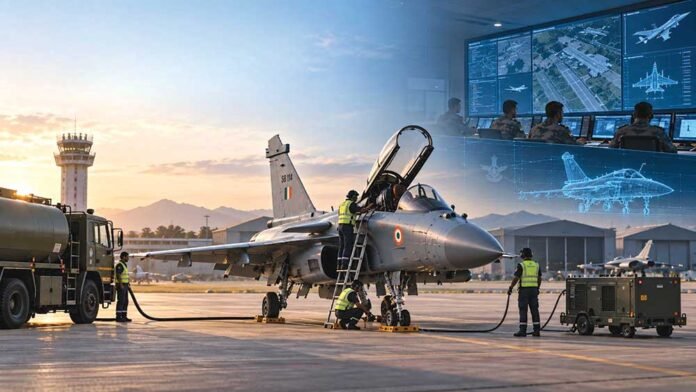
 Air operations have never been about fighter aircraft and helicopters alone. The way air power is generated and employed is transforming significantly. Future air campaigns will depend on sensors, shooters, command systems, support elements and decision-makers operating as one integrated force, not merely as separate platforms executing separate missions. If the force is to fight this way, it must also be trained this way.
That is the central challenge of Multi-Domain Operations (MDO) training for the Indian Air Force. It points towards a sovereign synthetic battlespace where the entire force can train, rehearse, and learn together.

Train as an Integrated Force, Not a Collection of Platforms
Multi-domain operations demand way more from every combatant. A fighter pilot no longer manages only an aircraft and a mission; the pilot is increasingly a node in a larger network, drawing upon airborne and space-based sensing, ground-based air defence, electronic warfare, cyber and information capabilities, and joint coordination.
Training centred primarily on individual platforms cannot adequately prepare personnel for this environment. Live exercises will remain essential, but cost, airspace, safety constraints and the difficulty of realistically representing contemporary threats impose inherent limitations. The requirement, therefore, is for training that brings multiple actors, at multiple levels, into the same dynamic and evolving operational scenario.
No single simulator can meet this requirement. What is needed is a comprehensive training ecosystem comprising platform simulators, mission rehearsal systems, command and control training, wargaming, sensor and air defence trainers, and ground operations training, while all of these share common scenarios, data standards and assessment frameworks. Standalone systems create islands of capability; an integrated ecosystem creates a continuum of learning from the individual and crew to the formation and command.
Importantly, this ecosystem must also include those elements of air operations that do not fly. Sustained sortie generation depends upon airside operations, specialist vehicles, logistics, ground handling, maintenance and the procedures that bind them together. Yet training investment has traditionally tended to concentrate on aircrew.

A synthetic environment incorporating ground crews can enable turnaround sequences, weapon loading, refuelling, specialist vehicle movements and fault handling to be rehearsed at realistic operational tempos, including the disruption an adversary may impose on an airbase. It enables the force to rehearse sustained operations, not merely the first sortie.
The same logic applies to the sensor-to-shooter chain. Radar operators, air defence controllers, missile crews and the command elements linking them need to practise detecting, tracking and engaging targets in dense, contested scenarios that are difficult or unsafe to reproduce live. Integrating air defence simulation with aircrew training within the same battlespace allows each participant to better understand the other’s operational challenge, improving coordination between those penetrating an air defence environment and those defending it.

Training the Decision Makers, Not Merely Just the Executors
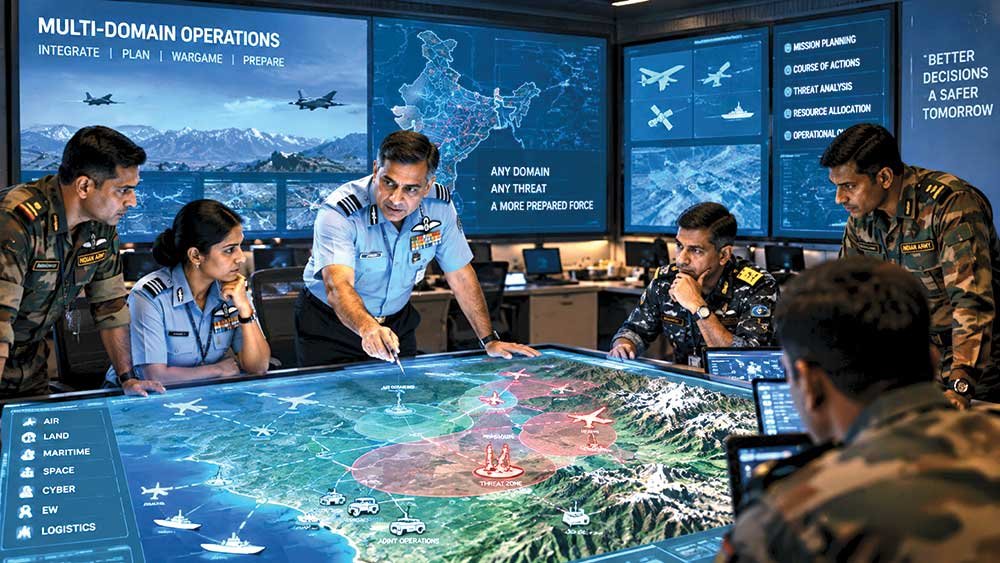
If simulation trains how forces act, wargaming trains how commanders think.
Wargames enable commanders and planners to test courses of action, confront an adaptive adversary and experience the consequences of decisions taken under uncertainty and time pressure. Their real value lies less in predicting outcomes and more in building judgement, challenging assumptions and developing shared understanding across the staff.
This becomes particularly important in multi-domain operations, where an action in one domain can fundamentally reshape options in another. For instance, an electronic warfare action will alter the air defence dynamics, while a logistics constraint will practically limit an air tasking plan.
Live exercises will remain essential, but cost, airspace and safety constraints, along with the difficulty of realistically representing contemporary threats, impose limitations. Therefore, training must bring multiple actors at multiple levels into the same dynamic and evolving operational scenario
Wargaming and simulation, however, are still often treated as separate disciplines, supported by separate tools. This separation limits their potential. When a decision taken during a wargame can flow directly into a simulated execution environment, and the results flow back to inform the next decision, training becomes a continuous cycle. A commander could finalise a strike package in the morning, watch crews execute it in a synthetic environment in the afternoon, and review the consequences with the staff by evening.
This requires common scenario databases, interoperable architectures and agreed standards for representing entities, effects and timelines.
This is where a collection of tools becomes an integrated training system; modular enough to incorporate new platforms and threat models; scalable from individual mission rehearsal to large multi-domain exercises; distributed enough for geographically dispersed units to train together without moving people and aircraft; and sufficiently instrumented to capture performance data so that debriefs, training outcomes and doctrinal development are based on evidence rather than impression.
Sovereignty of Training is an Operational Imperative
A synthetic battlespace is only as trustworthy as the scenarios, threat libraries, models and data that underpin it. These encode how a force fights, what it expects of an adversary and where its vulnerabilities lie. Dependence on external providers for this content — or for the underlying software — creates dependencies in precisely the area where operational confidence and sovereign control matter most.
“A sovereign training ecosystem is not merely about owning simulators. It is about owning the ability to model our threats, rehearse our doctrine, test our decisions and continuously adapt how we fight in an era where warfare is transforming rapidly and significantly,” says Amit Baveja, Head, Defence Business, Tecknotrove Systems.
Amit Baveja, who leads Tecknotrove’s Defence Business, believes that the next phase of transformation must move beyond standalone training devices towards an integrated and sovereign training ecosystem.
Tecknotrove is working towards reinvigorating this ecosystem through indigenous technologies that bring together simulation, wargaming, synthetic environments and data-driven training across different levels of training and operations.
If simulation trains how forces act, wargaming trains how commanders think. Wargames enable commanders and planners to test courses of action, confront an adaptive adversary and experience the consequences of decisions taken under uncertainty and time pressure
For India, this assumes particular significance. The Indian Air Force operates and is integrating a diverse mix of indigenous and imported aircraft, weapons and sensors, as well as a mix of legacy and modern systems, within an increasingly networked environment. It draws upon a growing domestic defence ecosystem and operates across a geographically dispersed battlespace where many of the most demanding scenarios cannot realistically be rehearsed live without consuming significant resources or exposing sensitive capabilities.
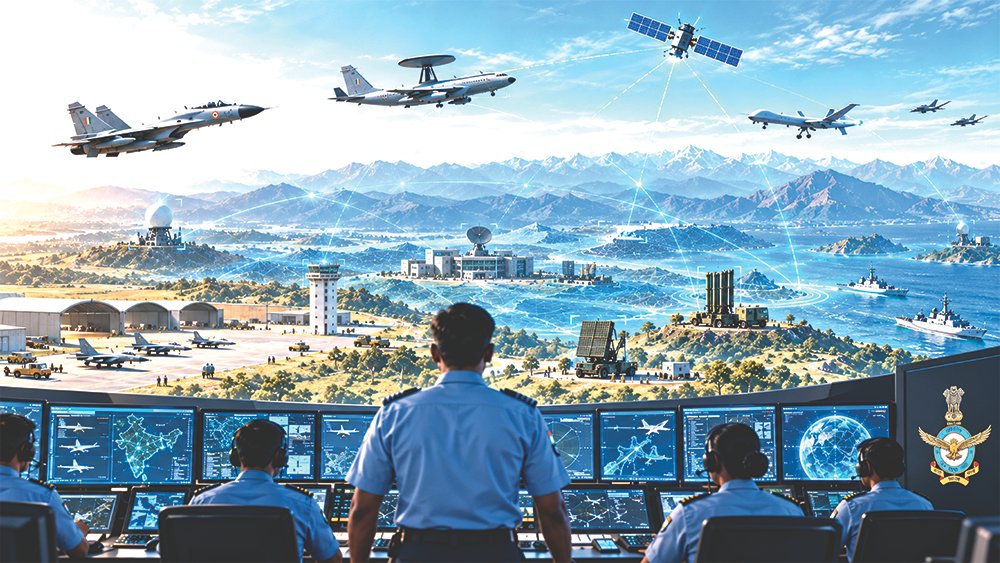
Control over source code, scenario design, threat modelling and data enables the Air Force to evolve its training as rapidly as its operations, technology and doctrine evolve; protect sensitive information; and integrate new indigenous systems without recurring external dependencies. Equally importantly, it builds the domestic industrial and technological expertise required to sustain and evolve the capability over decades.
Building such an ecosystem will require more than individual simulation products. It will require integrators capable of bringing together different simulation modalities, distributed environments and training applications, working closely with the Indian Air Force and India’s defence industry.
Multi-domain operations will increasingly favour forces that have trained and rehearsed as integrated wholes. The task, therefore, is to build that capability deliberately, integrate it progressively, retain sovereign control over its critical technologies and data, and develop the expertise to evolve it within India continuously. If the force is to fight as one integrated whole, it must start with training as one.

–The writer is Founder and Director of Tecknotrove Systems India Pvt Ltd. The views expressed are of the writer and do not necessarily reflect that of Raksha Anirveda





