


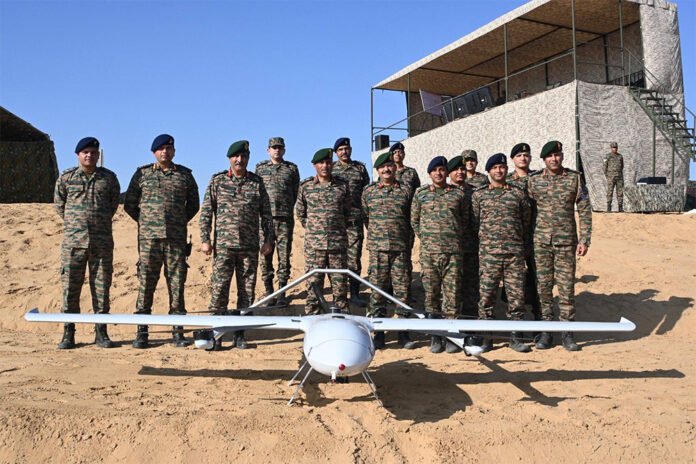
NEW DELHI. In a major doctrinal shift aimed at building deep-strike capabilities independent of conventional missile systems, the Indian Army has formally initiated the acquisition of indigenous, long-range one-way attack drones.
The programme, categorised under the Long Range Loiter Munition (LRLM) project, marks a significant milestone in India’s efforts to develop sovereign, low-cost precision warfare technologies.

The procurement is being executed under the ‘Make II’ category of the Defence Acquisition Procedure. This specialised framework requires domestic private defence firms to entirely fund their own research, development and prototyping. In return, the Indian Army provides a formal commitment to buy the systems in bulk once they successfully pass stringent technical evaluations and field trials.
Shifting Strategic Horizons
The procurement initiative is being spearheaded by the Army’s Regiment of Artillery, reflecting an operational mandate to extend the military’s offensive envelope far beyond traditional frontline boundaries.
Under the LRLM project, the military is seeking highly resilient, autonomous systems that can survive and operate effectively in heavily contested airspace and GPS-denied environments.
The technical parameters laid out for the domestic defence industry are highly demanding. The requested loitering munitions must be capable of carrying a minimum 25-kilogramme warhead, engineered to deliver a lethal 50-metre destruction radius upon impact.

Furthermore, the drones must be able to sustain flight altitudes exceeding 5,000 metres – making them viable for deployment across rugged high-altitude border regions – while achieving cruise speeds of at least 400 kilometres per hour.
To ensure maximum tactical flexibility, the platforms must be fully ruggedised to meet extreme military standards, allowing seamless operations across diverse geographical landscapes, including plains, deserts, dense jungles and high-altitude mountainous terrains.

Replicating Modern Combat Lessons
The push for a 1,000-kilometre strike capability draws heavily from operational insights gathered from recent global conflicts, particularly the extensive deployment of delta-wing one-way attack drones in the Russia-Ukraine war.
The Indian Army requires these new loitering munitions to execute complex flight profiles, including steep dives, slant attacks and ultra-low, terrain-hugging “nape-of-the-earth” manoeuvres designed to evade sophisticated enemy radar networks.
Reportedly, rather than buying standalone aerial platforms, the military is investing in complete operational ecosystems. Each acquired tactical set will include a dedicated launch vehicle, a mobile ground control station, a flight simulator for pilot training and a complement of 15 one-way combat aerial vehicles.
The drones will also feature modular configurations to carry distinct payloads, including deep-penetration warheads for fortified bunkers and thermobaric warheads for anti-personnel objectives.
Securing the Component Supply Chain
A core focus of the LRLM initiative is absolute self-reliance. The Ministry of Defence is closely auditing the supply chains of participating defence tech firms to evaluate the indigenous content of critical subsystems. This includes evaluating the domestic origins of propulsion engines, electro-optical payloads, flight avionics and structural mainframes.
The ultimate goal is to create a fully isolated domestic manufacturing ecosystem that can rapidly scale-up production volumes during a national security crisis without relying on foreign components.






