


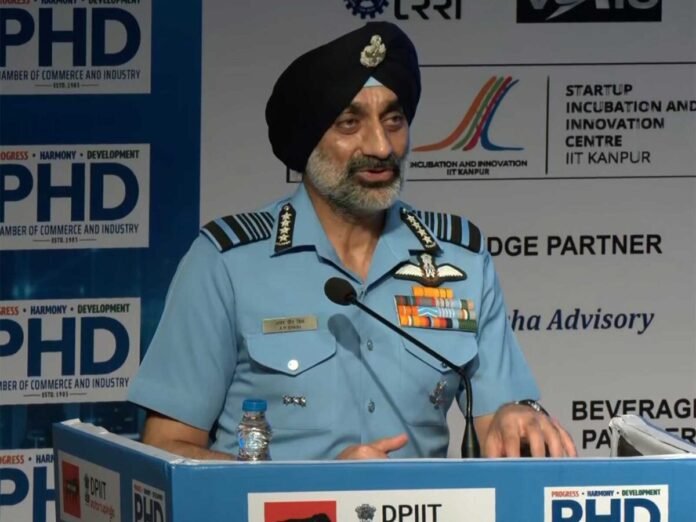
NEW DELHI. In a resounding call for indigenous defence innovation, Chief of the Air Staff, Air Chief Marshal Amar Preet Singh, declared that the future of combat operations lies in the strategic synthesis of manned aircraft with autonomous unmanned platforms.
Delivering the inaugural address at the PHD Chamber of Commerce and Industry’s (PHDCCI) flagship event, Bharat Drone Manthan 3.0, the Air Chief stressed that India must rapidly develop deep-tech capability to maintain air superiority in evolving conflict zones.

The two-day conclave, themed “Vision to Action: Powering India’s Deep-Tech Future”, brought together senior defence leaders, policymakers, drone industry pioneers, tech startups and academic researchers to chart India’s path toward becoming a global hub for drones and robotics by 2030.
Accelerated Innovation: “Technology Delayed is Technology Denied”
Reflecting on recent global conflicts where unmanned aerial systems (UAS) and counter-drone mechanisms redefined tactical outcomes, Air Chief Marshal Singh highlighted that technological delays carry severe operational costs. “Technology delayed is technology denied,” he remarked, urging private industry, startups and research institutions to scale up domestic manufacturing and expedite development cycles.
To bridge the gap between military operational needs and private industry capabilities, the Indian Air Force has established the Directorate of Aerospace Design (DAD). The Air Chief announced Dronathon 2026, a nationwide competitive platform designed to evaluate cutting-edge indigenous drone technologies through rigorous live flight demonstrations.
Key priority areas outlined by the IAF leadership include:

- AI-Enabled Autonomous Systems: Integrating edge computing and machine learning directly onto airborne payloads for real-time threat analysis.
- Manned-Unmanned Teaming (MUM-T): Pairing conventional fighter jets with autonomous wingmen to expand reconnaissance and striking radiuses.
- Component Localisation: Developing indigenous flight controllers, optical sensors, semiconductor chips and secure communication links to replace foreign dependencies.
- Cybersecurity & Counter-Drone Warfare: Fortifying autonomous systems against hostile electronic jamming, spoofing and cyber intrusion.
Institutional Support and Deep-Tech Ecosystem
Echoing the Air Chief’s vision, Dr N Ranjana, Director of the Directorate of Futuristic Technology Management at DRDO Headquarters, detailed how DRDO’s Industry-Academia Centres of Excellence are fostering breakthroughs in autonomous platforms, swarm intelligence, additive manufacturing and advanced propulsion. She urged emerging startups to actively utilise DRDO’s extensive testing infrastructure, technology transfer frameworks and research facilities.
Complementing defence efforts, Dr Panneerselvam Madangopal, CEO of MeitY Startup Hub, highlighted government initiatives such as iDEX (Innovations for Defence Excellence) that empower tech entrepreneurs. He underlined domestic semiconductor and electronics design as pivotal to establishing true self-reliance under Aatmanirbhar Bharat.

Moving From Vision to Action for Viksit Bharat 2047
PHDCCI leadership, including Civil Aviation Committee Chair Sanjiv Edward and CEO Dr Ranjeet Mehta, noted that the third edition of the conclave represents a decisive shift toward execution. Supported by India’s expanding ecosystem of over 1.5 lakh startups and 150 unicorns, the drone sector is positioned to become a central driver of national security, economic growth and skilled employment.
The conclave concluded with the release of a comprehensive PHDCCI Knowledge Report outlining strategic policy recommendations to accelerate supply-chain self-sufficiency and establish secure airspace architectures as India works toward its long-term Viksit Bharat 2047 objectives.






