

On the auspicious occasion of the summer solstice, marking the pinnacle of light and life, at midday on June 21, 2026, the longest day of the year, three indigenously built Naval vessels were commissioned into the roster of the Indian Navy, giving a boost to its fleet strength. The new Chief of Naval Staff, Admiral Krishna Swaminathan, welcomed Prime Minister Narendra Modi at the grand ceremony at Shayma Prashad Mukherjee Port in Kolkata. West Bengal Governor RN Ravi and Chief Minister Suvendu Adhikari were the guests of honour. FOC-in-Chief, Eastern Naval Command, Vice Admiral Sanjay Bhalla, and Commodore PR Hari (Retd), Chairman of Garden Reach and Shipbuilders Engineers (GRSE), also witnessed the ceremony.
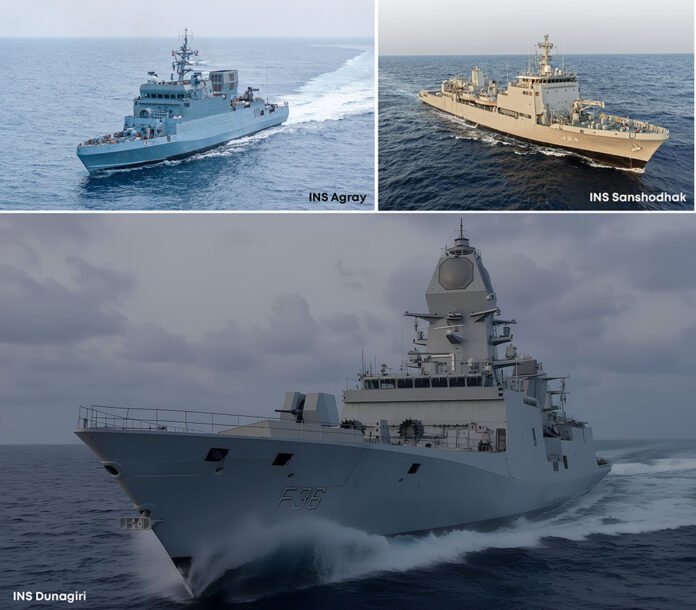
Three new ships commissioned in the Indian Navy are INS Dunagiri, INS Shanshodhak, and INS Agray. All three are marvels of the latest technology, fitted with modern maritime avionics, and, most importantly, are indigenously built with Indian materials and by Indian staff under Mission Aatmanirbhar in defence production. A new Trident has been inducted into the Indian Navy.

Nilgiri-class Guided Missile Platform
INS Dunagiri: It is a stealth frigate, the fifth ship of the Nilgiri-class guided missile platform under Project 17A, built in India by GRSE, a public sector defence production company recently elevated to Nav Ratna status. The keel of the vessel was laid in 2020 and was completed on March 30, 2026. It has been allotted pennant no F36. The weight of the ship is about 7,000 tonnes, length 150 metres, Beam 17.8 metres, Draft 5.22 metres and Depth 10 metres approx. The power plants are 2x Man Diesel 6000 kW each and 2x General Electric (HAL) LM 2500. The optimum speed is 18 kn, but it can achieve 28 kn (52 kmph). Cruising range at optimum speed is 5,500 nautical miles (10,200 km). The crew is composed of 226 sailors.
INS Dunagiri, a deadly weapons platform, is equipped with electronic warfare devices such as BEL Ajanta suite comprising 4x Kavach launchers and 2x NSTL Mareech torpedo countermeasures systems. Its main firepower is 4x 8-cell vertical launcher systems (VLS) for the Barak 8 anti-air missiles and 1x 8-cell VLS for BrahMos supersonic cruise missiles
INS Dunagiri is equipped with electronic warfare devices such as BEL Ajanta suite comprising 4x Kavach launchers and 2x NSTL Mareech torpedo countermeasures systems. The main firepower consists of 4x 8-cell vertical launcher systems (VLS) for the anti-air Barak 8 missile and 1x 8-cell VLS for the BrahMos supersonic cruise missile, making it a deadly weapons platform. It is also fitted with 2x triple tubes for anti-ship torpedoes and anti-submarine RBU-6000 rockets. It has a helipad and a hangar for two HAL Dhruv/Sea King helicopters.
Notably, INS Dunagiri 1.0 was a Leander-class frigate built in 1977 and was decommissioned in 2010, but the legacy continues. The warship has been named after a Himalayan peak, and the motto is ’Forever Victorious’. The other sister frigates in the Nilgiri-class frigates serving in the Indian Navy are INS Nilgiri, INS Udaygiri, INS Taragiri, INS Himgiri, and now INS Dunagiri has been launched to protect Indian maritime frontiers.
The multi-mission stealth frigates were designed by the Warship Bureau and were approved by the Directorate of Naval Design. The Mazagaon Docks and GRSE were jointly awarded a contract to build P17A frigates. Four were to be built by Mazagaon Docks, Goa/Mumbai, and three were to be constructed at GRSE, Kolkata. INS Mahendragiri and Vindyagiri are yet to be commissioned. The present Commanding Officer is Commander Divyank Alok, who received and read out the commissioning order from CNS.

Special features: P17A warships (Nilgiri group) are an improved version of the P17 group (Shivalik group). They are geo-symmetrically about 5% larger than Shivalik-class frigates. And almost 80% indigenous. Each frigate has been built from almost 4,000 tonnes of steel provided by the Steel Authority of India from Bokaro/Rourkela steel plants. The other important feature is very low radar signatures and a significant degree of stealth. It has been achieved by composite materials, radar observant paints, and low observable radar transparent technology. The unique rounded shape of the mooring decks, flush weapon mounts, and retractable antennas also assists in a near-zero radar cross-section.
INS Shanshodhak is the fourth hydrographic survey ship, which will be used for coastal and deep-water hydrographic surveys. This vessel is equipped with highly advanced hydrographic survey equipment, which will collect sensitive oceanographic and geophysical data for defence and civil applications
Another important feature is the application of a venturi and fluid injection system; the propulsion system and power generation infra-red signatures are suppressed considerably. Acoustic silence is maintained by specially designed propellers. P17A vessels, like Dunagiri, have been constructed with Integrated modular Technology – a manufacturing process where various parts are preassembled in modules and finally integrated in different locations. MDL has contracted Fincanteri SPA for providing expertise in modular construction methodology. All P17A warships are named after historical mountain ranges of India and old decommissioned ships. The new generation of frigates will join carrier battle groups of Vikrant and Virat, and later INS Vishal, the new aircraft carrier under construction.

Hydrographic Survey Ship
INS Shanshodhak: It is the fourth hydrographic survey ship, which will be used for coastal and deep-water hydrographic surveys. INS Shanshodhak is equipped with highly advanced hydrographic survey equipment, which will collect sensitive oceanographic and geophysical data for defence and civil applications. The other hydrographic ships of the project already deployed in service are INS Ikshak, INS Sandhyak, and INS Nirdeshak. The contract for four survey vessels (large) was signed on October 30, 2018. INS Sandhyak was commissioned on February 3, 2024. INS Nirdeshak joined the Indian Navy on December 18, 2024, and the third survey ship, INS Ikshak, was commissioned on November 6, 2025.
INS Agray’s combat role is anti-submarine warfare. Its displacement weight is 900 tonnes, length is 78 metres, beam is 10.5 metres, and draft is 3 metres. It is based on a water jet propulsion system. The speed is 25 knots, and the cruising range is 3,300 km. The crew is composed of 7 officers and 50 sailors
Special features: INS Sanshodhak is built by GRSE, Kolkata. It has a displacement of about 3,500 tonnes and an overall length of 110 metres. The keel was laid in June 2022 and launched in 2023. It had undergone comprehensive harbour and high sea trials. The hydrographic vessel is equipped with a state-of-the-art hydrographic data acquisition and processing system. Autonomous underwater vehicle (AUV) and remotely piloted vehicles (RPVs), DGPS long-range deep positioning system, and digital side scan sonar. It is powered by GE diesel engines and achieves a speed of 18 knots. The indigenous content is about 89%. It is also fitted with a CRN 91 naval gun for protection against drones and aerial/sea threats. It has a helipad and can accommodate one helicopter (Dhruv/Sea King). It has a crew of 231 sailors and is commanded by Captain (IN) Kuldip Singh with pennant number J 24, a pride of the Indian naval fleet.
Submarine Killer
INS Agray: It is the third blade of the Trident, commissioned on June 21. The identification code is P36. INS Agray is the fifth ship of the Arnala class. Its combat role is anti-submarine warfare shallow water craft (ASW-SWC). It has been built by GRSE, Kolkata. The keel was laid on December 31, 2022, and launched in 2024. It was acquired for trials in March 2026. The displacement weight is 900 tonnes, the length is 78 metres, the beam is 10.5 metres, Draft 3 metres. It is based on a water jet propulsion system. The speed is 25 knots, and the cruising range is 3,300 km. The crew is composed of 7 officers and 50 sailors.
Prime Minister Modi congratulated the Indian Navy, scientists, engineers, and workers of Garden Reach Shipbuilders and Engineers Ltd, DRDO, BEL, and all MSMEs who have contributed to the production of these wonderful weapon platforms. His address at the commissioning ceremony was very motivating
It is called a submarine killer. It is equipped with an ASW combat suite developed by DRDO. Abhay hull-mounted sonar, low-frequency variable-depth sonar for deep detection of submarines. It is also provided with an automatic power management system and a battle damage control system. The weapon platforms are 1x naval surface 30mm gun, 2x OFT 12.7 mm M2 stabilised guns. The main weapons against submarines are 1x RBU rocket launcher, 2x triple tube advance light weight torpedo launchers, ALWT, and mine laying rails for launching anti-submarine mines. It is like a shark looking for prey. INS Akshay, INS Ajay, and INS Amini are other submarine sharks in service for anti-submarine warfare. INS Agray is now operational and commanded by Commander Sumit Malhotra.
Prime Minister Modi’s address during the commissioning ceremony was very motivating and informative. He congratulated the Indian Navy, scientists, engineers, and workers of Garden Reach Shipbuilders and Engineers Ltd, DRDO, BEL, and all MSMEs who have contributed to the production of these wonderful weapon platforms. He said India was known as the largest arms importer until a few years ago; India’s defence production was Rs 40,000 crore in 2014, which has increased to Rs 1,80,000 crore now.

-The writer is an Indian Army veteran and a defence analyst. He has keen interest in Geo-strategic affairs and writes regularly on internal and external affairs issues related to India and neighbours. The views expressed are personal and do not necessarily reflect the views of Raksha Anirveda





