


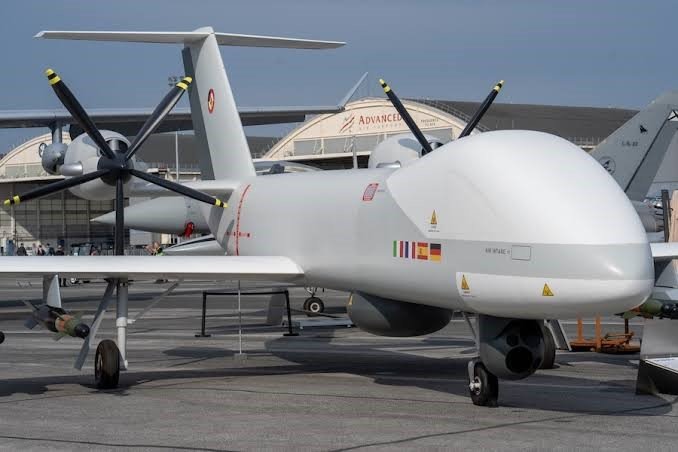
New Delhi: India is evaluating the anti‑submarine warfare (ASW) Eurodrone variant, jointly developed by Airbus and Kawasaki, as a new layer in its maritime defence. This system, capable of deploying sonobuoys and lightweight torpedoes, would complement India’s existing P‑8I Poseidon aircraft and MQ‑9 Sea Guardian drones, strengthening surveillance against Pakistan’s Hangor‑class and China’s large submarine fleet, according to media reports.
The drone would add a new anti‑submarine asset to India’s layered defence approach, complementing P‑8I aircraft and Sea Guardians, and enabling persistent patrols and manned–unmanned operations. This reflects the urgency driven by Pakistan inducting Chinese Hangor‑class submarines and China operating around sixty submarines in the Indo‑Pacific.

The Eurodrone ASW variant has entered the spotlight as a potential game‑changer for India’s maritime security. Co‑developed by Japan’s Kawasaki and Airbus, it is designed for long‑endurance patrols with sonobuoy deployment and lightweight torpedoes.
This capability could dramatically improve India’s ability to detect and track submarines across the Arabian Sea and Bay of Bengal. Its development underscores a global shift towards unmanned platforms for high‑risk, high‑coverage missions in contested waters. India’s current maritime surveillance relies on a dozen P‑8I Poseidon aircraft, with six more on order, and fifteen MQ‑9 Sea Guardian drones expected from a 2024 US deal. The Eurodrone’s integration could enable manned–unmanned teaming, where drones conduct wide‑area detection while manned aircraft execute targeted responses.
This approach reduces operational strain on expensive platforms and fills surveillance gaps across both coasts without proportionally increasing fleet size. The Indian Navy already operates IAI Heron drones and has ordered Drishti‑10 drones based on the Elbit Hermes 900, showing its commitment to expanding unmanned surveillance capabilities.
Persistent surveillance is a key advantage. Long‑endurance drones equipped with sonobuoys can patrol vast ocean areas for extended periods, allowing India to monitor Chinese submarine activity more effectively across the Arabian Sea and Bay of Bengal.

Manned–unmanned teaming, already being trialled by Japan with Kawasaki P‑1 aircraft, could be replicated by India with its P‑8I fleet, letting drones handle wide‑area detection while aircraft focus on precision strikes. Cost‑effective coverage is another benefit, as drones reduce the burden on expensive surface vessels and manned aircraft, freeing them for other missions.
Rising submarine threats are driving urgency. Pakistan is set to induct eight Chinese‑origin Hangor‑class submarines, while China already operates around sixty submarines, increasing the complexity of India’s maritime threat environment.

Historical incidents, such as the sinking of INS Khukri in 1971 by a Pakistani submarine, reinforce the strategic necessity of robust anti‑submarine capabilities. The Eurodrone’s persistent surveillance could help pre‑empt such threats by extending detection ranges and reducing adversary stealth advantages.
Future scenarios for India’s maritime surveillance suggest that if India adopts the Eurodrone ASW variant, one plausible outcome is a significant enhancement of undersea domain awareness, deterring adversary submarine operations in the Indian Ocean.
Alternatively, delays in procurement or integration could leave gaps in coverage, especially as Pakistan’s and China’s submarine capabilities mature. In either case, the move signals India’s recognition that autonomous, persistent surveillance will be central to securing its maritime interests in the coming decades.






