


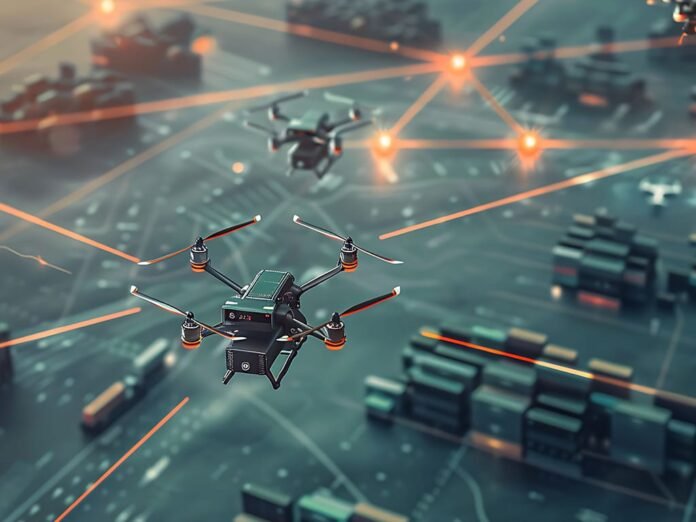
New Delhi. The era of remotely piloted drones guided by a human hand may be drawing to a close. Autonomous coordination firm Tashi Network and Indian UAV and defence solutions provider DroneVerse have unveiled autonomous, edge-native drone swarms after successful live tests of drones capable of continuing operations even when some lose connectivity, run low on battery, or return to base.
The trial was conducted in the Delhi region, demonstrating how a decentralised mesh keeps missions going even when individual drones drop out, batteries run low, or links back to base are intermittent. It was among the first demonstrations of its kind on Indian soil, and arrives at a moment of intense global competition to field intelligent, networked aerial systems.

The field trials were executed across a comprehensive 72-hour operational evaluation window, deploying scalable, multi-aircraft autonomous tactical cells tasked with securing a 20,000-square-metre simulated contested perimeter through high-frequency, 30-minute rapid-tasking cycles.
Two high-stakes scenarios were put to the test. In the first, multirole tactical drones executed a coordinated find-fix-finish mission over a predefined perimeter. Surveillance drones searched a designated area for targets, and once a target was detected, reconnaissance drones relayed the information and sought approval from a human operator. After authorisation was granted, the drones coordinated the rest of the mission autonomously.
In the second scenario, a simulated search-and-rescue operation saw the drone swarm automatically partition a ground sector into equal slices. Mid-mission, one aircraft returned to base on low battery. Rather than leaving a tactical blind spot, the remaining drones instantly renegotiated the flight plan at the edge, autonomously re-routing to absorb the abandoned sector while maintaining a unified, shared source of intelligence.
At the heart of the system is what Tashi Network calls its Vertex coordination fabric. Every participating drone operates as an equal peer on a shared Directed Acyclic Graph (DAG) mesh, continuously exchanging state, intent, and tasking. If a platform drops, the remaining units already hold the global plan and deterministically redistribute the workload. This architecture eliminates the single point of failure that has long been the Achilles’ heel of conventional drone operations, which rely on a ground control station that can be jammed, disabled, or destroyed in contested environments.

Amar Bedi, CEO of Tashi Network, framed the breakthrough in stark terms. “Most so-called autonomous systems fall apart the moment the link to their master is jammed, drops, or lags. In these trials we proved the opposite. Humans stay in the loop for intent, but machines handle the millisecond-by-millisecond choreography. We are moving from remote-controlled fleets to thinking swarms,” he said.
Pawan Khatri, Founder and CEO of DroneVerse, said the trial was designed not merely to test drones but to validate an entire autonomous ecosystem, noting that customers in defence and internal security want teams of drones that can think together across different vendors. DroneVerse’s credentials in this space are well established: the Gurugram-based company previously demonstrated its Rudra-7 FPV drones and Counter-UAS systems to the Indian Army in Ladakh at altitudes of up to 18,000 feet, where thin air, freezing temperatures, and turbulent winds pose severe challenges to aerial platforms.

The timing reflects a broader national urgency. The Indian Army’s first-ever technology roadmap for unmanned aerial systems and loitering munitions, released in April, outlines a structured vision for integrating drones into the Army’s operational framework over the coming years. Global defence budgets have tilted decisively toward massed, networked uncrewed systems, while the US Pentagon’s proposed $54.6 billion autonomous warfare push underscores the massive global pivot toward AI-enabled autonomous warfare.
Following the successful field trial, Tashi and DroneVerse plan to expand testing to larger drone formations, more complex mission scenarios, and mixed payload configurations. For India’s defence planners, the message is unambiguous: the future of aerial warfare will not be won by individual platforms, but by intelligent swarms that think, adapt, and act as one.






