


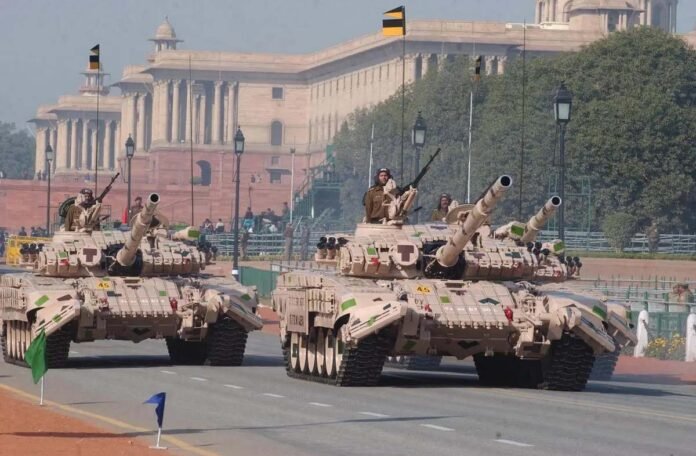
In a move aimed at giving India’s defence manufacturing ecosystem long-term business certainty, the Indian Army has approved a five-year pipeline of restoration and modernisation orders worth more than ₹75,000 crore for its ageing fleet of Soviet-origin tanks and armoured vehicles.
The decision addresses a persistent demand from the defence industry, including public sector units and MSMEs, which have long maintained that sustained order viability is essential for investment in capacity, technology and supply chains, since companies cannot build manufacturing capability or expand vendor networks on the basis of short-term contracts, particularly when the armed forces are their principal customer.

The pipeline covers life-cycle upgrades of the Army’s T-72 “Ajeya” and T-90 “Bhishma” tanks, infantry combat vehicles (BMPs) and Armoured Recovery Vehicles (ARVs). Under the programme, 790 T-72 tanks will be restored over five years at a cost exceeding ₹13,000 crore.
State-run Armoured Vehicles Nigam Limited (AVNL) will execute the work through its Vehicle Factory Jabalpur unit, supported by an ecosystem of around 1,200 MSMEs and start-ups.
AVNL had already completed the restoration of two T-72 tanks as a pilot project earlier this year, which were flagged off in January 2026 at a ceremony where Lieutenant General Aujla commended the Vehicle Factory Jabalpur team for completing the challenging task on schedule and signalled that a larger overhaul assignment would follow.
A further 200 T-90 tanks will undergo phased restoration over the next five years at an estimated cost of ₹56,000 crore, while the Army has also cleared the modernisation of 500 BMP infantry combat vehicles for under ₹5,000 crore, to be carried out at AVNL’s Ordnance Factory Medak, which has achieved more than 90 per cent indigenisation on the platform.

Additionally, the restoration of 230 Armoured Recovery Vehicles over five years has been approved at a cost of about ₹1,400 crore.
The restoration programme is designed to bring these platforms to what officials describe as a “near-zero-hour, zero-kilometre” state of operational readiness, by replacing worn mechanical, electronic and engineering systems and significantly extending the vehicles’ service life.

Army sources indicate the upgraded platforms will retain only their basic structures while being fitted with new-generation equipment. In a notable addition, the tanks will for the first time be equipped with drones for intelligence, surveillance, reconnaissance and combat roles, a change officials attribute to lessons drawn from the Russia-Ukraine conflict.
The overhaul will involve replacing parts, sub-assemblies and assemblies wherever necessary, and is also expected to reduce India’s dependence on imported spares and maintenance support – an issue that gained urgency after Russia’s war in Ukraine complicated the supply of spare parts and components for Soviet-origin platforms.
The move builds on years of indigenisation work by AVNL, which has already achieved indigenisation levels of 96 per cent for the T-72, 80 per cent for the T-90 and 98.5 per cent for the BMP-II infantry combat vehicle.
The company has continued to reduce reliance on Russian suppliers, having previously demonstrated the ability to independently service tank engines and components using indigenous parts.
The ₹75,000-crore pipeline sits alongside a broader run of large defence procurement approvals in India over the past year. The Defence Acquisition Council has cleared proposals worth ₹2.5 lakh crore so far in the current financial year, surpassing last year’s total, as India’s defence budget climbs to ₹6.8 lakh crore.
Industry watchers expect the assured, multi-year order flow to particularly benefit public-sector units and the wider MSME supplier base tied to armoured vehicle manufacturing, reinforcing the government’s broader push toward self-reliance in defence production.






