


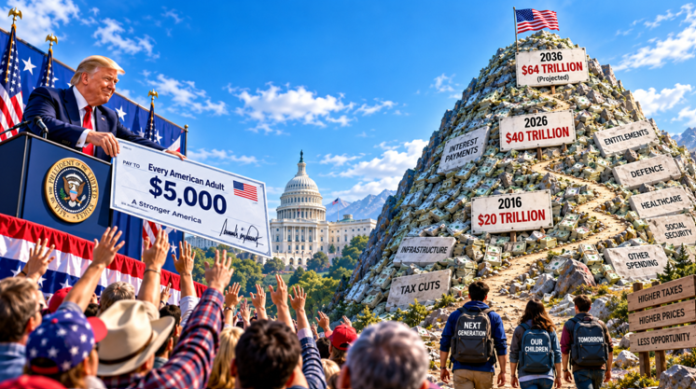
A $5,000 cheque sounds irresistible when it is somebody else who is promising to write it. At the Republican midterm convention in Dallas, President Donald Trump promised a $5,000 “dividend” to every adult American if Republicans retain control of Congress in the November 2026 elections.
Depending on eligibility, the proposal could cost roughly $1.2–1.35 trillion, an extraordinary sum even by Washington standards. Trump has suggested that tariff revenues could finance the payment, but current tariff collections are nowhere near sufficient to cover a programme of this scale without other financing.

The political attraction is obvious. For a household struggling with rent, groceries, medical expenses or a mortgage, $5,000 is real money. But the economic question is considerably less attractive: when a government promises free money, who ultimately pays for it?
That question becomes even more uncomfortable when the country making the promise is already sitting on a mountain of debt. The $5,000 cheque may be the headline, but the debt beneath it is the real story.
Promising every adult American a $5,000 cheque sounds like instant relief, but a $1.3 trillion political gift carries a steep hidden price tag. When governments hand out free money, they merely trade immediate voter goodwill for tomorrow’s economic burden
America has Been Borrowing at Historic Speed
The numbers tell a remarkable story. America’s gross federal debt was around $20 trillion a decade ago; it is now above $40 trillion; and the Congressional Budget Office (CBO) projects it to reach approximately $64 trillion by the end of 2036 under its current baseline.
In other words, a debt mountain that took more than two centuries to reach $20 trillion has roughly doubled in about a decade and is projected to add another $24 trillion over the next ten years.

The danger lies not simply in the size of the number but in its momentum. CBO projects a federal deficit of $1.9 trillion in 2026, rising to $3.1 trillion in 2036, meaning that America is not merely carrying yesterday’s debt; it is continuing to borrow heavily to finance today’s spending.
Even more worrying, debt held by the public is projected to rise from 101 per cent of GDP in 2026 to 120 per cent in 2036, surpassing America’s previous post-war peak.

America’s national debt has doubled to over $40 trillion in just a decade and is accelerating toward a staggering $64 trillion. The nation is no longer simply managing its debt mountain -it is relying on perpetual borrowing just to function
This changes the character of the problem. America is no longer merely living with debt. It is increasingly living through debt.
Living on a Mountain of Debt
Debt itself is not a sin. Great nations borrow, particularly during wars, recessions, pandemics and national emergencies. Borrowing to build infrastructure, finance productive investment or bridge a temporary crisis can strengthen a country’s future capacity to repay. The problem begins when borrowing becomes a permanent substitute for difficult choices and when governments borrow not principally to create tomorrow’s wealth, but to finance today’s consumption.
That is where America’s trajectory becomes dangerous. The federal government must continually refinance existing obligations while running fresh deficits, and the cost of carrying that mountain is rising.
CBO projects net interest outlays to increase from about $1 trillion in 2026 to $2.1 trillion in 2036. By then, interest payments alone would consume an amount approaching the entire federal discretionary budget.
By 2036, US’s net interest payments alone are projected to consume more than $2 trillion annually, surpassing the entire discretionary budget. Every dollar surrendered to service past borrowing is a dollar stolen from national defence, infrastructure, and future innovation
Think about the strategic implication. Every dollar spent servicing old debt is a dollar that cannot be spent on defence, infrastructure, research, education or a future crisis.
Debt therefore does not merely create a financial burden; it progressively reduces the strategic freedom of a nation.
The US Government Accountability Office (GAO) has already described America’s fiscal trajectory as unsustainable, warning that publicly held debt is growing faster than the economy and poses economic, national-security and societal risks.
GAO notes that interest spending in fiscal 2025 exceeded federal spending on national defence and is expected to keep growing.
Issuing the world’s reserve currency buys Washington time, but even the world’s largest economy cannot defeat simple arithmetic. When publicly held debt grows faster than GDP, even deep capital markets cannot protect a nation from fiscal reckoning
The most dangerous feature of a debt mountain is that it can appear stable – until circumstances change. A country may comfortably refinance debt while investors remain confident, interest rates remain manageable and economic growth remains strong.
But if borrowing costs rise, growth weakens or confidence deteriorates, yesterday’s manageable obligation can rapidly become tomorrow’s fiscal constraint.
A mountain does not become safe merely because the climber has been climbing it for years.
Is This Sustainable?
America possesses advantages that few other countries enjoy. It has the world’s largest economy, deep and liquid capital markets, an exceptionally strong institutional framework and the extraordinary privilege of issuing the world’s principal reserve currency.
US Treasury securities remain central to the global financial system, giving Washington borrowing capacity unavailable to most governments.
But the capacity to borrow is not the same as the capacity to borrow indefinitely.
Dangling cash payouts on the eve of elections transforms democratic governance into a high-stakes political auction. While structural reform requires patience, immediate giveaways offer instant electoral rewards while deferring the bill to future voters
That distinction matters. The reserve-currency advantage can buy time; it cannot repeal arithmetic. If debt consistently grows faster than the economy that supports it, the ratio eventually becomes harder to manage.
GAO’s warning is therefore significant precisely because it does not come from a political campaign or an ideological think tank.
America’s own government watchdog says the current fiscal path is unsustainable and calls for a long-term strategy to bring spending, revenues and debt onto a more sustainable trajectory.
The question America must therefore confront is not whether it can afford one more programme. It is whether the world’s most powerful economy can continue adding programmes, tax concessions, subsidies, emergency measures and electoral promises while postponing the larger question of fiscal balance.
Enter the Freebie Economy
This is where the $5,000 Trump dividend becomes more than an American political curiosity. It illustrates a broader transformation in democratic politics: the conversion of public finance into electoral finance.
The proposal is not legally conditioned on an individual voter casting a particular ballot, and that distinction is important. But politically, the timing is unmistakable: retain Republican control of Congress and a large payment may follow.
The proposal would still require congressional approval, and even within Republican circles there has been scepticism about its fiscal implications.
The deeper issue is not whether this particular proposal survives Congress. It is the political incentive behind such promises.
A government undertaking structural reform asks citizens for patience. A government rebuilding fiscal discipline asks citizens to accept difficult choices.
A government investing in productivity may take years before the benefits become visible. But a cheque is immediate, tangible and politically memorable.
This creates a dangerous asymmetry. The political reward from a giveaway arrives today; the fiscal cost arrives tomorrow. And tomorrow rarely votes in the next election.
The Freebie is Never Free
There are only a few ways to finance a large government giveaway. It can be paid for through higher taxes, spending cuts, existing revenues, new borrowing or some combination of them.
If it is financed through borrowing, the government has not eliminated the cost; it has transferred it into the future, with interest attached.
That is why the argument that tariffs can finance the dividend deserves scrutiny. Tariffs are ultimately taxes on imports, with their economic burden distributed through importers, businesses and consumers.
Financing trillion-dollar promises through tariffs or borrowing risks driving up consumer prices and interest rates even further. A government may hand citizens $5,000 with one hand, only to erode their purchasing power with the other
Even if tariff revenues rise substantially, they do not magically become free money. Reuters reported that current tariff revenues fall far short of what would be required to finance a $5,000 payment to every adult without adding to the deficit.
There is another danger. Injecting more than a trillion dollars into an economy already experiencing inflationary pressures can stimulate consumption without proportionately increasing productive capacity.
Economists have warned that such a large fiscal injection could add to inflation and borrowing costs.
The irony is almost cruel: a government could hand citizens $5,000 while simultaneously making some of the things they need more expensive.
Governments can distribute money with extraordinary ease; creating the wealth to pay for it is considerably harder.
Ballot Box on Auction
America is not alone in facing this temptation. Democracies everywhere have discovered the electoral attractiveness of subsidies, rebates, loan waivers, free utilities, cash transfers and other benefits.
Many are legitimate and necessary forms of social protection, particularly for citizens who genuinely need assistance. The problem begins when welfare becomes a permanent instrument of electoral competition rather than a carefully designed instrument of public policy.
Once citizens become accustomed to government giving them something before every election, removing the giveaway becomes politically difficult.
One party offers a benefit; another offers a larger one. The contest gradually shifts from who can govern better to who can promise more.
The ballot box then becomes an auction, while the national treasury becomes the credit card.
There is a profound intergenerational injustice hidden in this arrangement. The voter receiving today’s benefit may enjoy it immediately, while a younger American entering the workforce tomorrow inherits a larger debt, higher interest burden and potentially fewer fiscal choices.
Today’s cash handouts create an unfair legacy, rewarding current voters while saddling the next generation with compounding debt. Political cycles expire every few years, but the burden of sovereign borrowing weighs on working families for decades
The political cycle lasts four years; sovereign debt can last generations.
What Should a Great Government Promise?
A mature democracy should not measure prosperity by how much money its government can distribute. It should measure prosperity by how much productive capacity it can create.
The better dividend is a functioning infrastructure network, competitive industry, world-class research, quality education, affordable healthcare, secure energy, technological leadership and an economy in which citizens can earn more because productivity is rising.
Government should create the conditions in which a family can generate an additional $5,000 through opportunity rather than repeatedly depend upon receiving $5,000 through political generosity.
There is nothing inherently wrong with helping citizens. But social protection should protect society, not become a substitute for economic strategy.
America’s challenge is therefore larger than Trump and larger than one election. It is the challenge of reconciling the expectations of a prosperous democracy with the arithmetic of a heavily indebted state.
The numbers are already delivering the warning. Around $20 trillion became $40 trillion; CBO now projects roughly $64 trillion by 2036. Interest costs are rising rapidly, debt is growing faster than the economy, and America’s own fiscal watchdog is calling the trajectory unsustainable.
A $5,000 dividend may put a smile on a household’s face. But if it is financed by another trillion dollars of borrowing, it also places another stone on a mountain that future generations will have to climb.
For a government, freebies can be politically useful. For a voter, they can be economically welcome. But for a nation already carrying a mountain of debt, every new promise must eventually confront the same unforgiving question: where will the money come from, and who will pay when the cheque has been spent?
A great nation builds wealth by raising productive capacity, investing in quality education, and creating high-paying opportunities. Real prosperity means enabling families to earn an extra $5,000 through economic growth, rather than relying on state giveaways
Because a great nation can borrow to survive a crisis, and it can borrow to build its future. What it cannot safely do forever is borrow simply to make the present more comfortable.
Freebies may win elections. But eventually, the bill comes due – and it rarely arrives at the doorstep of the politician who promised them.

Lt Gen Rajeev Chaudhry (Retd) writes on contemporary national and international issues, strategic implications of infrastructure development towards national power, geo-moral dimension of international relations, and leadership nuances in a changing social construct. The views expressed are of the author and do not necessarily reflect the views of Raksha Anirveda





