



Friday, September 11, was technically the “pre-summit” day of BRICS 2026 – the leaders’ sessions proper begin Saturday – but it did more to set the tone of this year’s gathering than any single moment likely will over the following two days.
Russian President Vladimir Putin landed in the capital early, Iranian President Masoud Pezeshkian followed for his first visit to India since taking office, and the BRICS Business Forum at Bharat Mandapam became the venue where India’s economic diplomats road-tested the language they want the bloc’s 20th anniversary summit to be remembered for.

That language was carefully calibrated. Commerce Minister Piyush Goyal urged BRICS members to integrate their payment systems, settle more trade in each other’s currencies, and expand digital commerce, holding up India’s Unified Payments Interface (UPI) – now processing over 250 billion transactions annually and accepted across 11 countries – as a model for the bloc to build on.
Hormuz anxiety runs through everything. With 30% of India’s oil transiting the strait, PM Modi pressed Putin and Pezeshkian alike on securing sea lanes and freedom of navigation
External Affairs Minister S Jaishankar, at the same forum, pitched India’s scale, manufacturing momentum and talent base as assets for the bloc’s next phase, while framing the broader goal in defensive rather than confrontational terms: greater intra-BRICS economic activity, he argued, would translate into greater self-reliance and a stronger ability for member economies to withstand external shocks while staying globally competitive.
None of this happened in a vacuum. It unfolded against a backdrop of compounding global economic stress – the still-unresolved Russia-Ukraine war, the US-Iran conflict that has effectively choked shipping through the Strait of Hormuz, and Washington’s tariff offensive.
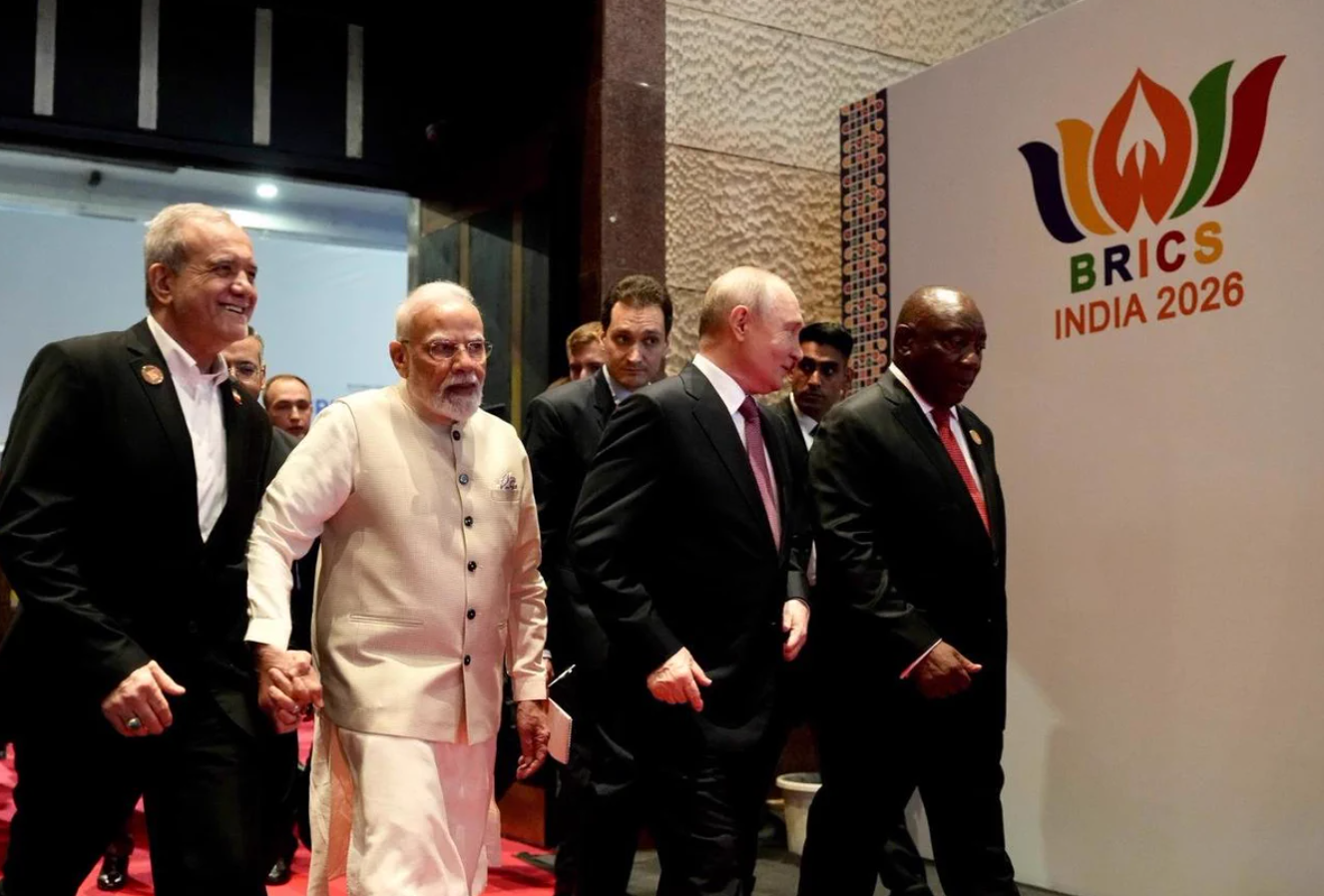

That triad – Ukraine, Hormuz, tariffs – is effectively the subtext of everything said in Delhi on Friday, and it explains why India has gone out of its way to insist that none of this amounts to a coordinated tilt against the dollar.
Trump has for over a year threatened BRICS nations with steep tariffs – as high as 100% – should the bloc create or back a rival currency, and India has been the most consistent voice inside BRICS resisting the “anti-dollar” framing even as it pushes local-currency settlement on practical grounds.

Goyal’s pitch: link UPI, not ditch the dollar. India wants payment-system integration and local-currency trade – but insists it isn’t de-dollarisation
A retired Indian diplomat, asked how much US pressure is shaping this year’s agenda, argued that aggressive tariff threats can be self-defeating, forcing exactly the diversification away from the dollar that Washington wants to prevent – but cautioned that the dollar’s depth and the absence of a credible alternative mean it isn’t going anywhere soon.

The Strait of Hormuz supplied Friday’s most pointed geopolitical moment. With roughly 30% of India’s oil imports transiting the waterway and Iran’s confrontation with the US and Israel unresolved, PM Modi used his engagements – first with Putin, then with Pezeshkian – to underline that global trade cannot function unless sea lanes and supply routes stay open and secure.
The Modi-Pezeshkian meeting, their first since the West Asia conflict escalated, saw the Iranian president press New Delhi and other BRICS members on the New Development Bank as a channel for sanctions relief outside the dollar system – a pitch India is unlikely to embrace given its parallel investment in ties with Washington and Jerusalem.
Pezeshkian’s Delhi visit was his first since taking office – and came as Iran pushed the New Development Bank as a sanctions-relief channel
Putin, for his part, used his own forum remarks to needle the G7 directly, asserting that BRICS economies have contributed a far larger share of global GDP and growth over the past five years than the G7 has, and crediting the size and vitality of BRICS’ domestic markets for that outperformance.
What was most conspicuous on Delhi’s first BRICS day, though, was what didn’t happen: the city wasn’t wrapped in bunting. Commentators have repeatedly contrasted this year’s understated build-up with the elaborate 2023 G20 spectacle, when the capital was decked out in murals, illuminated fountains and wall-to-wall branding ahead of Joe Biden’s arrival – a level of public mobilisation nowhere in evidence this time.
Publicity for BRICS has stayed largely technical, built around sectoral meetings on energy, trade and youth rather than a sweeping national campaign. Analysts tracking the shift argue this isn’t accidental: summit spectacle tends to lose its political payoff with repetition, and 2023’s G20 moment reflected a fortunate, hard-to-repeat alignment of India’s diplomatic standing with a leadership style built for narrative projection.
No G20-style spectacle this time. Analysts say the muted build-up reflects both a harder-to-manage 11-member bloc and the fading political returns of repeated summit theatre
BRICS is also a structurally harder forum to stage-manage – its expansion to include Iran, the UAE, Egypt, Ethiopia and Indonesia has folded-in members with real friction among themselves, a dynamic one described as awkward for a grouping that depends on consensus to function.
That tension between ambition and caution runs through India’s entire BRICS chairship. New Delhi wants the bloc’s financial-integration agenda – UPI linkages, a BRICS Pay mechanism, local-currency settlement – to advance, because it serves India’s own commercial interests and its long-standing complaint about non-tariff barriers costing exporters more than tariffs themselves.
But it does not want to be cast, in Washington’s eyes, as the architect of a dollar-alternative bloc. It wants Xi Jinping’s first visit to India since the 2020 Ladakh standoff to symbolise a genuine thaw, while still deepening the Quad with the US, Japan and Australia. And it wants to be seen leading the Global South without becoming, as one commentator put it, an “anti-Western bloc” – demonstrating instead that multipolarity need not mean disorder.
The real test is Saturday. Friday’s forum speeches set the tone; whether leaders can agree on a joint declaration covering Hormuz, Ukraine and financial reform will define the summit’s substance
Friday’s proceedings suggest India believes that balancing act is achievable through deliberately unglamorous diplomacy: business-forum speeches about payment rails and market access, bilateral meetings that manage rather than resolve hard security questions, and a summit atmosphere pitched several notches below G20 intensity.
Whether that quieter approach yields a substantive declaration when leaders formally convene on Saturday – on Hormuz, on Ukraine, on de-dollarisation, on reforming global governance – will determine if September 11 was merely prologue or the moment BRICS 2026’s real character was set.

-The writer is a New Delhi-based senior commentator on international and strategic affairs, environmental issues, an interfaith practitioner, and a media consultant. The views expressed are personal and do not necessarily carry the views of Raksha Anirveda





