


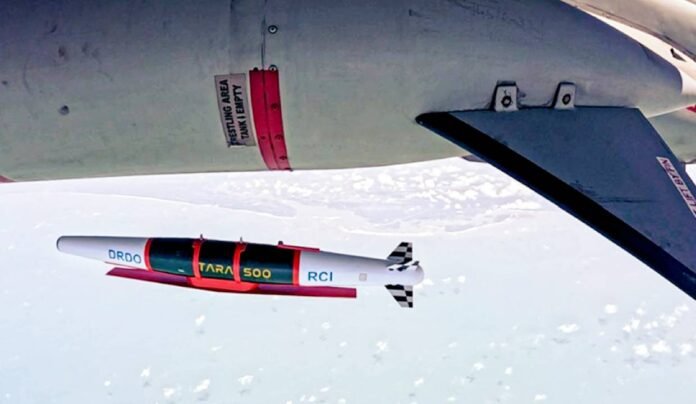
New Delhi. India on Thursday, May 7 achieved a major milestone in indigenous defence technology with the successful maiden flight trial of the Tactical Advanced Range Augmentation (TARA) weapon system, an indigenous glide weapon designed to convert conventional bombs into precision-guided munitions. The test was jointly conducted by the Defence Research and Development Organisation (DRDO) and the Indian Air Force (IAF) off the Odisha coast.
According to the Ministry of Defence, TARA is India’s first indigenous glide weapon system and represents a significant step in enhancing the country’s stand-off strike capability using low-cost precision-guided technology. Developed by Hyderabad-based Research Centre Imarat (RCI) along with other DRDO laboratories, the system is aimed at improving the lethality and accuracy of existing unguided warheads.

The maiden trial was carried out from a Jaguar fighter aircraft of the Indian Air Force. Defence officials said the test successfully validated the weapon’s release mechanism, guidance, navigation and flight performance parameters.
TARA functions as a modular range extension kit that can be attached to conventional “dumb bombs”, converting them into smart glide weapons capable of striking targets with high precision from a safe stand-off distance. Military experts say such systems significantly enhance combat aircraft survivability by allowing pilots to engage targets without entering heavily defended enemy airspace.
The Defence Ministry described the development as an important advancement in India’s push for self-reliance in critical military technologies under the “Aatmanirbhar Bharat” initiative. Defence Minister Rajnath Singh congratulated DRDO, the IAF and industry partners involved in the programme, calling the successful trial a “significant development in advancing India’s indigenous defence capabilities.”
Officials said one of the major advantages of TARA is its low-cost architecture. Unlike expensive imported precision-guided munitions, the indigenous kit allows the armed forces to upgrade existing conventional bomb inventories into smart weapons without major modifications.

The system has been developed under the Development-cum-Production Partner (DcPP) model, involving Indian private industry partners, and production activities have already commenced. Defence analysts view this as another example of increasing collaboration between DRDO and domestic defence manufacturers in the development of advanced weapons systems.
Available technical details suggest that TARA uses wing and tail guidance kits to extend the range of air-dropped bombs while maintaining accuracy. Reports indicate that future versions may incorporate electro-optical and infrared guidance systems for enhanced precision strike capability.

The successful trial places India among a select group of countries possessing indigenous glide weapon technologies capable of converting legacy warheads into precision-guided stand-off weapons. Defence experts say such systems are increasingly becoming central to modern warfare due to their ability to deliver accurate strikes at lower operational costs.
The TARA test also comes amid a broader push by India to strengthen its indigenous precision-strike arsenal. Over the past few years, DRDO has accelerated work on systems such as the Smart Anti-Airfield Weapon (SAAW), the Gaurav long-range glide bomb and advanced hypersonic missile technologies.
Defence observers believe TARA could eventually be integrated with multiple fighter platforms including the Jaguar, Su-30MKI and the indigenous LCA Tejas, providing the Indian Air Force with an affordable precision-strike option for tactical operations.
The successful maiden trial is expected to pave the way for further developmental and user trials before eventual induction into the armed forces. Officials indicated that the programme will continue to undergo refinement and operational validation in the coming months as India expands its indigenous smart weapons capability.






