


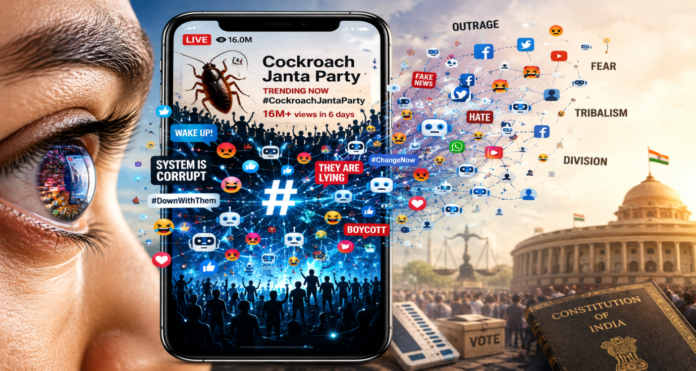
The Day Public Opinion Became Programmable: Democracy was designed for an age of newspapers, public debate and human-paced politics. It was never designed for an age where algorithms can emotionally influence millions within hours and where digital ecosystems can manufacture political momentum almost overnight.
The recent emergence of the so-called ‘Cockroach Janta Party’ in the virtual space offers a glimpse into this unsettling future. Within barely a week, the phenomenon reportedly attracted nearly 22.2 million viewers online — not through traditional political organisation, ideology or grassroots mobilisation, but through pure algorithmic virality, meme culture and digitally amplified engagement. Whether satirical, experimental or politically symbolic, its explosive rise demonstrates how rapidly public attention can now be converted into political energy.

That is the real disruption
For most of modern history, destabilising governments required wars, economic collapse, coups or years of sustained political mobilisation. Today, emotionally charged narratives, bot amplification and algorithm-driven outrage can shape public perception at unprecedented speed. Ten years from now, the ability to influence political sentiment may not take months or weeks. It may take only days.
Social media platforms — originally built to connect humanity — are increasingly evolving into powerful psychological ecosystems where outrage spreads faster than truth, tribal identity outperforms nuance, and emotional manipulation often overwhelms institutional stability.
The danger is no longer misinformation alone.

The greater danger is that democracy itself is entering an algorithmic age for which its institutions were never prepared.
The recent emergence of the ‘Cockroach Janta Party’ in the virtual space offers a glimpse into this unsettling future. Within barely a week, the phenomenon reportedly attracted nearly 22.2 million viewers online, not through traditional political organisation, ideology or grassroots mobilisation, but through pure algorithmic virality, meme culture, and digitally amplified engagement
The New Age of Digital Mobilisation
Traditional political movements once required ideology, organisation, leadership and years of grassroots mobilisation.

Social media has compressed all of that dramatically. Today:
- A hashtag can become a national movement overnight.
- A manipulated clip can inflame entire communities within hours.
- Anonymous influencers can shape political narratives without accountability.
- Digital outrage can pressure governments before facts are even established.
Attention itself has become political power.
The recent emergence of virtual political ecosystems attracting millions within days reveals how rapidly public emotions can now be mobilised online. Democracies, however, still function at an analogue speed. Courts deliberate slowly. Governments investigate cautiously. Institutions require due process. Social media demands instant emotional reaction.
This mismatch is creating structural instability across democracies worldwide.
The problem is compounded by algorithms designed not to protect truth or stability, but to maximise engagement. And nothing generates engagement more effectively than fear, anger, humiliation and conflict.
As a result, entire societies are slowly becoming emotionally hyper-reactive.
Social media platforms, originally built to connect humanity, are increasingly evolving into powerful psychological ecosystems where outrage spreads faster than truth, tribal identity outperforms nuance, and emotional manipulation often overwhelms institutional stability
How Digital Ecosystems Are Shaping Political Instability
The use of digital ecosystems for political destabilisation is no longer theoretical. Variations of it are already visible across multiple countries.
In Bangladesh, social media has repeatedly amplified political polarisation, religious tensions and anti-government mobilisation at extraordinary speed. Narratives spread online often outpace official communication, creating emotional surges before institutional responses can stabilise the situation.
In Nepal, digital narratives increasingly shape political sentiment, nationalism and anti-establishment mobilisation, often fuelled by misinformation, emotional rhetoric and coordinated online campaigns.
Similar patterns have emerged globally:
- Coordinated influence campaigns during elections.
- AI-generated misinformation.
- Bot-driven amplification.
- Foreign interference operations.
- Digitally accelerated protests.
- Targeted identity polarisation.
The objective of such operations is often not ideological persuasion alone. The deeper objective is erosion of trust: distrust in institutions, distrust in media, distrust in elections, distrust between communities, and ultimately distrust in the very idea of shared national identity.
A divided society becomes easier to manipulate.
For hostile state actors, extremist groups or covert influence ecosystems, social media provides an extraordinarily cost-effective tool of disruption. Destabilisation that once required covert intelligence operations can now be amplified through anonymous digital networks operating across borders.
This is psychological warfare on a population scale.
The emergence of virtual political ecosystems attracting millions within days reveals how rapidly public emotions can now be mobilised online. Democracies still function at an analogue speed, courts deliberate slowly, and governments investigate cautiously. Social media demands instant reaction. This mismatch is creating structural instability across democracies worldwide
The Future: Programmable Public Opinion
The coming decade may transform this challenge into something far more dangerous.
Artificial intelligence is already capable of generating: realistic fake videos, cloned voices, synthetic speeches, personalised propaganda, automated outrage campaigns, and hyper-targeted emotional messaging. Soon, digital systems may predict and manipulate collective emotional behaviour with astonishing precision.
Public opinion itself risks becoming programmable.
This creates a profound challenge for democratic governance. Democracies depend fundamentally on informed citizens making rational choices based on shared facts and institutional trust. The danger is not merely misinformation. The danger is epistemic collapse — a condition in which societies no longer agree on reality itself.
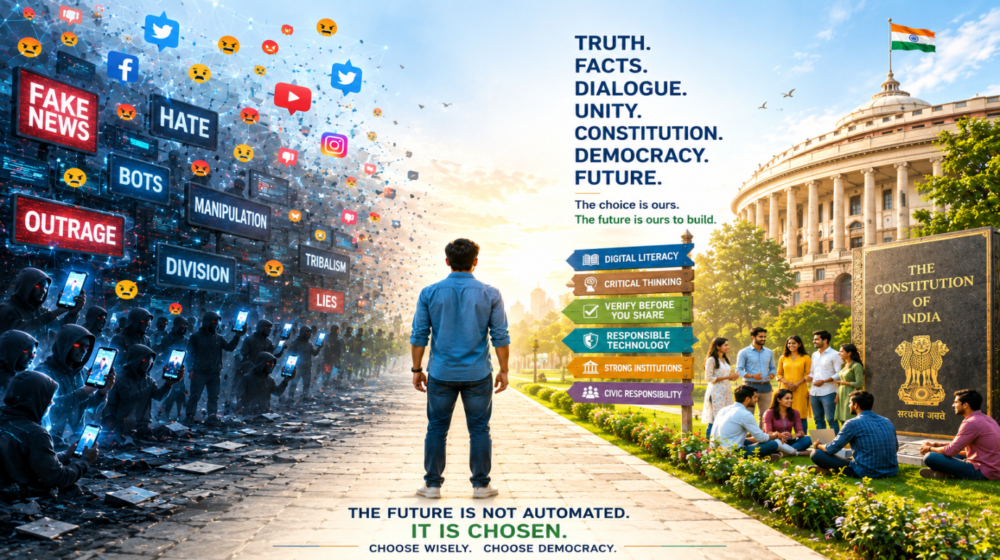
Without shared truth: consensus collapses, governance weakens, institutions lose legitimacy, and political stability becomes fragile. In such an environment, governments may find themselves trapped in perpetual reaction mode, unable to focus on long-term governance, economic development or national cohesion.
No nation can pursue sustained growth if it remains permanently consumed by digitally amplified outrage and psychological fragmentation.
The objective of such operations is often not ideological persuasion alone. The deeper objective is erosion of trust: distrust in institutions, distrust in media, distrust in elections, distrust between communities, and ultimately distrust in the very idea of shared national identity. A divided society becomes easier to manipulate
What Must Be Done Immediately
The answer is not authoritarian censorship. Democracies cannot survive by destroying freedom of expression.
But neither can societies remain passive while industrial-scale manipulation operates unchecked. Several urgent measures are necessary.
- Algorithmic Transparency: Technology platforms must disclose how political amplification functions and how emotionally manipulative content is prioritised.
- Identification of Coordinated Bot Networks: Anonymous industrial-scale influence operations should face strict scrutiny and accountability mechanisms.
- National Digital Resilience Frameworks: Governments must treat information warfare as a national security challenge, not merely a social media issue.
- AI Regulation: Deep-fakes and synthetic political propaganda require urgent legal and technological safeguards before they become uncontrollable.
- Digital Literacy at National Scale: Citizens must be educated to recognise manipulation, propaganda and emotionally engineered narratives.
- Faster Institutional Communication: Governments and institutions must learn to communicate rapidly, transparently and credibly in the digital domain before misinformation dominates public perception.
- Strengthening Civic Identity: Societies fragmented along religion, ethnicity, caste, language and ideology become easier targets for digital destabilisation. National cohesion is therefore no longer merely cultural — it is strategic.
Artificial intelligence is already capable of generating: realistic fake videos, cloned voices, synthetic speeches, personalised propaganda, automated outrage campaigns, and hyper-targeted emotional messaging. Soon, digital systems may predict and manipulate collective emotional behaviour with astonishing precision
The goal must not be the suppression of dissent. The goal must be the protection of democratic integrity from industrial-scale manipulation.
To sum up, the defining political struggle of the 21st century may not be fought only through armies, borders or economic sanctions. It may increasingly be fought through algorithms, perception management and the weaponisation of human emotion.
Democracy was built for human-paced politics. It was never designed for algorithmic civilisation. If societies fail to adapt, future governments may not fall because of military defeat or economic collapse alone. They may fall because public perception itself becomes continuously programmable through outrage ecosystems, AI-driven manipulation, and digitally amplified tribalism.
Technology is advancing exponentially. Human wisdom, institutional adaptation and democratic safeguards are not. That imbalance may become one of the greatest threats to peaceful governance in the modern age.

Lt Gen Rajeev Chaudhry (Retd) writes on contemporary national and international issues, strategic implications of infrastructure development towards national power, geo-moral dimension of international relations, and leadership nuances in a changing social construct. The views expressed are of the author and do not necessarily reflect the views of Raksha Anirveda





