


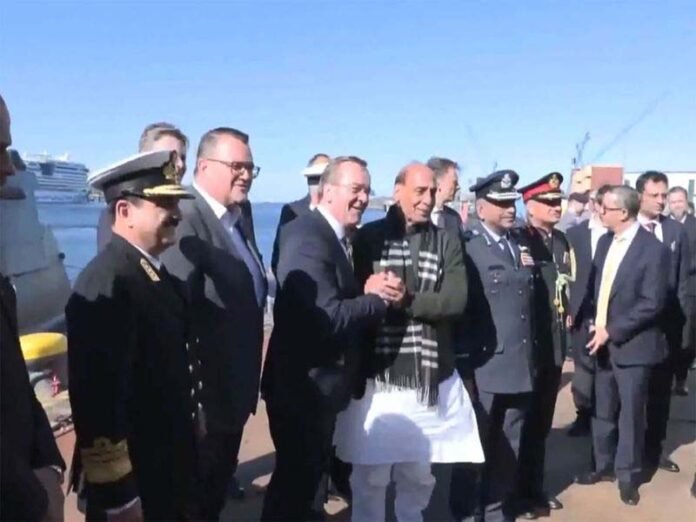
the global travel schedule of Defence Minister Rajnath Singh highlights a calculated evolution in New Delhi’s international security strategy. Moving away from historically transactional procurement ties, the Ministry of Defence has shifted to an integrated framework focused on hardware co-development, joint electronic warfare research, and localised military manufacturing. This diplomatic push directly mirrors the historic expansion of India’s domestic output, which reached an all-time high of ₹1.54 lakh crore ($18.5 billion). By actively engaging with partners in Western Europe, North Africa, and the Indo-Pacific, India is systematically becoming an essential security anchor in a multipolar global order.
The New Blueprints of Military-Industrial Engagement
The strategic deployment of defence diplomacy follows a dual-track approach that separates global engagements into the Indo-Pacific arch and contiguous security systems. In the Indo-Pacific, visits to nations such as Vietnam and South Korea focus heavily on BrahMos missile integration, artificial intelligence, cyber defence protocols, and defence acquisition alignment. Concurrently, the contiguous vector targets nations like Germany and Morocco to address subsurface production, drone architectures, and armoured platform overhauls.

The strategic results of these foreign tours reveal a highly purposeful matrix of kinetic milestones. In Vietnam, the integration of BrahMos coast defence systems alongside AI support builds a multi-layered maritime denial capacity in the South China Sea. In South Korea, the synergy between defence acquisition bodies and the establishment of cyber defence protocols secures crucial micro-electronic supply chains against sudden geopolitical disruptions. On the European front, the acceleration of subsurface co-production and drone architectures with Germany fast-tracks Project-75I to effectively bridge critical conventional submarine gaps. Finally, the construction of a dedicated Wheeled Armoured Platform manufacturing plant in Morocco establishes India’s initial military-industrial footprint on the African continent.
The Defence Minister’s talks with Germany centred on India’s critical Project-75I, a multi-billion dollar programme to build next-generation conventional attack submarines equipped with fuel-cell Air-Independent Propulsion systems. His visit overcame various hurdles by offering German shipbuilders a way to technology integration with Indian shipyards
The Western European Vector: Subsurface Parity and High-End Systems
The Defence Minister’s significant visit to Germany addressed long-standing, structural gaps within the Indian Navy’s conventional subsurface fleet. For decades, bureaucratic obstacles and differences over technology transfer slowed down defence industrial cooperation between New Delhi and Berlin. However, accelerating geopolitical changes in Eastern Europe and the Indian Ocean Region forced a strategic reset, clearing the path for the signing of a comprehensive Defence Industrial Cooperation Roadmap.
The operational core of the Berlin talks centred on India’s critical Project-75I, a multi-billion dollar programme to build next-generation conventional attack submarines equipped with fuel-cell Air-Independent Propulsion systems. By offering German shipbuilders like ThyssenKrupp Marine Systems a clear path for deep technology integration with Indian shipyards, the visit moved negotiations past long-standing impasses. This engagement successfully secured ironclad guarantees for joint manufacturing, which directly insulates India’s subsurface defences from unilateral parts embargoes. Beyond these critical subsurface systems, the bilateral framework established joint research and development pipelines for advanced Unmanned Aerial Vehicles, tactical military transport engines, and real-time cyber defence mechanisms.
Rajnath Singh’s historic trip to Morocco served as a practical case study for India’s evolving ‘Make in India, Make for the World’ export strategy. Marking the first-ever visit by an Indian Defence Minister to Rabat, this initiative shifted India’s relationship with African partners away from simple training programmes towards a deeply collaborative manufacturing model
The Mediterranean and North African Gateway: Anchoring the African Continent
The Defence Minister’s historic trip to Morocco served as a practical case study for India’s evolving “Make in India, Make for the World” export strategy. Marking the first-ever visit by an Indian Defence Minister to Rabat, this initiative shifted India’s relationship with African partners away from simple training programmes towards a deeply collaborative manufacturing model. This strategy relies heavily on the industrial foundation laid by Tata Advanced Systems Maroc, where the launch of the WhAP 8×8 facility at Berrechid marks India’s initial defence assembly plant on African soil. This operational footprint positions domestic military platforms directly into new African and Mediterranean security markets, bypassing traditional Western dependencies.

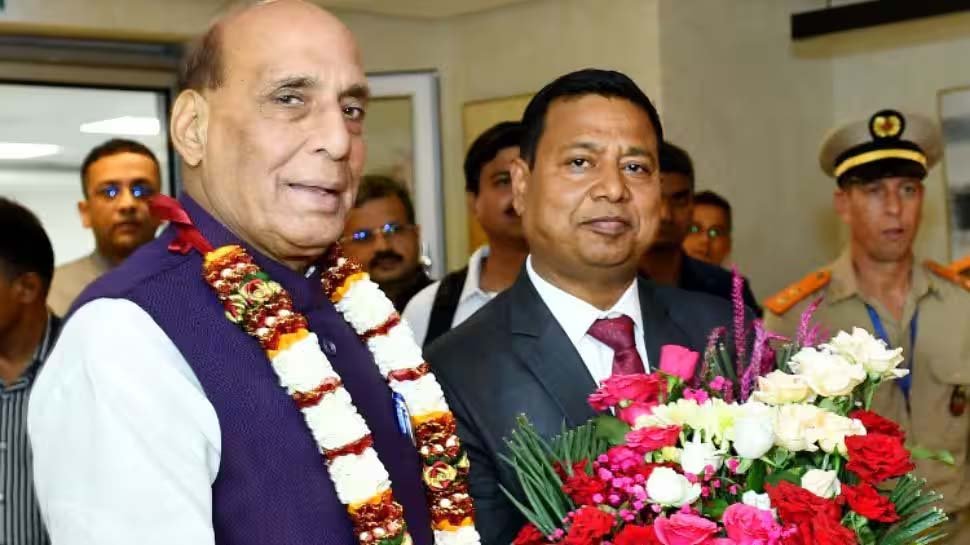
The structural anchor of this diplomatic visit was the formal launch of this manufacturing facility to produce the highly modular Wheeled Armoured Platform. From a strategic perspective, this development provides New Delhi with a highly cost-competitive, reliable assembly footprint directly adjacent to Mediterranean and sub-Saharan defence markets. By integrating Moroccan engineering into an Indian defence framework, New Delhi has created a repeatable blueprint for entering overseas military hardware markets, demonstrating its capacity to deliver high-quality platforms without the complex geopolitical strings tied to traditional Western and Chinese arms contracts.

By integrating Moroccan engineering into the Indian defence framework, India has created a repeatable blueprint for entering overseas military hardware markets, demonstrating its capacity to deliver high-quality platforms without the complex geopolitical strings tied to traditional Western and Chinese arms contracts
The Indo-Pacific Arch: Strengthening Ties with Vietnam and South Korea
The recent two-nation tour to Vietnam and South Korea highlights India’s ongoing commitment to its Act East Policy, building deep security connections with key Indo-Pacific powers. Faced with rising maritime assertions across the South China Sea and vital international shipping lanes, these visits aimed to operationalise existing partnerships through explicit tactical integration.
In Hanoi, discussions with General Phan Van Gang focused heavily on completing the delivery and operational deployment of the shore-based anti-ship variant of the BrahMos supersonic cruise missile system. Supplying Vietnam with a highly lethal, Mach 3-capable anti-ship missile system introduces a powerful defensive deterrent into regional waters, significantly raising the tactical risks of aggressive naval incursions. This security architecture was further strengthened by the signing of an advanced memorandum of understanding focused on Artificial Intelligence and Quantum Technology for military use. These technologies are designed to enhance automated coastal surveillance radar arrays, ensure secure, un-jammable communications, and provide real-time maritime domain awareness across contested shipping corridors.
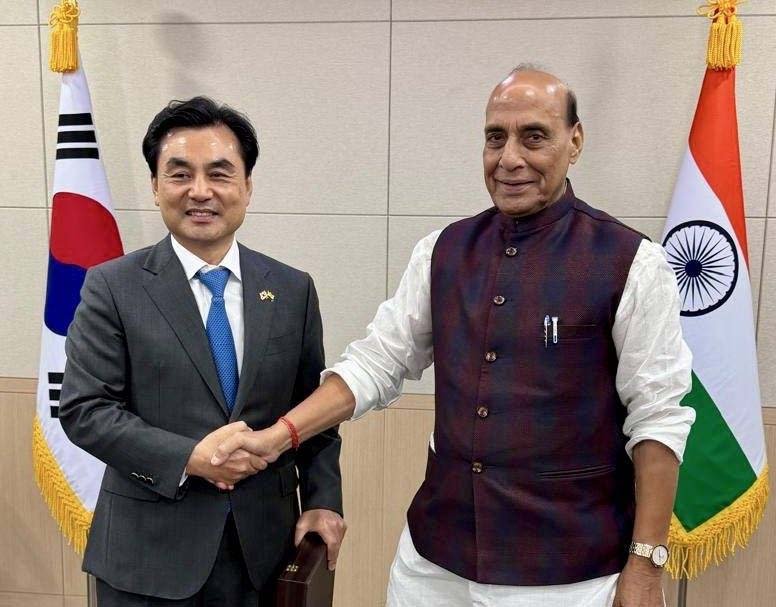
Transitioning immediately to Seoul, the Defence Minister met with South Korean Defence Minister Ahn Gyu-back and the leadership of the Defence Acquisition Programme Administration to introduce key operational upgrades. First, formally signed protocols established integrated defence cyber cooperation through shared, real-time tracking systems to identify and counter sophisticated state-sponsored cyber threats targeting defence infrastructure.
The tour to Vietnam and South Korea highlights India’s ongoing commitment to its Act East Policy, building deep security connections with key Indo-Pacific powers. Faced with rising maritime assertions across the South China Sea and vital international shipping lanes, these visits aimed to operationalise existing partnerships through explicit tactical integration
Second, the partnership secures advanced component supply chains by leveraging South Korea’s advanced industrial base to guarantee the delivery of military-grade micro-components, ensuring India’s defence fabrication lines remain uninterrupted. Third, the agreements institutionalise defence education between the National Defence College of India and the Korea National Defence University, formalising joint strategic research on hybrid warfare and the security of global maritime chokepoints. This itinerary concluded with a deeply symbolic event marking the joint inauguration of the Indian War Memorial, which honours the historic medical and humanitarian service of the Indian Army’s 60 Parachute Field Ambulance during the Korean War to highlight a shared, multi-generational commitment to regional security.
The Strategic Synthesis: Designing Global Interdependence
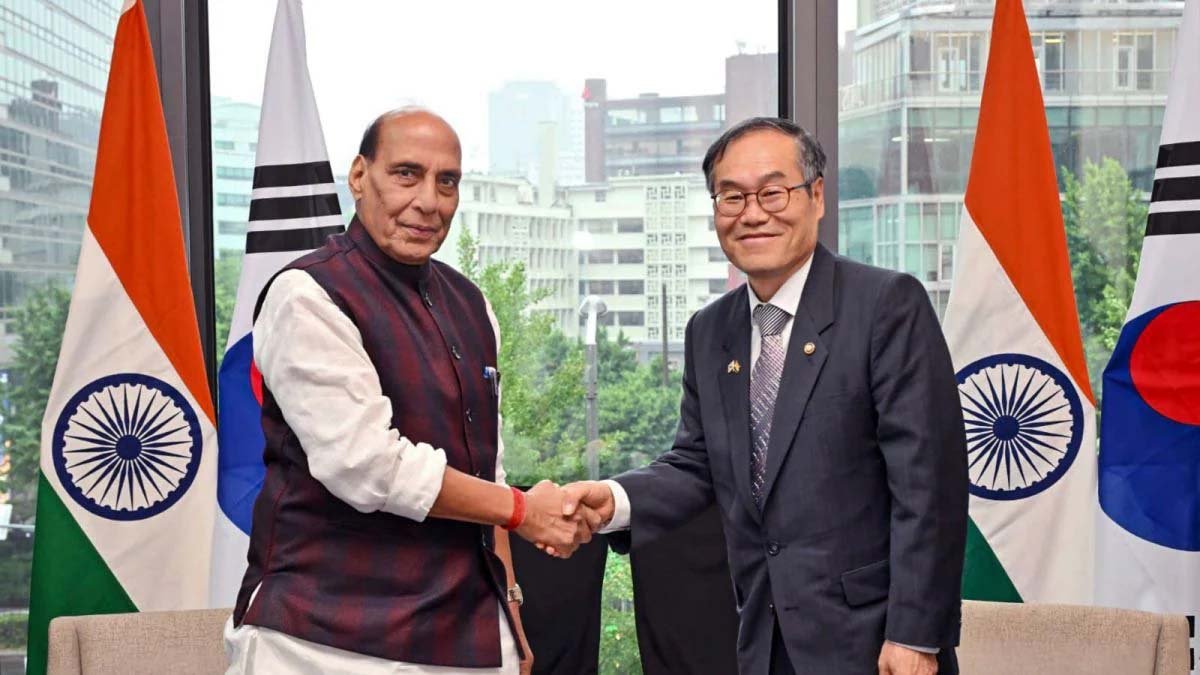
When analysed as a single, coordinated diplomatic strategy, Rajnath Singh’s recent foreign trips demonstrate that India is successfully moving past outdated, transactional defence frameworks. New Delhi is actively building a highly resilient, cross-continental security architecture by hardening critical tech components via agreements with industrialised economic partners like Germany and South Korea. Simultaneously, the nation is scaling up high-end defence hardware exports to key front-line nations like Vietnam while embedding local manufacturing capabilities in emerging regional markets like Morocco. These calculated steps are systematically expanding India’s strategic reach, positioning the nation not just as a regional power but as an indispensable manager of international stability and an independent leader in global defence technology.

–The writer is Assistant Professor, ICFAI School of Liberal Arts, ICFAI University, Jaipur. The views expressed are of the writer and do not necessarily reflect the views of Raksha Anirveda





