


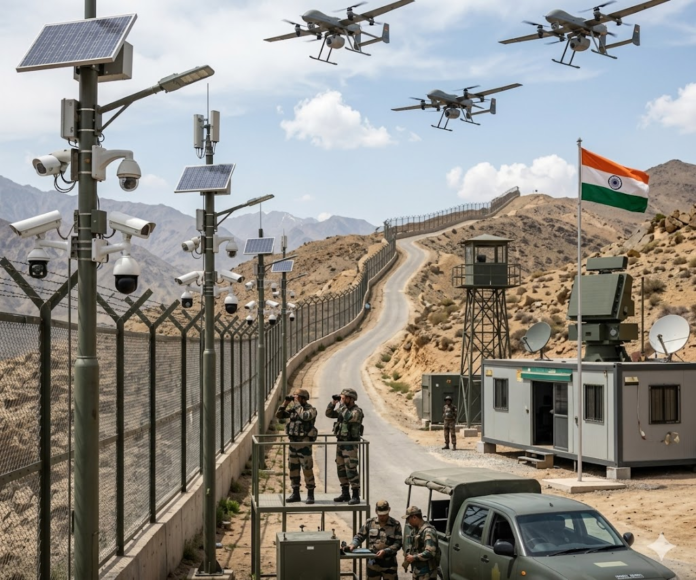
India’s current transition in border management marks a significant doctrinal shift from perimeter defence to continuous domain awareness. The recent articulation of a smart border architecture signals that sovereignty is no longer protected solely by fences and patrols, but by integrated sensing, real-time analytics, and rapid-response structures that function as a single national nervous system. The western and eastern frontiers, long treated as static security challenges, are now being reimagined as dynamic operational theatres where information dominance is as critical as physical control.
The announcement of a comprehensive deployment of drones, radar networks, optical fibre backbones, tunnel detection systems, high-mast lighting, and artificial-intelligence-enabled command interfaces reflects a clear recognition of the evolving contemporary threat landscape. Adversaries no longer rely solely on conventional infiltration; instead, they use unmanned aerial systems, subterranean corridors, encrypted coordination, and dispersed logistics. In response, India is building a border architecture that not only resists intrusion but also anticipates it.

This transformation, under the leadership of Union Home Minister Amit Shah and the operational execution of the Border Security Force (BSF), represents a fundamental recalibration of how border security is conceptualised. The shift is moving away from manpower-centric deterrence toward technology-driven denial system. The optical fibre backbone being laid beneath border infrastructure is particularly significant because it creates a secure, uninterrupted data highway between the field and command centres. This compresses decision cycles and enables near-real-time interception capabilities.
Anti-drone systems now form a critical layer of this architecture. Low-cost aerial platforms have democratised surveillance and smuggling, forcing states to respond with integrated detection and neutralisation ecosystems. Similarly, tunnel detection technologies acknowledge that underground infiltration is no longer a marginal tactic but a persistent operational method. When fused with sensor grids and predictive analytics, these systems create a multidimensional security envelope spanning the air, surface, and subsurface domains.
However, the strategic value of this initiative depends not only on technological infusion but also on structural integration. Without a unified command architecture, even the most advanced systems risk fragmentation. This is where the principle of “One Border, One Force” becomes strategically decisive. The doctrine of “One Border, One Force” is not merely an administrative reform; rather, it is a multi-layered, multi-tiered structural integration under the Army’s command and control. It is an operational necessity for building an integrated border architecture, given that the geography and geometry of threats have been redefined. At present, overlapping jurisdictions and fragmented responsibilities often dilute responsiveness and delay coordination.
The recent articulation of a smart border architecture signals that sovereignty is no longer protected solely by fences and patrols, but by integrated sensing, real-time analytics, and rapid-response structures that function as a single national nervous system
A unified force structure for each border sector would ensure single-point accountability, streamlined command chains, and a coherent operational doctrine. Furthermore, it would eliminate duplication of effort and strengthen real-time decision-making. Under this framework, each border would function as an integrated security organism with its own dedicated force, intelligence grid, technological infrastructure, and command hierarchy. This would enable the seamless integration of surveillance data, patrol movements, and rapid-response assets. It would also ensure that technology investments are not fragmented across agencies but embedded within a unified operational ecosystem.

A sovereign border architecture must also be anchored in technological self-reliance. Sovereign technology embedment means that India must own not only the hardware but also the software, algorithms, and data ecosystems that drive border intelligence. Dependency on external vendors for critical analytics or system upgrades introduces unacceptable strategic risk. The indigenous development of drone platforms, sensor systems, encrypted communication protocols, and artificial intelligence models is therefore essential, not optional.
Data sovereignty and AI integration, which enable predictive rather than reactive intelligence, are equally critical. A smart border will generate continuous streams of sensitive geospatial and behavioural data. This data must reside within a secure national infrastructure with tightly controlled access protocols. Any external dependency in data processing would compromise the strategic integrity of the entire system. Therefore, secure national data centres dedicated to border management must become foundational infrastructure.

Institutional convergence is another essential pillar. A smart border cannot function effectively if intelligence agencies, paramilitary forces, military units, and state police operate in isolation. A unified command-and-control architecture with interoperable digital dashboards must be established to ensure that intelligence flows without friction. This is particularly important in fast-evolving situations, where delays in coordination can lead to operational failure.
Human capital remains the decisive factor in this transformation. Technology amplifies capability but does not replace judgment. Border personnel must be trained to operate in a data-rich environment, interpreting sensor outputs, drone feeds, and predictive alerts in real time. This requires a new training doctrine that blends conventional field craft with digital literacy and systems thinking.
A smart border cannot function effectively if intelligence agencies, paramilitary forces, military units, and state police operate in isolation. A unified command-and-control architecture with interoperable digital dashboards must be established to ensure that intelligence flows without friction
On the domestic front, state-level integration will determine the effectiveness of implementation, particularly in sensitive frontier regions such as West Bengal, where land allocation for smart border infrastructure has already begun. Local administrative coordination, community engagement, and intelligence-sharing mechanisms must be integrated into the technological framework to ensure a deep situational awareness.
At the strategic level, it must be recognised that adversaries will continuously adapt. Any technological advantage will eventually be studied, countered, and challenged. Therefore, the smart border cannot be a static installation. It must evolve continuously through iterative upgrades, adaptive algorithms, and real-time system learning. This requires a procurement philosophy centred on lifecycle adaptability rather than one-off acquisitions.
In conclusion, the smart border initiative marks a foundational shift in India’s national security architecture. It signals the emergence of a border system that is intelligent, networked, and responsive. However, its long-term success will depend on four critical enablers. The first is sovereign technology embedding to ensure full control over data, algorithms, and systems. The second is institutional integration through the doctrine of “One Border, One Force” to eliminate fragmentation and create unified command and accountability. The third is a proactive and pre-emptive doctrine of deterrence and denial. The fourth is continuous technological upgrades supported by indigenous innovation ecosystems. If these principles are implemented with strategic clarity, India will not merely secure its borders; it will redefine border security as a model of integrated, proactive, pre-emptive, and technology-driven sovereignty suited to the complexities of twenty-first-century geopolitics.

The writer, a PVSM, AVSM, VSM has had an illustrious career spanning nearly four decades. A distinguished Armoured Corps officer, he has served in various prestigious staff and command appointments including Commander Independent Armoured Brigade, ADG PP, GOC Armoured Division and GOC Strike 1. The officer retired as DG Mechanised Forces in December 2017 during which he was the architect to initiate process for reintroduction of Light Tank and Chairman on the study on C5ISR for Indian Army. Subsequently he was Consultant MoD/OFB from 2018 to 2020. He is also a reputed defence analyst, a motivational speaker and prolific writer on matters of military, defence technology and national security. The views expressed are personal and do not necessarily carry the views of Raksha Anirveda





