


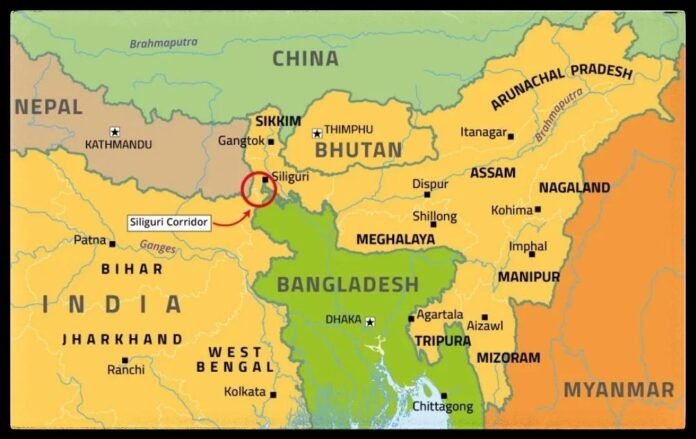
There are places on the map whose importance far exceeds their size. The Siliguri Corridor is one such place. Barely 20 to 22 kilometres wide at its narrowest point, this narrow tract of land in northern West Bengal connects the Indian mainland to the entire Northeast. More than 45 million Indians, eight states, critical military formations, strategic highways, rail lines, oil pipelines and communication networks depend on this fragile corridor. For decades, Indian strategists privately described it as the country’s greatest geographic vulnerability.
Yet for years, India approached Siliguri with caution rather than urgency. Governments acknowledged the danger but moved slowly. Bureaucratic delays, political friction between the Centre and West Bengal, land acquisition disputes and peacetime complacency ensured that strengthening the corridor remained a subject of defence seminars rather than decisive state action. That hesitation now appears to be ending.

Over the past few days, India has moved with unusual speed to transform Siliguri from a vulnerable ‘Chicken’s Neck’ into a hardened strategic passage. Border fencing has accelerated. Surveillance systems have multiplied. Strategic highways are being shifted to central agencies for rapid expansion. Rail redundancy projects have suddenly gained momentum. Intelligence coordination has intensified. Air infrastructure is expanding. Even diplomatic signalling towards Bangladesh has acquired a sharper strategic undertone.
The most striking aspect is not any one project. It is the pace and coordination of action. India appears to have concluded that in an unstable regional environment, delay itself has become a security risk.
The Siliguri Corridor sits squeezed between Nepal to the West, Bhutan to the North, Bangladesh to the south, and Chinese-controlled Tibet beyond Sikkim. At several points, the corridor narrows so dramatically that military planners have long feared the possibility of disruption through military pressure, sabotage, infiltration or even coordinated instability
The Geography That Haunted India
Every Indian map hides a strategic nightmare in plain sight.
The Siliguri Corridor sits squeezed between Nepal to the West, Bhutan to the North, Bangladesh to the south, and Chinese-controlled Tibet beyond Sikkim. At several points, the corridor narrows so dramatically that military planners have long feared the possibility of disruption through military pressure, sabotage, infiltration or even coordinated instability.

The vulnerability is psychological as much as geographic. If the corridor were ever seriously compromised, India’s Northeast would effectively be isolated from the mainland by land. Reinforcing troops, transporting heavy military equipment or maintaining uninterrupted civilian logistics would become immensely difficult.
The fear is not theoretical. The trauma of the 1962 war with China still shapes Indian strategic thinking. The 2017 Doklam crisis again reminded New Delhi how quickly tensions could rise in the Eastern sector. Meanwhile, growing Chinese influence in South Asia — including infrastructure projects and strategic penetration into neighbouring countries — has deepened Indian anxieties about encirclement.

The instability in Bangladesh after political upheaval further sharpened these concerns. Reports of unrest, refugee movement, radical elements and fears of Chinese strategic involvement near Northern Bangladesh suddenly pushed Siliguri back into the centre of India’s national security calculations.
For decades, India treated Siliguri as a vulnerability to be managed. Today, it appears determined to turn it into a vulnerability to be neutralised.
Why New Delhi Suddenly Accelerated
The shift did not emerge from one single event. It emerged from the convergence of several strategic anxieties.
Bangladesh: The first trigger was Bangladesh. India has traditionally relied upon stable relations with Dhaka to ensure security along its Eastern frontier. However, political turbulence in Bangladesh created fears of instability spilling towards the border. Intelligence alerts regarding infiltration, refugee movement and extremist activity heightened concern in New Delhi. The BSF’s rapid deployment of 12-foot concertina fencing along vulnerable sectors near the corridor reflected how seriously India viewed the changing environment.
China: The second factor was China. Indian strategic circles increasingly worry about China’s growing footprint in Bangladesh, including infrastructure and dual-use facilities. Reports of possible Chinese-linked activity in the Lalmonirhat region of northern Bangladesh intensified concerns due to its proximity to Siliguri. Indian planners appear to have concluded that the corridor can no longer be viewed merely as a border management issue. It must be treated as a potential theatre in a larger strategic competition.
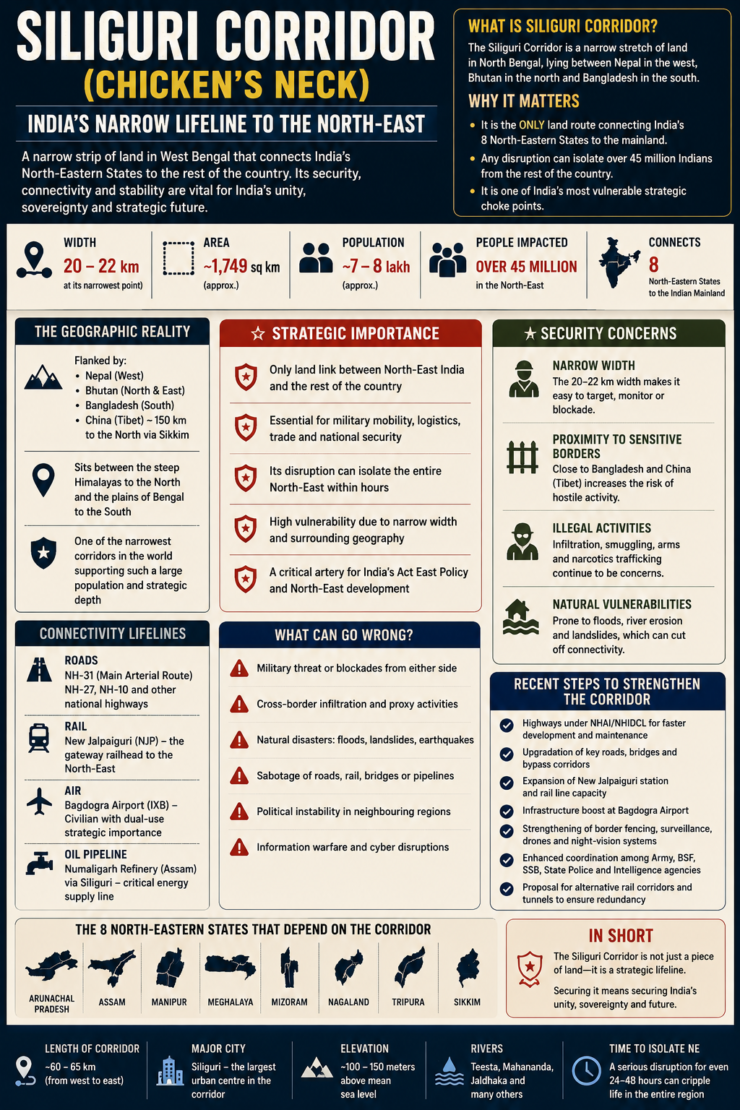
Political Alignment: The third factor may have been political alignment. For years, several infrastructure and security projects in the corridor progressed slowly due to friction between the Centre and the West Bengal government. Post-election political changes dramatically altered that equation. Projects that had remained stalled suddenly moved ahead with speed. The West Bengal government’s decision to hand over several strategic highway stretches to central agencies represented more than administrative coordination. It signalled the removal of political bottlenecks that had long delayed strategic infrastructure expansion.
India has moved aggressively to convert the Siliguri region from a porous frontier into a monitored security grid. The BSF’s rapid installation of 12-foot concertina fencing across vulnerable stretches of the India-Bangladesh border represented a visible assertion of urgency. Also, intensified patrols, floodlighting, thermal cameras, drones and enhanced surveillance systems
The psychological change may be the most important of all.
India appears to have stopped assuming stability. It is now preparing for uncertainty.
The Infrastructure Blitzkrieg
The most visible dimension of India’s response has been to accelerate dual-use infrastructure.
Roads Become Strategic Assets: India has long understood that roads are not merely civilian infrastructure in border regions. They are military arteries too. The recent decision to transfer several key highway stretches passing through the Siliguri Corridor to agencies such as NHAI and NHIDCL marks a major strategic shift. These include critical stretches like NH-31 and other routes linking the Northeast to mainland India.
The objective is clear: widen roads, improve maintenance, create all-weather mobility and reduce bottlenecks that could cripple troop movement during a crisis.
In military planning, mobility often matters more than numbers. Reinforcements delayed by damaged roads or narrow choke points can decisively alter battlefield outcomes. India appears determined to ensure that the corridor remains operational even under pressure. Roads in Siliguri are no longer being treated as ordinary highways. They are reinforcement corridors.
Railways as Strategic Insurance: If roads are the arteries of strategic mobility, railways are the backbone of sustained military logistics. The proposed Varanasi-Siliguri high-speed rail corridor is therefore far more than an economic project. It represents strategic redundancy. Faster connectivity between the heartland and Eastern India means quicker mobilisation capacity during emergencies.
Even more significant is the proposal for a 40-kilometre underground rail corridor and expansion to four railway lines through the region. The logic behind this is unmistakably strategic. Surface rail infrastructure in narrow corridors is vulnerable to sabotage, air attack or disruption. Underground and multi-line redundancy improves survivability. India is not merely expanding connectivity. It is building resilience into connectivity.
Bagdogra and Air Mobility: Modern warfare is ultimately about logistics. Air mobility compresses geography. Bagdogra Airport’s major expansion, therefore, has clear strategic implications. The enlarged terminal, additional aircraft bays, aerobridges and upgraded airfield systems will significantly increase operational capacity. Though officially civilian in orientation, Bagdogra has always held strategic importance because of its dual civilian-military utility.
The shift in India’s approach did not emerge from one single reason. The first trigger was Bangladesh. India has traditionally relied upon stable relations with Dhaka to ensure security along its Eastern frontier. However, due to political turbulence in Bangladesh, intelligence alerts regarding infiltration, refugee movement and extremist activity heightened India’s concern
An expanded Bagdogra means faster troop movement, greater airlift flexibility, improved evacuation capability and stronger logistical support for the Northeast.
In modern strategic planning, distance is defeated not by geography, but by infrastructure.
Hardening the Borders
Infrastructure alone cannot secure a corridor. Borders must also be hardened.
India has therefore moved aggressively to convert the Siliguri region from a porous frontier into a monitored security grid. The BSF’s rapid installation of 12-foot concertina fencing across vulnerable stretches of the India-Bangladesh border represented a visible assertion of urgency. Alongside fencing came intensified patrols, floodlighting, thermal cameras, drones and enhanced surveillance systems. This transformation reflects a major shift in security philosophy.
Earlier border management focused heavily on post-event response — intercepting infiltrators after movement occurred. The new emphasis appears centred on denial, detection and real-time monitoring. The first battle in modern conflict is fought through detection.
India’s broader ‘smart border’ approach suggests an integrated security architecture where sensors, drones, intelligence feeds and rapid-response forces operate as one network. In a region as strategically fragile as Siliguri, ambiguity itself becomes dangerous. The ability to instantly identify suspicious movement or infiltration attempts dramatically reduces vulnerability.
Equally important is the political decision by the West Bengal government to expedite land transfer for border fencing. Long-pending procedural delays are suddenly being resolved with remarkable speed. That speed tells its own story.
Indian strategic circles increasingly worry about China’s growing footprint in Bangladesh, including infrastructure and dual-use facilities. Reports of possible Chinese-linked activity in the Lalmonirhat region of northern Bangladesh intensified concerns due to its proximity to Siliguri. For Indian planners, the corridor is a potential theatre in a larger strategic competition
Militarising Response Time
The biggest transformation may not even be visible in infrastructure. It may be the compression of response time.
India appears to be building a system where threats can be identified faster, decisions taken quicker, and responses executed immediately. Multi-agency coordination has intensified sharply. Security reviews involving the Army, BSF, SSB, ITBP, state police and intelligence agencies have focused heavily on eliminating inter-agency delays and creating real-time intelligence sharing mechanisms.
New army garrisons around the wider region, including Chopra in West Bengal and Kishanganj in Bihar, indicate an effort to create layered defensive positioning around the corridor. At the same time, India has reportedly strengthened air defence coverage through systems such as S-400, MRSAM and Akash deployments in the Eastern theatre. This reflects a deeper strategic evolution.
Traditional defence thinking focused on territorial defence after conflict began. Modern strategic thinking focuses on ensuring that the adversary never finds an exploitable window in the first place.
India’s objective is no longer simply to defend Siliguri. It is to make any attempt against it operationally futile.
The Message Beyond Siliguri
India’s actions are not meant only for Siliguri. They are intended as strategic signalling.
To China, the message is clear: India recognises the vulnerability and is actively reducing it. Any strategy based on threatening the Northeast through corridor pressure will face increasingly hardened resistance.
To Bangladesh, the message is more nuanced. India still prefers stability, cooperation and strong bilateral ties. The appointment of a politically influential envoy to Dhaka reflects this diplomatic balancing act. Yet India is simultaneously signalling that instability near Siliguri will trigger hardened security responses.
The proposal for a 40-km underground rail corridor and expansion to four railway lines through the region is significant. The logic behind this is unmistakably strategic. Surface rail infrastructure in narrow corridors is vulnerable to sabotage, air attack or disruption. Underground redundancy improves survivability. India is building resilience into connectivity
To the Indian system itself, the message may be even more important. For decades, strategic projects moved painfully slowly. Siliguri demonstrates that when political will, strategic urgency and administrative alignment converge, India can move with surprising speed.
The corridor may therefore become a template for future Indian strategic infrastructure doctrine — combining highways, railways, airfields, surveillance, intelligence and political coordination into one integrated security architecture.
Conclusion: From Vulnerability to Resolve
India cannot change its geography.
The Siliguri Corridor will always remain narrow. It will always sit amid a complicated strategic neighbourhood. It will always carry immense vulnerability because of the enormous national dependence placed upon it. But vulnerability does not have to mean helplessness.
For decades, Siliguri symbolised India’s deepest strategic anxiety — a weak neck connecting a vast nation to its eastern frontier. Today, that symbolism is beginning to change. Roads are expanding. Rail redundancy is being planned. Borders are being hardened. Surveillance is intensifying. Military mobility is improving. Political hesitation is giving way to strategic urgency.
Most importantly, India is no longer reacting slowly. The speed itself is the real story.
Nations ultimately reveal their seriousness not by speeches, but by how they protect their weakest points. The narrow corridor that once exposed India’s fragility may now become the clearest expression of its strategic resolve.

Lt Gen Rajeev Chaudhry (Retd) writes on contemporary national and international issues, strategic implications of infrastructure development towards national power, geo-moral dimension of international relations, and leadership nuances in a changing social construct. The views expressed are of the author and do not necessarily reflect the views of Raksha Anirveda





