


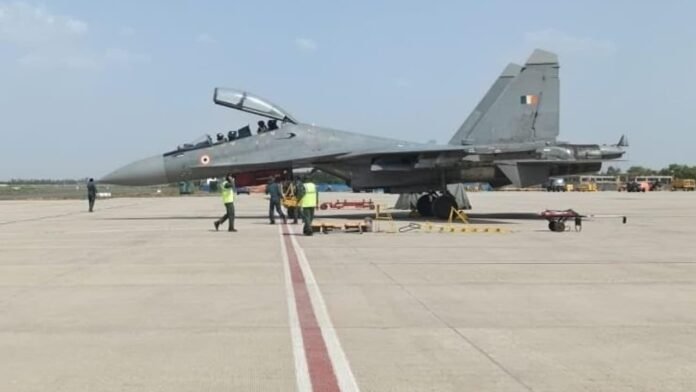
The western frontier, historically the most sensitive theatre of operations for the Indian Armed Forces, became the proving ground for a monumental leap in national security architecture. Defence officials confirmed that recent war games focused on “jointness” – the ability of different military branches to operate as a single, cohesive entity in real-time. The exercise marked a critical milestone in operationalising a unified, digitised air defence grid capable of neutralising threats ranging from low-altitude suicide drones to high-speed ballistic missiles.
The Power of Integration: Akashteer and IACCS
The centerpiece of these manoeuvres was the interoperability between the Akashteer system – the backbone of the Indian Army’s low-level air defence – and the Indian Air Force’s ‘Integrated Air Command and Control System’ – IACCS. While IACCS acts as the overarching strategic brain, managing vast swathes of national airspace and coordinating fighter assets, Akashteer functions as the tactical nervous system for ground-based units.

By fusing these platforms, field commanders achieved an unprecedented “single-screen” view of the battlefield. Data from long-range Air Force radars, ground-based Army sensors, and naval tracking systems was aggregated into a continuous, real-time air situation picture.
This integration eliminates the “fog of war” that previously caused delays in threat identification. During the simulation, this network automatically identified incoming targets, classified them by threat level, and assigned the most effective weapon system – whether a surface-to-air missile, an air defence gun, or an interceptor jet – without human intervention.

Neutralising Modern Threats
The drills were specifically engineered to counter the volatile tactical realities seen in recent global conflicts. With the proliferation of loitering munitions and drone swarms, the traditional method of relying on human operators to scan radar screens is no longer sufficient.
The exercise demonstrated how Akashteer’s edge-AI processors ingest satellite imagery and battlefield data to track hostile drones even when they attempt to bypass active radar by flying at extremely low altitudes.

By bypassing manual approval loops, the system allowed for decentralised, “plug-and-fight” engagement. Frontline units effectively utilised a laptop-based command interface to lock onto targets and coordinate strikes with surgical precision, drastically reducing the reaction time from minutes to mere milliseconds.
A Fortress of Indigenous Engineering
Beyond tactical success, the exercise served as a rigorous validation of India’s ‘Aatmanirbhar Bharat’ initiative. Developed by Bharat Electronics Limited (BEL) in collaboration with the DRDO and ISRO, both Akashteer and the IACCS network function with zero dependency on foreign components or software.
The successful synchronisation of these systems confirms that India has moved past the era of disjointed, siloed defence. As the armed forces continue to move toward integrated theater commands, this digital convergence ensures that every asset, from a soldier’s portable air defence unit to the nation’s advanced fighter squadrons, is linked in a singular, hardened, and highly responsive security web. The western border remains calm, but behind the scenes, India’s digital fortress has never been more alert.






