


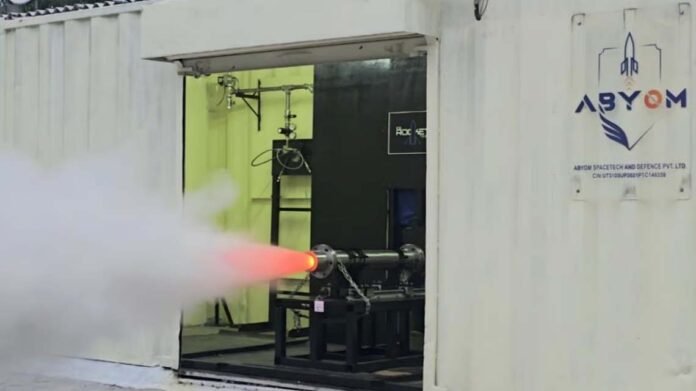
Hyderabad. Hyderabad-based aerospace pioneer Abyom SpaceTech and Defence has successfully fired India’s first entirely in-house developed reusable liquid rocket engine, unlocking an affordable frontier for the nation’s rapidly growing commercial space sector.
The global aerospace landscape is evolving rapidly, with international market operators shifting decisively toward reusable launch systems to aggressively lower the baseline costs of deploying orbital payloads.

Capitalising on this structural transition, deep-tech startup Abyom SpaceTech and Defence has completed a historic qualification test campaign for a liquid-propellant rocket engine engineered entirely within the country.
Incubated at the technology business incubator of the BITS Pilani Hyderabad campus, the company executed the first live hot-fire evaluation at its proprietary Commercial Test Facility, proving that sophisticated tactical propulsion architectures can be built without relying on external international technology pipelines or expensive imported components.
The technological breakthrough centres on the BattleShip Engine, or BSE-II, a highly engineered liquid rocket engine operating within the two-point-five kilonewton thrust class.
Built entirely from scratch by an indigenous engineering team, the platform has endured an intense developmental cycle encompassing over two hundred and fifty individual static hot-fire tests to systematically validate its structural resilience under extreme thermal stress, with temperatures climbing past twenty-two hundred degrees Celsius during active combustion cycles.

The latest qualification milestone verified a suite of advanced parameters vital for vertical take-off and vertical landing manoeuvres, including highly responsive throttleable thrust capabilities, electronic ignition sequences, and stable blow-down combustion dynamics.
Every internal subsystem, ranging from specialised instrumentation and automated control software to high-speed data acquisition stacks, was developed internally to establish a sovereign technology portfolio.

This successful engine validation serves as the primary technical foundation for Abyom’s ambitious long-term orbital blueprint, which centres on the development of the Hybrid Orbital Propulsion Engineering framework and the flight-ready HOPE reusable rocket prototype.
By mastering the intricate mechanical disciplines of autonomous vertical recovery and precision guidance, the startup aims to deploy scalable vehicles optimised for low-cost small satellite positioning, responsive tactical defence operations, high-altitude meteorological data collection, and short-duration microgravity experiments above the Kármán line.
Following the successful closure of this qualification window, the corporate roadmap shifts toward scaling the current design into a higher-thrust cryogenic propulsion network alongside the associated automated ground-handling infrastructure required for active orbital launch campaigns.
Beyond its immediate engineering objectives, the company is deliberately positioning its physical infrastructure to act as a major catalyst for the wider domestic aerospace ecosystem.
The compact, containerised rocket engine testing facility is being actively transformed into an open, modular propulsion testing platform designed to support early-stage space startups, academic research laboratories, and sovereign institutions across India.
By making advanced static testing services commercially accessible and affordable, the platform effectively removes massive capital entry barriers for third-party developers, allowing universities and independent technical teams to quickly iterate, test, and validate their own proprietary engine designs.
Reflecting on the wider strategic significance of the milestone, Jainul Abedin, the founder and chief executive officer of Abyom SpaceTech and Defence, emphasised that the campaign represents a critical leap toward anchoring an independent, end-to-end reusable propulsion manufacturing base in India.
Backed by key institutional recognitions and support from the Department of Science and Technology, the Ministry of Electronics and Information Technology, and the Indian Space Research Organisation, the company’s successful deployment reinforces Hyderabad’s growing stature as an international cluster for high-value deep-tech engineering and defence manufacturing.
As private industry efforts begin expanding to capture a projected thirteen-billion-dollar domestic space economy by 2030, this achievement demonstrates that decentralised private innovation can independently deliver the complex sovereign infrastructure required to sustain affordable, frequent access to the cosmos.






