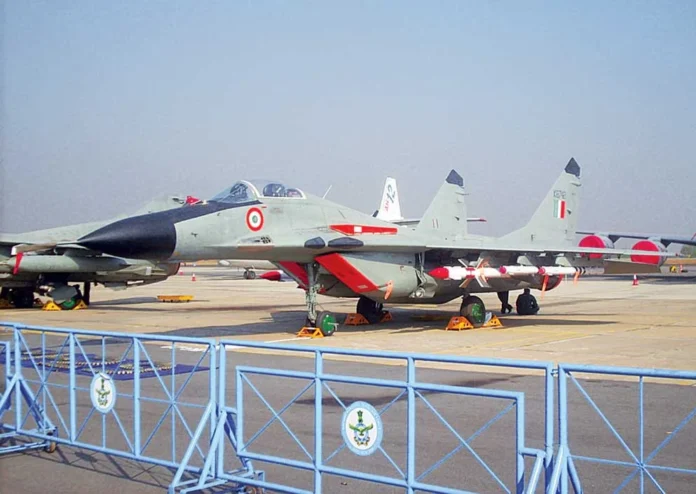
New Delhi. Keeping up its guard even as India and China move toward disengagement along the Line of Actual Control (LAC), the Indian Air Force has acquired the capability to fly its MiG-29 fighters at night from its Leh base in the future.

The process of night-flying, which has already begun, would be a “game-changer” because training by night will strengthen its capability to conduct full-spectrum operations at the Line of Actual Control on short notice, given Leh’s proximity to the LAC, sources told the media.
The new capability is fuelled by upgrades to the MiG-29, including advanced avionics, and faster and more extensive training of IAF pilots among other factors.
Leh is not a permanent fighter base, but detachments of aircraft are sent there on a regular basis.
An IAF officer said the MiG-29s are carrying out extensive, round-the-clock flying from Leh, which will also help the force validate geospatial data to enhance its capabilities in night operations.

Fighters such as the Sukhoi Su-30s conduct night operations in the Leh and Ladakh regions, but they come from other bases that have night capabilities. Apache and Chinook helicopters also carry out night-time operations.
“The first reason is that there are chances of the enemy being comparatively less alert during the night. Secondly, there is less chance of visual detection of the aircraft, which helps in surprising the enemy,” an IAF officer said.

An aircraft can be detected visually and by radars. Flying at night cuts down the visual spectrum of detection.
Another officer said Chinese airfields in the LAC region near Ladakh are at a higher altitude than Leh, and thus, their load carrying capacity is lower, while fighters operating from Leh airbase can have a higher load-carrying capacity.
“This gives India a strategic advantage too, both in day and night flying,” the officer said.
A 2013 policy brief written by Air Marshal VK Bhatia on ‘Air Power Across the Himalayas: A Military Appreciation of Indian and Chinese Air Forces’ noted that if the People’s Liberation Army Air Force (PLAAF) was to operate from its well-established bases at Khotan, Kashgar, Golmud, it would have to operate from much greater distances to reach the IAF airfields, resulting in reduced payloads and possible requirement of in-flight refuelling.
Bhatia’s brief stated that the IAF could easily reach its airfield targets in Tibet from its main bases strung around the entire Indo-Tibetan boundary without any payload or other penalties.
IAF officers also explained why night flying is difficult in the mountains as high altitude and rarefied air limit manoeuvrability and capability of an aircraft.