


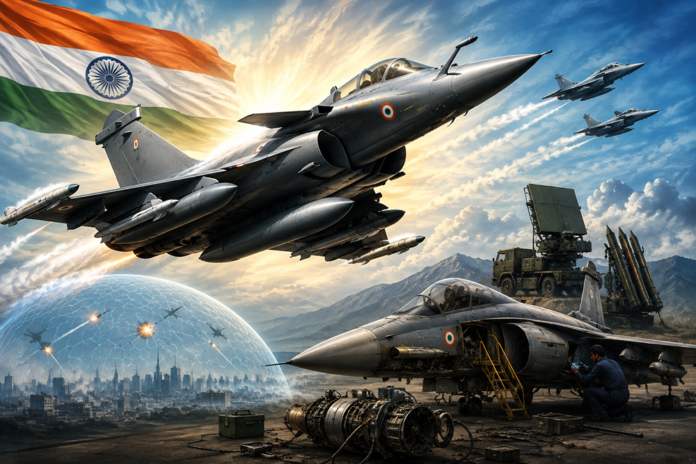
On social media, the noise against the Rafale never stops. The deal is too costly. India does not get the software codes. The Meteor missile cannot match the range of China’s PL-17. One hundred and fourteen Rafales can never stand against a thousand Chinese J-20s. The Rafale is only a 4.5-generation aircraft while China already fields fifth-generation fighters and talks of sixth-generation ones. These complaints are loud and constant. Yet, they hide a far more dangerous truth.
The Indian Air Force is shrinking. Squadron strength has fallen to around 29–31 against the sanctioned requirement of 42. Ageing aircraft are retiring faster than new ones can replace them. Without urgent action, the force that guards our skies will keep withering. The decision to buy more Rafales is not a luxury. It is a desperate attempt to keep the Air Force alive while our own aircraft industry struggles to deliver.

Look at the Tejas story. The original plan was clear. The Light Combat Aircraft was meant to replace the large fleet of MiG-21s and enter service by the year 2000. That deadline came and went. Delays piled up year after year. By the early 2000s the Air Force was already asking for extra Mirage 2000s as a temporary solution. When that did not happen, a full competition was held. French, American, Swedish, Russian and European aircraft were tested under tough Indian conditions – dusty airfields in 50-degree heat one day, high-altitude bases at minus 20 degrees the next. After all the trials, the Rafale and Eurofighter stood at the top. The Rafale was chosen.
The Indian Air Force is shrinking. Squadron strength has fallen to around 29–31 against the sanctioned requirement of 42. Ageing aircraft are retiring faster than new ones can replace them
Even then the Tejas was not ready. Final operational clearance for the basic Mark 1 came only in 2019. That version still lacked beyond-visual-range missiles and a proper self-protection suite. Those features were promised later in the Mark 1A. Meanwhile, Jaguars are reaching the end of their lives. Old airframes are being bought just for spare parts. MiG-29s will also have to retire soon. The Su-30 fleet is large and can be upgraded, but it belongs to an earlier design philosophy. Modern fighters like the Rafale allow easy replacement of modular systems. Making the Su-30 equally maintenance-friendly would need a complete redesign – an expensive task for a public sector company already struggling with deadlines.
Today the Air Force has already inducted Rafales, trained pilots and ground crews, and built support facilities. The nation is committed to this path while it waits for the Tejas to appear in meaningful numbers. Engine supplies from the United States have finally stabilised, yet new excuses keep appearing. Promises of eight aircraft a year, then sixteen, have remained largely on paper. As of mid-2026, the first Tejas Mark 1A jets are only now approaching delivery after long delays. Orders for 180 aircraft exist, production lines have been expanded, and targets of 18–24 aircraft by the end of the year have been set. Still, the record of missed deadlines makes confidence difficult.
This is why imports have become unavoidable. The Rafale is not the long-term answer. It is the only practical bridge available right now. Switching suddenly to another foreign fighter would mean starting training, maintenance and infrastructure all over again – a luxury the Air Force does not have.

Bureaucratic habits, slow decision-making and repeated slippage have damaged both the Air Force and the company’s own future. If HAL truly wants to capture a larger share of the defence market – both within India and abroad – it must change. Production must become reliable. Quality and timelines must be treated as non-negotiable. The private sector supply chain that has begun to support Tejas production needs to be expanded further and treated as a strength, not a threat
The Chinese challenge is real. A large fleet of J-20s cannot be ignored. But it is a mistake to think that 114 Rafales will be sent alone to fight a thousand stealth fighters in a straight contest. Air power does not work that way. India must identify Chinese weaknesses – in logistics, high-altitude operations, and certain geographical stretches – and use the full range of its capabilities, including missiles, air defence systems, and joint force planning. Underestimating an adversary is foolish. Pretending an adversary has no weaknesses is equally foolish.
The deeper problem lies at home. Hindustan Aeronautics Limited has carried the responsibility of giving India its own combat aircraft for decades. Bureaucratic habits, slow decision-making and repeated slippage have damaged both the Air Force and the company’s own future. If HAL truly wants to capture a larger share of the defence market – both within India and abroad – it must change. Production must become reliable. Quality and timelines must be treated as non-negotiable. The private sector supply chain that has begun to support Tejas production needs to be expanded further and treated as a strength, not a threat.

The path forward is clear. The additional Rafales will buy time. That time must be used wisely. Tejas Mark 1A has to reach the squadrons in the numbers promised. Tejas Mark 2 and the Advanced Medium Combat Aircraft must follow without the same cycle of delay. Only then will India move from temporary fixes to genuine self-reliance
Ravi Kota, who now leads Hindustan Aeronautics Limited, carries a heavy and urgent responsibility. He must closely watch the decision-making teams inside the various divisions of the company. Many of these teams still carry the old bureaucratic mindset that has delayed projects for years. These officers and managers must be made fully accountable and answerable to the Ministry of Defence for every missed deadline and every slow decision. If they continue to work with the same outdated habits that have held back the Tejas programme, they should be removed without hesitation. Only firm and clear leadership can break the culture of delay that has hurt both the Air Force and India’s own aerospace future
The path forward is clear. The additional Rafales will buy time. That time must be used wisely. Tejas Mark 1A has to reach the squadrons in the numbers promised. Tejas Mark 2 and the Advanced Medium Combat Aircraft must follow without the same cycle of delay. Only then will India move from temporary fixes to genuine self-reliance.
Rafale is not a permanent solution. It is the only realistic hope available in this critical window. The real test is whether HAL can finally wake up from its bureaucratic slumber, deliver what the nation needs, and prove that Indian industry can stand on its own in the high-stakes world of combat aircraft. The skies will not wait forever.

-The writer is an award-winning science communicator and a Defence, Aerospace & Geopolitical Analyst. He is the Managing Director of ADD Engineering Components India Pvt. Ltd., a subsidiary of ADD Engineering GmbH, Germany. You can reach him at: girishlinganna@gmail.com. The views expressed are personal and do not necessarily carry the views of Raksha Anirveda





