

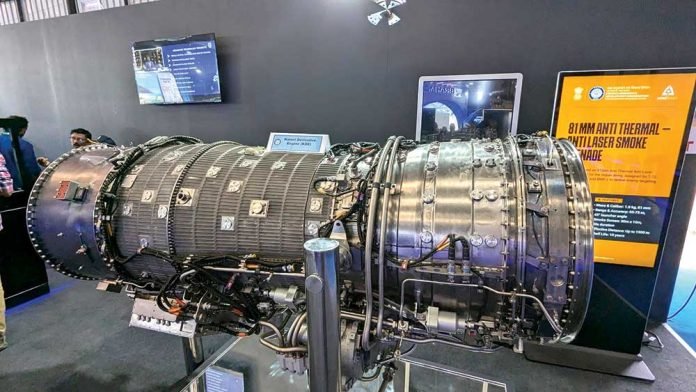
New Delhi: India has marked a significant milestone in its pursuit of aerospace self-reliance with the successful full afterburner test of the Kaveri engine at the Gas Turbine Research Establishment (GTRE) in Bengaluru.
Defence Minister Rajnath Singh witnessed this demonstration first-hand, highlighting the government’s commitment to indigenous jet propulsion technology.

The event showcased a redesigned afterburner section, developed in collaboration with BrahMos Aerospace. This integration represents a pivotal advancement for the long-standing Kaveri programme, which has endured numerous challenges since its inception decades ago.
Recent progress with the Dry Kaveri Engine (KDE) variant has provided a strong foundation. Ground tests have consistently achieved nearly 49 kN of dry thrust, making it suitable for powering unmanned combat aerial vehicles such as the DRDO Ghatak stealth drone.
The afterburner, however, has historically posed the greatest hurdle. Earlier iterations managed only around 73 kN of wet thrust, which, while promising, did not match the performance of contemporary low-bypass turbofans.
For comparison, the General Electric F404 engine in the Tejas MK-1 delivers approximately 49 kN dry and surges to 84 kN with afterburner—a 70 per cent augmentation. Modern designs typically achieve 60-80 per cent thrust increases, depending on operational conditions and engineering refinements.

The new BrahMos Aerospace – designed afterburner module addresses these shortcomings head-on. Tailored for the KDE core, it targets 81-83 kN of wet thrust—or around 78-80 kN in conservative estimates—offering a 60 per cent or greater leap over the dry baseline.
This performance positions the Kaveri engine competitively with established fighter jet powerplants, potentially paving the way for manned aircraft applications in the future. The Defence Minister’s presence during the full afterburner run signals the onset of rigorous trials for validation and certification.

Beyond technical achievements, this development underscores India’s strategic drive towards Aatmanirbharta, or self-reliance, in defence manufacturing. Aero-engine technology has long been a domain dominated by foreign suppliers, leaving India vulnerable to external dependencies.
The Kaveri programme’s evolution—from a dry engine for stealth drones to a fully augmented variant—closes a critical gap in national capabilities. It aligns with broader efforts to indigenise high-end propulsion systems amid rising geopolitical tensions.
During his GTRE visit, Rajnath Singh emphasised accelerating development through innovations like artificial intelligence, advanced materials, and strategic partnerships. These directives aim to compress timelines and foster breakthroughs in a field notorious for protracted R&D cycles.
The collaboration with BrahMos Aerospace exemplifies effective public-private synergy. BrahMos’s expertise in supersonic cruise missile propulsion has directly enhanced the afterburner’s efficiency, combustion stability, and thermal management.
Looking ahead, successful certification could integrate the Kaveri into diverse platforms. For unmanned systems like Ghatak, the dry variant suffices, but the wet configuration opens possibilities for lightweight fighters or trainer aircraft upgrades.
Challenges remain, including scaling production, ensuring reliability under extreme conditions, and achieving single-digit thrust-specific fuel consumption. GTRE’s ongoing sea-level and high-altitude simulations will be crucial.
India’s defence ecosystem benefits immensely from such progress. With initiatives like the Tejas Mk-2 and Advanced Medium Combat Aircraft (AMCA) in the pipeline, a mature Kaveri derivative could reduce import reliance by over 70 per cent for future fleets.
International parallels abound: nations like China have overcome similar hurdles through persistent investment, transitioning from imported engines to indigenous ones like the WS-10. India’s trajectory mirrors this, bolstered by a burgeoning private sector.
The Ministry of Defence’s confirmation of the test via official channels lends credibility, quelling past scepticism around the programme. Sustained funding—earmarked under the 2026-31 defence budget—will be key to momentum.
This quiet but historic milestone at GTRE reverberates across India’s aerospace ambitions. It transforms the Kaveri from a symbol of struggle into a beacon of potential self-sufficiency, fortifying the nation’s strategic posture for decades to come.






