


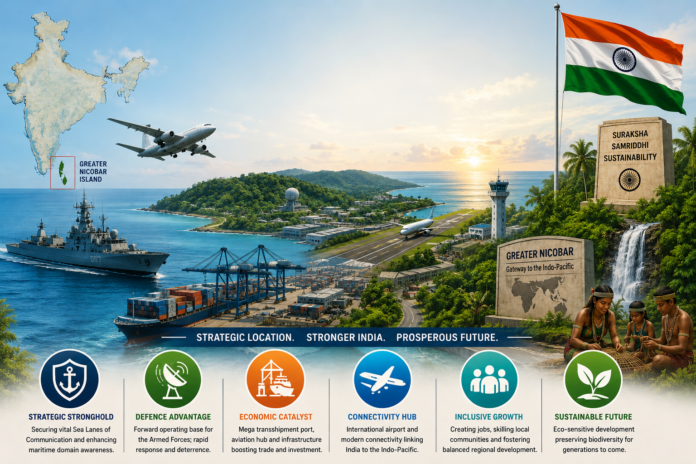
In an era defined by intensifying great-power competition in the Indo-Pacific, India cannot afford to remain a passive spectator on critical maritime routes. The Greater Nicobar Island Development Project stands as one of the most consequential infrastructure initiatives of our time.
This ₹81,000 crore (approximately $9-10 billion) transformative endeavour, conceived by NITI Aayog and executed through the Andaman and Nicobar Islands Integrated Development Corporation, will reshape Great Nicobar into a dual-purpose strategic and economic hub.

Spanning phases over three decades, the project encompasses an International Container Transshipment Terminal (ICTT) at Galathea Bay, a greenfield dual-use international airport, a hybrid gas-and-solar power plant, an integrated township, and supporting connectivity infrastructure.
Its significance transcends immediate construction; it embodies India’s determination to secure its maritime frontiers, reduce economic vulnerabilities, and emerge as a net security provider in the Indian Ocean Region (IOR).
The Geostrategic Imperative: Securing the Indo-Pacific Lifelines
Great Nicobar’s location is its greatest asset. Situated roughly 40 nautical miles from the East-West international shipping route and in close proximity to the Strait of Malacca – one of the world’s busiest maritime chokepoints – the island commands a vantage point over vital sea lanes connecting the Indian Ocean to the Pacific.
This positioning directly addresses India’s “Malacca Dilemma” concerns while countering the expanding Chinese footprint in the IOR, including port access in Sri Lanka, Pakistan, and Djibouti, alongside frequent submarine and surveillance deployments.

The project strengthens India’s strategic presence in the Andaman Sea and Southeast Asia. The proposed deep-water port and dual-use airport (with naval oversight) will enhance maritime domain awareness, enable rapid force projection, and support humanitarian assistance and disaster relief (HADR) operations.
Existing infrastructure like INS Baaz naval airbase at Campbell Bay gains powerful synergy. In an age of hybrid threats and contested sea lanes, this development transforms a remote outpost into a credible forward operating hub aligned with India’s Act East Policy and broader Indo-Pacific vision.

Spanning phases over three decades, the project encompasses an International Container Transshipment Terminal (ICTT) at Galathea Bay, a greenfield dual-use international airport, a hybrid gas-and-solar power plant, an integrated township, and supporting connectivity infrastructure
Defence veterans, including former Air Chief Marshal RKS Bhadauria, have rightly emphasised its critical importance for India’s military footprint and national security. Opposition that weakens this position inadvertently advantages adversarial interests.
Economic Dividends: From Revenue Leakage to Maritime Self-Reliance
India currently routes approximately 75% of its transshipment cargo through foreign hubs such as Singapore, Colombo, and Port Klang, resulting in annual losses estimated at $200–220 million in handling charges alone.
The Greater Nicobar ICTT, with Phase-I capacity targeting 4 – 4.4 million TEUs (expandable to 16+ million TEUs), is designed to capture a substantial share of this traffic. Natural water depths exceeding 20 metres at Galathea Bay provide a decisive advantage for large container vessels.
This shift will lower logistics costs for Indian exporters and importers, improve supply-chain resilience, attract foreign direct investment in logistics and ancillary industries, and generate significant foreign exchange savings. Long-term economic multipliers are profound.
Official estimates project up to 50,000 direct and indirect jobs over time, alongside billions in annual revenue once fully operational. Construction phases alone will employ thousands, while the integrated township and industrial components will foster skills development, entrepreneurship, and sustained economic activity on the islands.
The project strengthens India’s strategic presence in the Andaman Sea and Southeast Asia. The proposed deep-water port and dual-use airport (with naval oversight) will enhance maritime domain awareness, enable rapid force projection, and support humanitarian assistance and disaster relief (HADR) operations
By 2047, under the Amrit Kaal Vision, Great Nicobar could evolve into a regional transshipment powerhouse rivalling established hubs, supporting Maritime India Vision 2030 and positioning India as a pivotal node in global trade flows between Asia, Africa, Europe, and the Americas. The greenfield airport (peak capacity 4,000 passengers per hour) will further catalyse tourism and business connectivity to Southeast Asia.
Holistic Development: Powering Inclusive Growth and Regional Connectivity
Beyond port and airport, the project delivers comprehensive infrastructure. A 450 MVA hybrid power plant combining gas with solar and battery storage will provide reliable, lower-carbon energy – replacing diesel dependency and supporting industrial and residential growth.
An elevated coastal expressway, mass transit links, and desalination facilities ensure sustainable urbanisation. The integrated township will accommodate growing populations of workers, professionals, and residents, transforming the island’s socio-economic landscape.
Tourism components, leveraging the island’s pristine ecology, position Great Nicobar as a gateway near Phuket, Penang, and other regional destinations. This aligns seamlessly with the Holistic Development of Islands programme, accelerating overall progress in the Andaman and Nicobar archipelago while enhancing connectivity under Act East.
Crucially, no displacement of indigenous populations is planned; instead, net additions to tribal reserve areas have been notified. Independent monitoring committees for pollution, biodiversity, and tribal welfare, alongside studies by premier institutions like the Zoological Survey of India and Wildlife Institute of India, ensure ongoing oversight
Long-term, it fosters balanced regional development, reduces mainland-island disparities, and creates a self-sustaining economic ecosystem.
Sustainable and Inclusive Approach: Balancing Ambition with Responsibility
Critics rightly highlight ecological sensitivities and tribal concerns involving the Shompen and Nicobarese communities. The government has incorporated robust safeguards: environmental clearance with 42 compliance conditions, compensatory afforestation (including large-scale planting in Haryana), phased tree felling limited to under 2% of island forest cover in key phases, and preservation of extensive green zones maintaining over 75% forest cover.
Crucially, no displacement of indigenous populations is planned; instead, net additions to tribal reserve areas have been notified. Independent monitoring committees for pollution, biodiversity, and tribal welfare, alongside studies by premier institutions like the Zoological Survey of India and Wildlife Institute of India, ensure ongoing oversight.
The National Green Tribunal has upheld clearances, recognising the project’s strategic national importance alongside adequate protections. This balanced model demonstrates that strategic development and environmental stewardship are not mutually exclusive when executed with due diligence.
Long-Term Benefits: Building a Resilient, Prosperous Maritime Power
In the decades ahead, the Greater Nicobar Project will yield compounding returns. Economically, it reduces vulnerability to external chokepoints and foreign port dependencies, strengthening India’s trade competitiveness and strategic autonomy.
Job creation, skill development, and revenue streams will uplift island communities and contribute meaningfully to national GDP. Strategically, enhanced surveillance, rapid response capabilities, and dual-use infrastructure deter adversarial adventurism while reinforcing India’s role as a responsible maritime power.
With strong environmental and tribal safeguards in place, and overwhelming strategic and economic rationale, the project deserves broad national support. Critics may highlight short-term disruptions, yet the long-term legacy far outweighs them
The project supports deeper Quad and ASEAN engagement, bolsters supply-chain security amid global disruptions, and positions India to shape rules in the Indo-Pacific. Socially and developmentally, improved connectivity, reliable power, and tourism infrastructure promise higher living standards, better healthcare and education access, and cultural exchange.
By 2047, Great Nicobar could host smart-city elements, finance-linked precincts, and wellness tourism hubs – turning a sparsely populated island into a vibrant node of prosperity. The alternative – inaction – would perpetuate dependence, cede influence in critical sea lanes, and forgo economic opportunities at a time when global trade volumes continue rising.
A Vision Worth Pursuing
The Greater Nicobar Island Development Project is not merely an infrastructure scheme; it is a statement of intent. It affirms India’s resolve to secure its maritime destiny, harness geography for national strength, and deliver inclusive, sustainable growth.
With strong environmental and tribal safeguards in place, and overwhelming strategic and economic rationale, the project deserves broad national support. Critics may highlight short-term disruptions, yet the long-term legacy far outweighs them.
This initiative will not only reduce India’s dependence on foreign ports and generate tens of thousands of jobs but will also position the nation as a pivotal player in global maritime trade and Indo-Pacific security architecture.
As India aspires to become a leading global power, such visionary projects embody the spirit of Aatmanirbhar Bharat. They demonstrate that strategic foresight, when paired with responsible governance and environmental stewardship, can transform remote regions into engines of national progress
By 2047, Great Nicobar could emerge as a thriving hub of commerce, logistics, tourism, and innovation – contributing meaningfully to Viksit Bharat while strengthening supply-chain resilience in an uncertain world.
As India aspires to become a leading global power, such visionary projects embody the spirit of Aatmanirbhar Bharat. They demonstrate that strategic foresight, when paired with responsible governance and environmental stewardship, can transform remote regions into engines of national progress.
Greater Nicobar offers the chance to lead – turning a strategic outpost into a beacon of security, commerce, and opportunity for generations to come. In embracing this project with prudence and purpose, India takes a decisive step toward shaping its own future and contributing positively to regional stability and global trade flows. The time to act is now; the rewards will define India’s maritime century.

The writer is an independent researcher. The views expressed are of the writer and do not necessarily reflect the views of Raksha Anirveda





