


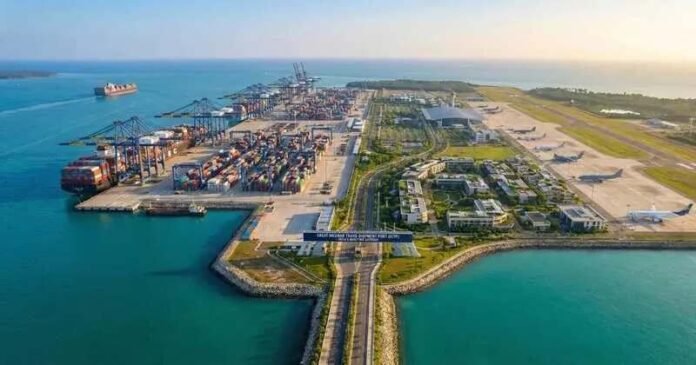
India stands at a turning point in its rise as a global power. The Great Nicobar Project is not just another infrastructure plan. It is a bold, game-changing move that will strengthen India’s economy, secure its borders, and give the country real power in the Indian Ocean. Under this ₹81,000 crore project, located on the southern tip of the Andaman and Nicobar Islands, a world-class trans-shipment port, a dual-use airport, a power plant, and a modern township will be developed.
India is intensifying its naval activities next to the Strait of Malacca, one of the world’s busiest shipping lanes, directly tackling China’s biggest weakness — the Malacca Dilemma. In simple terms, this project turns a remote island into India’s ‘unsinkable aircraft carrier’, and it gives New Delhi the leverage to protect its interests while checking China’s over-dependence on a single sea route.

The Vision Behind the Great Nicobar Project
The Great Nicobar Project was conceived by NITI Aayog and is being executed by the Andaman and Nicobar Islands Integrated Development Corporation. The total cost is around ₹81,000 crore, with the port alone estimated at ₹41,000 crore in early phases. Work is planned in stages over the next 30 years. The heart of the project is the Galathea Bay International Container Transshipment Terminal.
Phase one will handle 4 million TEUs (twenty-foot equivalent units) by 2028, and the full capacity will reach 16 million TEUs. This will make it one of Asia’s biggest ports. Along with the port, the project includes a greenfield international airport that can serve both civilian flights and military operations, a 450 MVA power plant that mixes gas and solar energy, and a township to support thousands of residents and workers. In plain terms, this is not just building roads and buildings. It is creating a completely new economic and defence hub at India’s southernmost point.
The heart of the project is the Galathea Bay International Container Transshipment Terminal. This will be one of Asia’s biggest ports. The project includes a greenfield international airport that can serve both civilian flights and military operations, a 450 MVA power plant that mixes gas and solar energy, and a township to support thousands of residents and workers
The island covers about 166 square kilometres of development area out of Great Nicobar’s total land. The project will bring jobs, boost trade, and turn a sparsely populated area into a thriving centre. Most importantly, it reduces India’s heavy dependence on foreign ports like Singapore and Colombo for transshipping goods. Indian cargo ships will no longer need to travel extra miles to unload and reload containers elsewhere. This saves time, cuts costs, and keeps more money inside the Indian economy.
The Strategic Location That Changes Everything
Great Nicobar Island sits in a perfect spot for both trade and security. It is only about 130 to 150 kilometres from the western entrance of the Strait of Malacca. Some shipping lanes pass just 40 nautical miles (around 74 kilometres) away. The Andaman and Nicobar Islands as a whole guard the entrance to the Andaman Sea and the busy routes connecting the Indian Ocean to the Pacific. Over 80,000 to 94,000 merchant ships pass through the nearby Malacca Strait every year. These ships carry nearly 30 to 40 per cent of global trade and about one-third of the world’s maritime oil. For India, this location is a natural gift. The islands already host the country’s only tri-services command—the Andaman and Nicobar Command—since 2001. Bases like INS Baaz are already monitoring the area with radars, aircraft, and naval ships.

The Great Nicobar Project adds a deep-water port, an airport, and supporting infrastructure that can be used by both commercial and military forces. In simple language, India gets eyes and ears on one of the most important waterways in the world. Any ship heading to or from East Asia must pass near this zone. This gives Indian forces the ability to watch movements, respond quickly in a crisis, and project power far beyond our shores without needing aircraft carriers every time.
Great Nicobar Island sits in a perfect spot for both trade and security. It is just 130 km from the Strait of Malacca. The Andaman and Nicobar Islands as a whole guard the entrance to the Andaman Sea and the busy routes connecting the Indian Ocean to the Pacific. Nearly 94,000 merchant ships pass through the Strait of Malacca every year
Understanding China’s Malacca Dilemma
China calls it the Malacca Dilemma. It is a simple but scary fact for Beijing. About 70 to 80 per cent of China’s imported crude oil travels through the narrow Strait of Malacca. The Strait is the shortest and cheapest route from the Middle East and Africa to Chinese ports. Every year, more than 60,000 vessels carry roughly 25 per cent of global maritime trade through this 2.8-kilometre-wide choke point at its narrowest. For China, which imports over half its oil needs, this route is a lifeline. If it gets blocked—even for a few weeks—factories would stop, fuel prices would skyrocket, and the economy would suffer badly. Chinese leaders have worried about this for years. They know that in any conflict with the United States or even a tense situation involving India, rival navies could easily shut down the strait. That is why China is building ports in Pakistan, Myanmar, and Sri Lanka under its Belt and Road Initiative. It is trying to create alternative land routes and diversify supplies. But pipelines and roads can carry only a fraction of what ships carry—maybe 10 to 15 per cent at best. The sea route remains the only realistic option for the huge volumes China needs. This dependence makes China nervous and forces it to spend billions on naval expansion to protect its ships.

How the Great Nicobar Project Gives India Real Leverage
This is where the Great Nicobar Project becomes India’s masterstroke. By building a major port and dual-use airport so close to the Malacca Strait, India gains the ability to monitor, influence, and, if needed, control access to this critical waterway. The new facilities will let Indian Navy ships and aircraft operate from a forward base with excellent natural depth and shelter. Surveillance will improve dramatically with radars and patrol aircraft based right there. In a crisis, India could support allies, protect its own trade, or apply pressure on any adversary trying to dominate the region.
Up to 80% of China’s crude oil travels through the narrow Strait of Malacca, which is the shortest and cheapest route from the Middle East and Africa to Chinese ports. Every year, more than 60,000 vessels carry roughly 25% of global maritime trade through this 2.8-km-wide chokepoint at its narrowest. For China, which imports over half its oil needs, this route is a lifeline
The project directly counters China’s “String of Pearls” strategy—the network of ports Beijing is building around India. Instead of letting China surround us, India is strengthening its own forward position in the eastern Indian Ocean. The transshipment port will also attract international shipping lines. Many countries that trade with Southeast Asia will prefer to use an Indian facility that is closer and more secure than depending on Singapore, which is under heavy Chinese economic influence. This reduces India’s own logistics costs and creates revenue from port fees and services. Data backs this up strongly.
The Malacca route carries trade worth trillions of dollars annually. Even a small share of transshipment business at Great Nicobar can bring in hundreds of crores in revenue while creating thousands of direct and indirect jobs. More importantly, it gives India diplomatic leverage. Countries worried about China’s growing naval power in the Indo-Pacific will see India as a reliable partner that can help keep sea lanes open and free. This strengthens ties with the United States, Japan, Australia, and ASEAN nations under frameworks like the Quad. In short, the project turns a geographic advantage into real strategic power without firing a single shot.
Economic Benefits That Go Beyond Defence
The Great Nicobar Project is not only about security—it is also about jobs and growth. India aims to become a $10 trillion economy. A modern transshipment hub will make the country a key player in global shipping. Currently, most Indian cargo is transshipped at foreign ports, adding extra costs of up to 20 per cent. The new port will change that. It will handle feeder vessels from Indian ports and big mother ships heading to Europe and East Asia. The airport will open the islands to tourism and high-value cargo.
The Great Nicobar Project is essential because it solves two problems at once: it builds economic strength and secures India’s place in the Indo-Pacific. By addressing China’s Malacca Dilemma head-on, India gains the upper hand without aggression. It shows the world that India is serious about protecting its interests and contributing to a stable, rules-based order at sea
The power plant and township will support a population of tens of thousands, bringing modern facilities, schools, and hospitals. Local tribes will benefit from new opportunities, while the government has promised to protect their rights. Overall, the project will boost India’s Exclusive Economic Zone, encourage eco-tourism in other parts of the islands, and create a ripple effect across the mainland economy through better connectivity.
Balancing Progress With Responsibility
Critics have raised valid points about the environment and local communities. Great Nicobar has rich forests and unique wildlife. The government has conducted detailed studies and is using sustainable methods, including compensatory afforestation and coral protection measures. Only a portion of the island is being developed, and strict rules under coastal regulation zones are in place. The project also includes plans to minimise impact on the indigenous Shompen and Nicobarese tribes. Development and ecology can go hand in hand when planned carefully, and the long-term gains in national security and jobs far outweigh short-term concerns. India cannot afford to leave such a strategic location undeveloped while competitors race ahead.
A Bold Step Towards India’s Future
The Great Nicobar Project is essential because it solves two problems at once: it builds economic strength and secures India’s place in the Indo-Pacific. By addressing China’s Malacca Dilemma head-on, India gains the upper hand without aggression. It shows the world that India is serious about protecting its interests and contributing to a stable, rules-based order at sea. As ships from every continent sail past our islands, this project ensures that India, not any other power, holds the key to those vital lanes. In the end, this is not just about one island or one port. It is about India’s rise as a confident maritime power. The Great Nicobar Project will create jobs, protect trade, and give our armed forces the reach they need. It is a smart, forward-looking investment that will pay dividends for generations. India must push ahead with full speed. Our future security and prosperity depend on it.

The writer is an independent researcher. The views expressed are of the writer and do not necessarily reflect the views of Raksha Anirveda





