


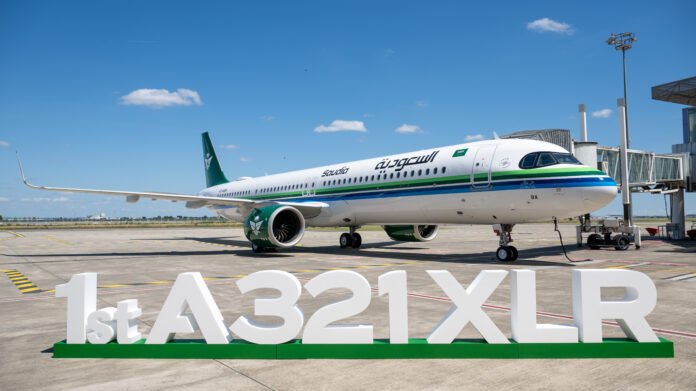
Toulouse. Saudia, the national flag carrier of the Kingdom of Saudi Arabia, has taken delivery of its first A321XLR, marking a significant milestone as the first airline in the Middle East and Africa to operate Airbus’ newest extra-long-range single-aisle aircraft.
The aircraft, powered by CFM International LEAP-1A engines, is the first of 15 A321XLRs on order by the airline. This delivery is a cornerstone of Saudia’s comprehensive fleet modernisation program, directly supporting the expansion of its international network in alignment with Saudi Vision 2030. By increasing connectivity and capacity, the A321XLR will support the Kingdom’s ambition to attract over 150 million visitors annually by the end of the decade.

This delivery reinforces a partnership between Airbus and Saudia that spans more than 40 years, beginning with the carrier’s first A300 delivery in 1984. Today, Airbus aircraft remain central to Saudia’s operations as it scales its fleet development and network growth.
Saudia currently serves more than 100 destinations across four continents, with the A321XLR supporting further expansion into new international markets. With a range of up to 4,700 nautical miles, the A321XLR enables Saudia to expand its international destinations with a single-aisle aircraft. These routes would have traditionally been served by larger widebody aircraft, while maintaining a premium guest experience.
The aircraft features a highly premium, low-density configuration with 24 full flat Business Class seats providing direct aisle access, alongside 120 comfortable Economy Class seats. The aircraft features the Airbus Airspace Cabin, bringing a widebody experience to a single-aisle jet. Key features include extra-large overhead bins, advanced lighting systems and one of the quietest cabins in its class.
The A321XLR is the latest evolution of the A320neo Family, designed to meet the global demand for increased range and operational flexibility. It delivers a 30% reduction in fuel burn per seat compared to previous-generation aircraft, lowering CO2 emissions and noise footprints. Today all Airbus aircraft are capable of operating with 50% sustainable aviation fuel (SAF) with a target to increase to up to 100% SAF capability by 2030, directly supporting the aviation industry’s sustainability goals.

To date, the A320 Family has secured more than 19,900 orders from over 300 customers worldwide, solidifying its position as the world’s most successful commercial aircraft programme.






