


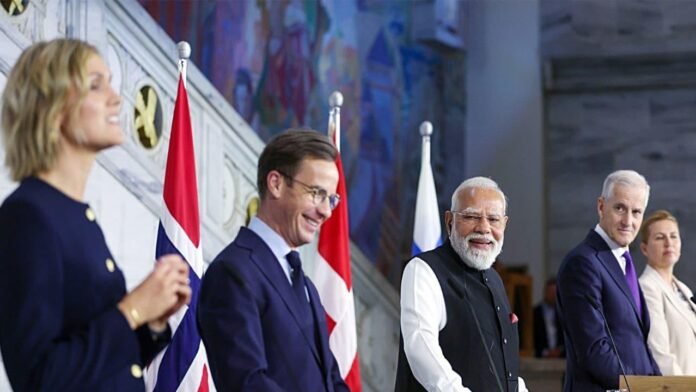
New Delhi: India’s emergence as a co‑author of global governance was underscored at the 3rd India‑Nordic Summit in Oslo, where Denmark’s Prime Minister Mette Frederiksen described India as “not a middle power, but one of the world’s greatest powers.”
This remark captured the broader geopolitical transition in which India is increasingly recognised as a sherpa of climate, technology and governance frameworks rather than a peripheral participant. The summit was not a routine diplomatic gathering but a structural shift in India’s positioning within the global order.

According to analysts Akshara Agrawal and Somen Chatterjee, writing in One World Outlook and India Narrative respectively, the summit crystallised India‑Nordic relations into a strategic alignment. Agrawal described the moment as a transformation from a “nice‑to‑have” arrangement into a purpose‑driven partnership centred on green transition, technological collaboration and geopolitical coordination.
Chatterjee framed it as a “quiet but consequential re‑wiring of global technology governance,” where India was no longer a passive consumer of rules but a co‑author of digital and AI norms.
At the heart of the summit was the formal elevation of ties into a “Green Technology and Innovation Strategic Partnership.” This was not mere diplomatic phrasing but a deliberate convergence linking cooperation to clean energy, blue economy initiatives, shipping, climate innovation and digital systems.
The timing was significant, as the India‑EU Free Trade Agreement concluded in January 2026 and the India‑EFTA Trade and Economic Partnership Agreement operationalised in late 2025 provided the institutional scaffolding.

Under the EFTA agreement, which includes Norway and Iceland, the bloc committed to a US$ 100 billion investment ambition in India over fifteen years, focusing on green hydrogen and digital infrastructure.
Trade between India and the Nordic countries currently stands at around US$ 19 billion, with more than 700 Nordic companies operating in India and about 150 Indian companies present across the Nordic region. These figures illustrate the evolution from limited commercial engagement into a broader strategic ecosystem.

Agrawal argued that the relationship is complementary: Nordic economies bring expertise in wind energy, geothermal systems, green hydrogen, maritime decarbonisation, battery technology and digital governance, while India offers scale, manufacturing capacity and a rapidly expanding technology ecosystem.
She noted that Nordic innovation requires India’s markets and manufacturing partners to achieve global impact, while India needs Nordic technological depth to accelerate its green and digital ambitions.






