

For nearly a decade, India’s rise has carried the confidence of a country convinced its moment has arrived. New highways now connect regions once left behind by poor infrastructure. Airports are appearing in smaller cities. Digital payments have transformed everyday commerce. Manufacturing ambitions have expanded. India increasingly speaks not merely as a balancing power, but as a country shaping global conversations. The phrase ‘Viksit Bharat’ captured that national mood perfectly.
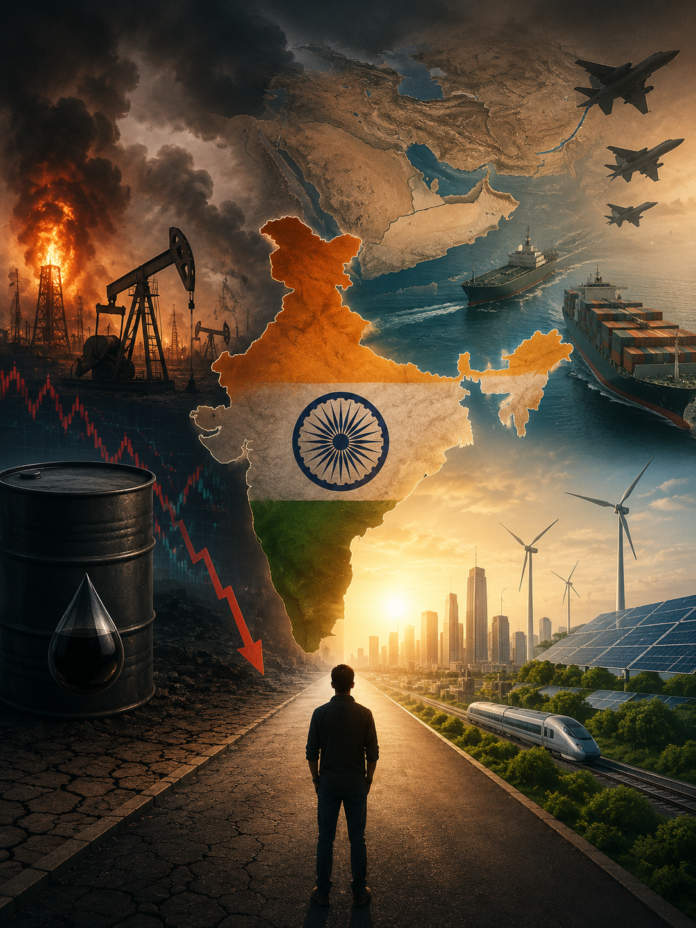
Then came the Iran conflict and the fresh instability across West Asia.

At first, the concern appeared limited to oil markets. Crude prices climbed sharply. Shipping risks increased around the Strait of Hormuz. Freight and insurance costs rose. Economists began warning about inflationary pressure. But as the crisis unfolded, it exposed something larger than energy dependence alone. It exposed the gap between growth and resilience.
India today is unquestionably stronger than it was during earlier global crises. Foreign exchange reserves are healthier. Infrastructure capacity has improved dramatically. Renewable energy expansion has accelerated. Digital governance systems now allow quicker economic responses than in the past. India’s diplomacy has also become more agile, allowing it to maintain working relationships across competing global powers. These are significant national strengths.
Yet modern crises do not test only economic momentum. They test structural durability.
The first vulnerability remains energy. India still imports most of the crude oil it consumes. That dependence means any instability in West Asia quickly travels into the domestic economy. In India, fuel prices never remain confined to petrol pumps. They move silently through transportation costs, food distribution, aviation, fertilisers, and industrial logistics.

Geopolitics eventually reaches ordinary homes through monthly expenses. Yet the larger lesson from the Iran crisis is not only about oil. It is about dependence itself.
India’s representation among the world’s top 500 companies has narrowed significantly. Market cycles are natural, but it is a reminder that economic confidence can change quickly when global uncertainty rises. The shrinking size of India’s so-called ‘hundred-billion-dollar club’ tells a similar story. Only a handful of Indian firms remain above that valuation threshold today
India’s growth story still relies heavily on global supply chains, imported technologies, maritime trade routes, and foreign capital flows. As shipping uncertainty increased and investors became cautious, the pressure became visible across markets and industries.

That shift was also evident in India’s corporate rankings. At the beginning of 2025, Reliance Industries, HDFC Bank, and Tata Consultancy Services were among the world’s top 100 companies by market capitalisation. Months later, all three slipped out of that group following sustained market correction and foreign investor outflows. India’s representation among the world’s top 500 companies also narrowed significantly. This does not signal decline. Market cycles are natural. But it serves as a reminder that economic confidence can change quickly when global uncertainty rises.
The shrinking size of India’s so-called ‘hundred-billion-dollar club’ tells a similar story. Only a handful of Indian firms remain above that valuation threshold today. Foreign investor selling, elevated market valuations, and wider regional instability have all contributed to the correction. The lesson is not that India lacks potential. Rather, the lesson is that large ambitions require equally deep financial resilience.
Another debate gaining attention concerns the growing dependence on surplus transfers from the Reserve Bank of India to support government finances. Critics increasingly worry that repeated large transfers from the RBI could gradually erode financial buffers meant to support economic stability during future crises. The concern is not about a single transfer, but about the long-term balance between fiscal requirements and institutional independence.
Another debate gaining attention concerns the government’s dependence on surplus transfers from the RBI. Critics worry that repeated large transfers from the RBI could erode financial buffers meant to support economic stability during future crises. The concern is about the long-term balance between fiscal requirements and institutional independence
Strong economies depend not only on growth but on trust in institutions capable of functioning independently during difficult periods.
The Iran crisis also exposed India’s dependence on maritime trade. Nearly all of India’s trade by volume moves through sea routes. Any disruption in strategic waterways affects shipping schedules, export competitiveness, energy access, and industrial production simultaneously. That changes how national security must be understood. Naval preparedness is no longer only a military issue. It has become directly linked to economic security.
The same applies to technology. India has emerged as a global leader in software services and digital public infrastructure, yet critical hardware ecosystems still depend heavily on external supply chains. Semiconductors, telecom equipment, specialised electronics, sensors, and battery systems remain vulnerable to geopolitical tensions and supply disruptions.
The Iran crisis exposed India’s dependence on maritime trade. Nearly all of India’s trade by volume moves through sea routes. A disruption in waterways affects shipping schedules, export competitiveness, energy access, and industrial production. Naval preparedness is no longer only a military issue. It has become directly linked to economic security
The world is entering an era in which energy, technology, and trade access are increasingly shaped by strategic competition rather than by market efficiency alone. India is not unique in facing these challenges. Europe struggled after disruptions in gas supply during the Ukraine war. China remains deeply dependent on maritime routes for trade and energy. Japan and South Korea have managed similar vulnerabilities for decades. In an interconnected world, no major economy is fully insulated from external shocks.
The real difference lies in preparedness.
India still possesses enormous structural strengths. Its domestic market is among the largest in the world. Its demographic profile remains favourable compared to ageing economies elsewhere. Infrastructure expansion continues at a remarkable speed. Manufacturing capacity is improving steadily. India’s diplomatic positioning has become more balanced and pragmatic than at any point in recent decades.
That is precisely why the Iran crisis should not be viewed as a setback to the Viksit Bharat vision. It should be treated as a strategic warning delivered early enough to act upon.
Growth alone does not create resilience. Resilience comes from diversification, redundancy, institutional strength, strategic reserves, technological depth, and the ability to absorb external shocks without losing national momentum.
India still possesses enormous structural strengths. Its domestic market is among the largest in the world. Its demographic profile remains favourable compared to ageing economies elsewhere. Infrastructure expansion continues at a remarkable speed. Manufacturing capacity is improving steadily. The vision of Viksit Bharat remains achievable
That means expanding energy security further. It means investing more seriously in public transport, freight rail, storage systems, semiconductor manufacturing, and domestic industrial ecosystems. It means integrating economic planning, maritime strategy, technology policy, and national security into one coherent framework rather than treating them separately.
Most importantly, it requires recognising that future crises will not remain confined to distant battlefields. Wars today disrupt currencies, shipping networks, stock markets, technology flows, food prices, and household economics simultaneously.
The vision of Viksit Bharat remains achievable. India’s rise is real and historically significant. But the next stage of that journey will depend less on headline growth numbers and more on whether India can build systems strong enough to endure a far more unstable world.
Because nations become truly developed not when the global environment is calm, but when instability no longer shakes their foundations.

The writer, a PVSM, AVSM, VSM has had an illustrious career spanning nearly four decades. A distinguished Armoured Corps officer, he has served in various prestigious staff and command appointments including Commander Independent Armoured Brigade, ADG PP, GOC Armoured Division and GOC Strike 1. The officer retired as DG Mechanised Forces in December 2017 during which he was the architect to initiate process for reintroduction of Light Tank and Chairman on the study on C5ISR for Indian Army. Subsequently he was Consultant MoD/OFB from 2018 to 2020. He is also a reputed defence analyst, a motivational speaker and prolific writer on matters of military, defence technology and national security. The views expressed are personal and do not necessarily carry the views of Raksha Anirveda





