


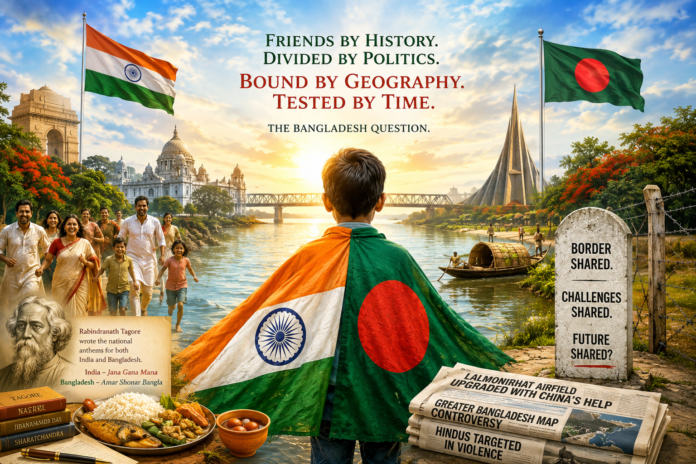
The Death in Chattogram and the Larger Question: On May 19, 2026, the death of Naren Dhar, an Assistant Protocol Officer, in Chattogram triggered concern far beyond the immediate tragedy of one life lost. In another context, the death of this mid-level official may have remained a localised incident. But in the present uneasy climate of India-Bangladesh relations, it carried a larger symbolic meaning.
The incident came amid a series of developments that have steadily deepened Indian unease. For many Indians, especially those who remember 1971 emotionally, these developments are deeply unsettling. India fought a war, absorbed millions of refugees, sacrificed soldiers, and altered the map of South Asia to help liberate East Pakistan and create Bangladesh. Yet, fifty-five years later, the relationship often appears fragile, suspicious, and strategically uncertain.

What went wrong? Was it a failure of Indian foreign policy? Was it the resurgence of religious identity? Or was it a combination of both?
The answer lies in the intersection of history, identity, geopolitics, and strategic neglect.
1971: India’s Greatest Moral and Strategic Intervention
The birth of Bangladesh in 1971 remains one of independent India’s greatest strategic and moral achievements. The Pakistani military crackdown in East Pakistan unleashed widespread atrocities, political repression, and humanitarian devastation. Millions of refugees crossed into India, creating immense social and economic pressure on border states.
The emotional bond created during the Bangladesh liberation struggle generated an expectation in India that Dhaka would remain a natural partner. But nations do not define themselves through a single historical moment. The ideological foundations of Bangladesh were far less settled than they appeared in 1971
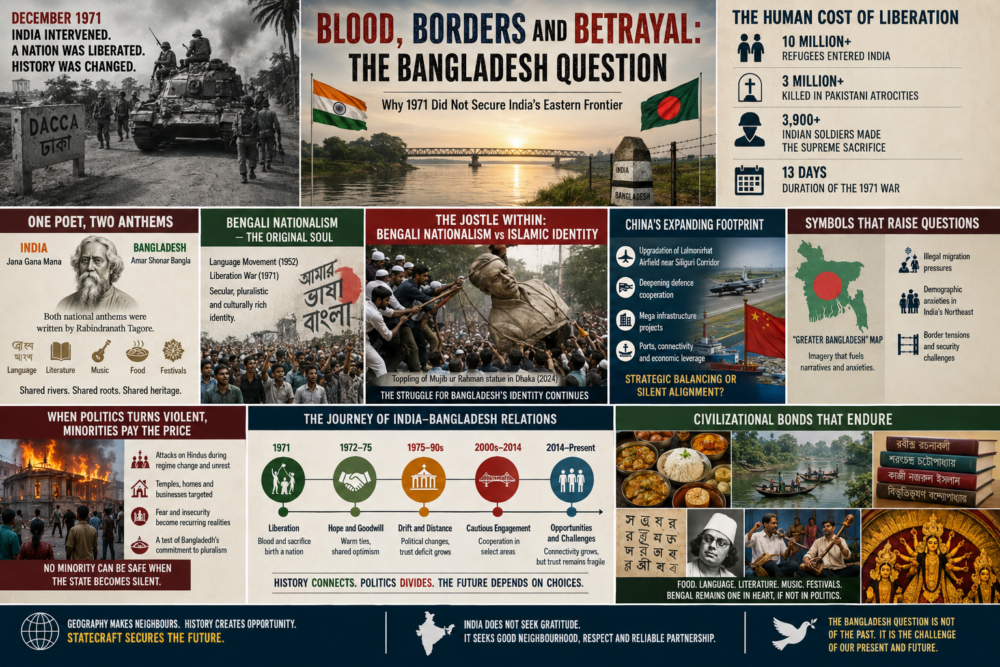
India responded with extraordinary diplomatic and military clarity. Despite pressure from major powers and the risks of escalation, India intervened decisively. The Bangladesh Liberation War ended in a stunning Indian victory within thirteen days. Pakistan was divided, and Bangladesh emerged as an independent nation. For India, the war represented more than military success. It was seen as the triumph of justice over oppression and of Bengali identity over authoritarian domination. The emotional bond created during the liberation struggle generated an expectation in India that Bangladesh would remain a naturally aligned partner.

However, India misunderstood one crucial reality: nations do not permanently define themselves through one historical moment. The ideological foundations of Bangladesh were far less settled than they appeared in 1971.
The Central Contradiction: Bengali Nationalism vs Islamic Identity

India believed that Bengali linguistic and cultural identity would permanently outweigh religious identity in Bangladesh. That assumption proved only partially correct.
The liberation struggle had certainly been driven by Bengali nationalism. But it had not erased the deep social and political influence of Islam within Bangladeshi society. Liberation from Pakistan did not necessarily mean liberation from the politics of religious identity.
The assassination of Sheikh Mujibur Rahman in 1975 marked a decisive turning point. Bangladesh gradually moved away from the secular principles embedded in its original constitutional vision. Military rulers such as Ziaur Rahman and H.M. Ershad reintroduced Islamic symbolism into politics and governance. Over time, secular nationalism weakened while religious identity regained political space.
The Bangladesh liberation struggle had certainly been driven by Bengali nationalism. But it had not erased the deep social and political influence of Islam within Bangladeshi society. Liberation from Pakistan did not necessarily mean liberation from the politics of religious identity. Islam became a source of political legitimacy. Pakistan’s ideological shadow quietly returned
The ideological vocabulary of the state slowly changed. Islam increasingly became a source of political legitimacy. Pakistan’s ideological shadow, though not dominant, quietly returned through sections of religious discourse and political mobilisation.
Bangladesh remained culturally distinct from Pakistan. Yet the internal tension between Bengali pluralism and Islamic political mobilisation never disappeared. This contradiction continues to shape Bangladesh even today. One section of society sees the country as a secular Bengali nation with a unique cultural identity. Another sees Islamic solidarity and religious politics as equally central to national identity.
India underestimated the depth and durability of this internal ideological struggle.
The Regime Change, Mob Power and the Hindu Question
Recent political instability in Bangladesh has exposed the dangers of this unresolved tension. Organised street mobilisation, regime-change turbulence, and allegations of deep-state involvement created an atmosphere where mob politics began overpowering institutional stability.
During these periods of unrest, Hindu minorities once again became vulnerable. Reports emerged of attacks on temples, homes, businesses, and individuals. Fear spread among minority communities that have historically faced insecurity during moments of political upheaval.
For India, this issue carries significance beyond humanitarian concern. The fate of Hindus in Bangladesh resonates emotionally and civilisationally within India. Every attack on minorities across the border strengthens mistrust and deepens public anxiety regarding the long-term direction of Bangladesh.
This internal instability has coincided with another major development — the growing strategic presence of China.
China’s Expanding Footprint and the Strategic Shift
The Chinese-assisted upgradation of Lalmonirhat airfield is not merely an infrastructure project. Its proximity to India’s strategically sensitive Siliguri Corridor gives it wider geopolitical implications. For Indian strategic planners, such developments cannot be viewed in isolation.
China has steadily expanded its footprint in Bangladesh through infrastructure investments, defence cooperation, connectivity projects, technology networks, and economic engagement. Beijing’s approach has been patient, systematic, and transactional. Unlike India, China carries no historical baggage in Bangladesh and offers large-scale investment without public political pressure.
For India, attacks on Hindu minorities, their temples, homes, businesses, and individuals carry significance beyond humanitarian concern. The fate of Hindus in Bangladesh resonates emotionally within India. Every attack on minorities deepens public anxiety regarding the long-term direction of Bangladesh
Bangladesh, like many smaller nations, seeks strategic balancing. It does not want overwhelming dependence on any one power. China provides an alternative source of leverage against India’s natural geographic dominance.
The controversy surrounding the “Greater Bangladesh” imagery on the cover of Art of Triumph: Graffiti of Bangladesh’s New Dawn also carried symbolic significance. Whether intentional or not, such imagery feeds Indian anxieties regarding illegal migration, demographic pressure, and territorial sensitivities in the Northeast.
Geopolitics is shaped not only by armies and treaties, but also by narratives and symbols.
Maps matter. Historical imagination matters. Political messaging matters.
India once assumed geography guaranteed influence. China’s rise in Bangladesh demonstrates that geography alone cannot ensure strategic alignment.
India’s Foreign Policy Miscalculations
India’s biggest mistake was assuming that the emotional memory of 1971 would permanently sustain goodwill.
New Delhi invested heavily in military victory but insufficiently in long-term strategic influence. India failed to build deep and lasting engagement with Bangladesh’s educational institutions, intellectual circles, media ecosystem, and younger generation.
China-assisted upgradation of Lalmonirhat airfield is not merely an infrastructure project. Its proximity to India’s strategically sensitive Siliguri Corridor gives it wider geopolitical implications. For Indian strategic planners, such developments cannot be viewed in isolation
Over time, India also acquired the image of a “big brother” — powerful, sometimes insensitive, and occasionally dismissive of Bangladeshi concerns. Water-sharing disputes, such as the Teesta issue, remained unresolved. Border tensions periodically generated resentment. Anti-India rhetoric became politically useful for Bangladeshi politicians seeking nationalist legitimacy.
Meanwhile, rival powers invested steadily and strategically.
It is in this context that the recent remarks of Prime Minister Narendra Modi in May 2026 regarding commitment, professionalism, and accountability among Indian Foreign Service officers acquire wider relevance. His emphasis reflected a deeper strategic truth: neighbourhood diplomacy cannot function through routine bureaucracy or episodic engagement.
India requires diplomats with regional expertise, historical understanding, linguistic familiarity, and long-term strategic commitment. Relationships with neighbouring countries cannot survive merely through ceremonial visits or references to historical friendship. They require continuous cultivation across generations.
The challenge before India is not emotional disappointment, but strategic adaptation.
Why Bangladesh Still Matters Deeply to India
Despite tensions and disappointments, Bangladesh remains critically important for India.
The two countries share geography, history, culture, rivers, and deep human connections. Bangladesh is central to connectivity with India’s Northeast and to stability in the Bay of Bengal region. Economic cooperation between the two countries has grown significantly over the years.
Geopolitics is shaped not only by armies and treaties, but also by narratives and symbols. Maps matter, historical imagination matters, political messaging matters. India once assumed geography guaranteed influence. China’s rise in Bangladesh demonstrates that geography alone cannot ensure strategic alignment
Despite political tensions, the civilisational and cultural bonds between India and Bangladesh remain profound and unique. Few relationships in the modern world are bound by such deep linguistic, literary, and emotional continuity. Remarkably, the national anthems of both India and Bangladesh were written by the same poet, Rabindranath Tagore. India sings Jana Gana Mana while Bangladesh sings Amar Sonar Bangla. The rivers, music, poetry, cuisine, festivals, and literary traditions of Bengal continue to flow across political borders. From Tagore and Kazi Nazrul Islam to shared culinary traditions of fish, rice, sweets, and tea culture, the cultural intimacy between the two societies remains extraordinary. That is precisely why periods of hostility and mistrust feel not merely strategic, but deeply civilisational and emotional.
There have also been major positive developments. Under Sheikh Hasina, security cooperation improved substantially. Bangladesh acted against insurgent groups operating against India from its territory. Connectivity and trade expanded. Energy cooperation increased.

These successes show that constructive engagement is entirely possible.
However, India must recognise that Bangladesh’s internal identity struggle and external balancing strategy will continue. The relationship cannot be built merely on memories of 1971.
India requires diplomats with regional expertise, historical understanding, linguistic familiarity, and long-term strategic commitment. Relationships with neighbouring countries cannot survive merely through ceremonial visits or references to historical friendship. They require continuous cultivation across generations
The Hard Lesson of 1971
The story of Bangladesh is ultimately a hard lesson in statecraft.
India won a historic military victory in 1971 and helped create a new nation. But military success alone cannot permanently shape another country’s political identity or strategic orientation. Bangladesh today stands at the intersection of Bengali nationalism, Islamic politics, Chinese influence, domestic instability, and regional balancing. India, meanwhile, must move beyond emotional assumptions and embrace long-term strategic realism.
The generation that emotionally remembers India’s sacrifices in 1971 is slowly fading. Younger generations in Bangladesh judge India not through history, but through present realities. That is the strategic landscape India now faces. India’s victory in 1971 changed the map of South Asia forever. But history now reminds us of a deeper truth: strategic influence must be renewed patiently and continuously across generations — or it gradually fades, even among those whose freedom once came through our sacrifice.
Nations do not operate on gratitude. They operate on interests, identity, security, and political narratives.

Lt Gen Rajeev Chaudhry (Retd) writes on contemporary national and international issues, strategic implications of infrastructure development towards national power, geo-moral dimension of international relations, and leadership nuances in a changing social construct. The views expressed are of the author and do not necessarily reflect the views of Raksha Anirveda





