


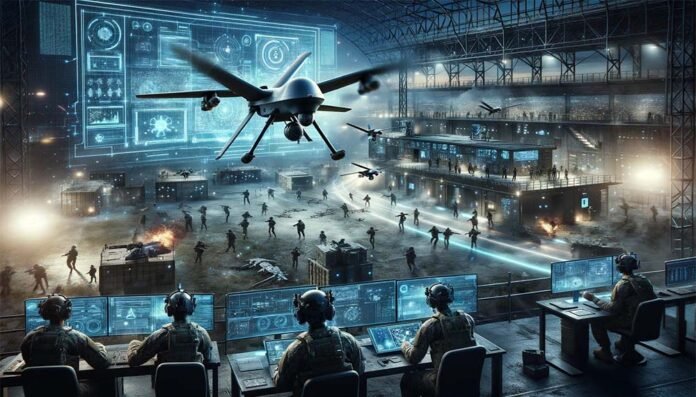
The character of warfare has undergone a dramatic transformation over the past few decades. For centuries, military success depended largely on manpower, firepower, and industrial capacity. Today, however, the battlefield is increasingly shaped by technology, data, and intelligent systems. With Artificial Intelligence (AI), autonomous drones, cyber capabilities, and advanced sensors, nations are redefining the concept of Warfare.
Recent conflicts have highlighted this transformation more clearly than ever before. The Russia-Ukraine war has demonstrated how relatively inexpensive drones can threaten military assets worth millions of dollars. Battlefield success is no longer determined solely by the number of tanks or aircraft a nation possesses, but also by its ability to collect information, process data, and make decisions faster than its adversary. In this new era, AI is emerging as a powerful force multiplier, making autonomous systems a centre of modern warfare.

Rise of Autonomous Systems
One of the most visible outcomes of AI-driven military innovation is the rapid growth of autonomous systems. Surveillance drones are now capable of conducting long-duration reconnaissance missions, identifying targets, and transmitting real-time intelligence with minimal human intervention.
Equipped with advanced sensors, edge computing capabilities, and AI-powered image recognition systems, these platforms provide commanders with unparalleled situational awareness.
Beyond military applications, autonomous systems are already transforming various sectors such as transportation, logistics, manufacturing, and healthcare. These developments demonstrate the growing maturity of AI technologies and their potential to influence future military operations
Another major development is the rise of loitering munitions, often referred to as ‘Kamikaze Drones’. These systems combine surveillance and strike capabilities within a single platform. Unlike traditional missiles, loitering munitions can remain airborne for extended periods, search for targets independently, and execute precision attacks when opportunities arise. Their effectiveness in recent conflicts has accelerated global interest in autonomous strike systems.
AI-assisted targeting has further reduced the time required to identify, classify, and engage threats. By integrating sensor data from multiple sources, machine learning algorithms can help military operators detect targets with greater speed and accuracy. Although human oversight remains essential, AI is increasingly becoming a critical decision-support tool to dominate the battlefield.

Beyond military applications, autonomous systems are already transforming various sectors such as transportation, logistics, manufacturing, and healthcare. These developments demonstrate the growing maturity of AI technologies and their potential to influence future military operations.
The Global Race for Military AI
Major military powers around the globe have already recognised the strategic significance of AI and are investing heavily in autonomous warfare capabilities.

The United States remains at the forefront of military AI development. Through initiatives such as the Department of Defence’s Replicator Program, Washington aims to rapidly deploy thousands of autonomous and AI-enabled systems across multiple domains. Their objective is clear: create affordable, scalable, and networked platforms capable of operating in highly contested environments while maintaining human control over critical combat decisions.
The US is at the forefront of military AI development, China has embraced the concept of ‘intelligentised warfare’, and Israel has emerged as a global leader in drone technology and AI-enabled battlefield integration. The success of the Bayraktar TB2 drone has transformed Turkiye into an exporter of military drones
China has also embraced the concept of ‘intelligentised warfare’, which seeks to integrate AI into every aspect of military operations. Supported by substantial defence investments and close cooperation between civilian technology firms and the military, China is developing autonomous systems, drone swarms, and AI-enabled command networks. Beijing views AI as a key part of the quest to build a world-class military by the mid-2030s.
Israel has also emerged as a global leader in drone technology and AI-enabled battlefield integration. The Israeli defence ecosystem combines advanced surveillance networks, automated target generation systems, and autonomous platforms to enhance operational effectiveness. Its experience demonstrates how AI can shorten the gap between intelligence collection and strike execution.
Turkey also provides another important example. The success of the Bayraktar TB2 drone has transformed the country into a major exporter of military drones. Its performance in multiple conflict zones has shown that cost-effective unmanned systems can generate significant military and geopolitical influence. Turkey’s experience highlights how indigenous innovation can create both strategic and economic advantages.
India’s Progress in Autonomous Warfare
India has made notable progress in adopting AI and autonomous technologies for defence applications. The Defence Research and Development Organisation (DRDO) is pursuing several projects aimed at strengthening indigenous capabilities in autonomous warfare. Programmes such as the Ghatak Unmanned Combat Aerial Vehicle (UCAV), AI-enabled surveillance systems, and advanced drone-launched weapon concepts indicate the growing momentum in this field.
To remain competitive in the evolving security environment, India must significantly expand investments in defence research and development. Indigenous programmes focused on AI, autonomous systems, quantum technologies, and advanced aerospace platforms should receive sustained support
Equally important is the emergence of a vibrant domestic drone ecosystem. Indian startups such as ideaForge, Garuda Aerospace, Raphe mPhibr, NewSpace, and several others are developing innovative solutions for defence, surveillance, and unmanned operations. These companies are contributing to India’s broader goal of reducing dependence on imported technologies.
The Indian Armed Forces have also accelerated the adoption of drones and autonomous systems. The Army is integrating drones for tactical surveillance and reconnaissance missions, while the Navy is expanding the use of unmanned platforms for maritime domain awareness. The Indian Air Force is exploring advanced concepts such as loyal wingman systems and future combat drones designed to operate alongside manned aircraft.
Government initiatives such as the IndiaAI Mission, Innovations for Defence Excellence (iDEX), and increased support for defence startups are creating a favourable environment for technological innovation. Together, these efforts are laying the foundation for a more self-reliant and technologically advanced indigenous defence ecosystem.
Challenges Ahead
Despite encouraging progress, India faces several challenges in its pursuit of AI-enabled military capabilities.
Cybersecurity remains a major concern. Autonomous systems depend heavily on software, communications networks, and data infrastructure, all of which can become targets for cyberattacks. Adversaries may attempt to disrupt operations through hacking, data manipulation, or electronic warfare.
Cybersecurity remains a major concern. Autonomous systems depend heavily on software, communications networks, and data infrastructure, all of which can become targets for cyberattacks. Adversaries may attempt to disrupt operations through hacking, data manipulation, or electronic warfare
Data security presents another challenge. AI systems require massive amounts of reliable data for training and operational effectiveness. Protecting sensitive military information from breaches and unauthorised access will be essential.
Ethical and legal questions surrounding autonomous weapons continue to generate global debate. Issues such as accountability, civilian protection, algorithmic bias, and the acceptable level of machine autonomy in combat require careful consideration. Human oversight must remain central to decisions involving the use of lethal force.
India also addresses shortages in skilled human capital. Building a robust military AI ecosystem will require trained researchers, software engineers, defence technologists, and military personnel capable of operating increasingly sophisticated systems.
Finally, dependence on imported components, particularly semiconductors, sensors, and advanced electronics, remains a strategic vulnerability. Long-term self-reliance will depend on strengthening domestic manufacturing capabilities across critical technology sectors.
The Way Forward
To remain competitive in the evolving security environment, India must significantly expand investments in defence research and development. Indigenous programmes focused on AI, autonomous systems, quantum technologies, and advanced aerospace platforms should receive sustained support.
A strong AI ecosystem will be equally important. Initiatives under the IndiaAI Mission should continue to promote domestic innovation, computing infrastructure, talent development, and responsible AI governance.
India must strengthen collaboration between defence startups, private industry, academia, and government institutions. Innovation thrives when research, entrepreneurship, and operational requirements are closely connected. Startups can bring agility and fresh ideas, while academic institutions can contribute advanced research and skilled talent
Collaboration between defence startups, private industry, academia, and government institutions must be strengthened. Innovation thrives when research, entrepreneurship, and operational requirements are closely connected. Startups can bring agility and fresh ideas, while academic institutions can contribute advanced research and skilled talent.
India should also establish a long-term military AI roadmap that aligns technological development with national security objectives. Such a roadmap would help ensure coordinated investments, capability development, and strategic planning across all branches of the armed forces.
Conclusion
The future battlefield will be defined not only by weapons and manpower, but by the ability to process information, make decisions, and act faster than an adversary. Artificial intelligence and autonomous systems are rapidly becoming the foundation of that advantage.
For India, the challenge is not merely to adopt these technologies but to develop them indigenously and at scale. The objective should not be to replicate the American or Chinese model, but to build cost-effective, mission-oriented solutions tailored to India’s unique strategic requirements. Nations that master AI-driven warfare will shape the balance of power in the decades ahead. For India, embracing this transformation is not a choice; it is a strategic necessity.

The writer is an engineering student pursuing a B.E. in Artificial Intelligence and Machine Learning from Pune. His areas of focus include autonomous warfare systems, aerospace innovation, artificial intelligence in defence, and India's evolving national security landscape.





