


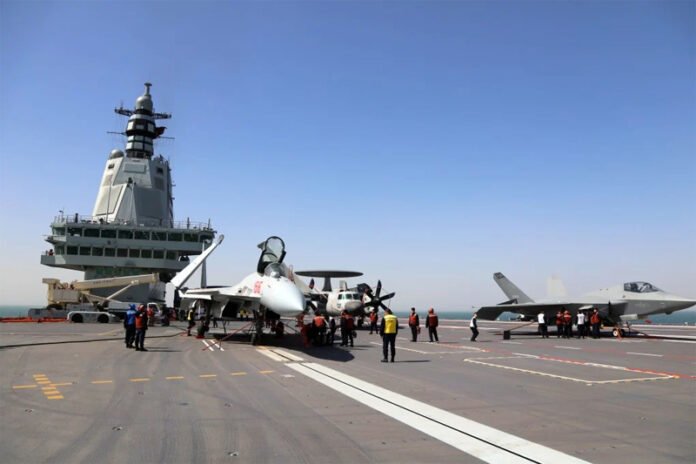
Beijing: Three carrier-based aircraft have for the first time successfully carried out electromagnetic catapult-assisted take-off and landing from the country’s third aircraft carrier, the Fujian, announced China’s navy on September 22.
Gearing up for its official induction, Fujian is the first among the three Chinese aircraft carriers equipped with the electromagnetic aircraft launch system (EMALS), a technology so far used only by US carriers.

As per the China’s navy, carrier-based aircraft J-15T, J-35 and KongJing-600 have successfully completed their inaugural electromagnetic catapult-assisted take-off and arrested landing training on the Fujian.
The success marked another breakthrough in the development of China’s aircraft carriers, the state-run Xinhua news agency said, quoting the naval announcement. It showed that China’s first domestically built catapult-equipped aircraft carrier has obtained electromagnetic catapult launch and recovery capabilities.
Launched last year, Fujian is stated to be the most advanced aircraft carrier possessing EMALS and has completed multiple sea trials, accumulating more than 100 days of sea trials.
Capable of carrying a wide range of aircraft, including fighter jets, early warning aircraft, anti-submarine aircraft and drones, the over 80,000-tonne Fujian will enable China to enter a new era of three aircraft carriers, according to official media reports.

The commissioning of the Fujian is slated later this year as it has completed extensive sea trials, setting the stage for the Chinese navy for the first time to operate three carrier groups.
Recent trial deployments of the Fujian in the Taiwan Strait and the disputed South China Sea have raised concerns about Beijing flexing its muscle to enforce its territorial claims. China claims Taiwan as part of its mainland and also claims most of the South China Sea, contested by The Philippines, Vietnam, Malaysia, Brunei and Taiwan.

China may also extend after the operationalisation of the Fujian, the deployment of aircraft carriers in India’s backyard – the Indian Ocean and Arabian Sea, where its naval fleet is active with bases in Djibouti in the Horn of Africa, Pakistan’s Gwadar port, and Sri Lanka’s Hambantota port, which China acquired as a debt swap.
China currently operates 234 warships, the largest in the world, overtaking the US Navy’s 219, according to a recent BBC report. The Indian Navy currently operates two carriers – INS Vikrant and INS Vikramaditya – and is commissioning new ships to maintain its influence in the Indian Ocean.
Beijing is planning to develop four to five aircraft carriers, including a nuclear-powered carrier, as it seeks to expand its global naval influence with deployments in the South China Sea, the Taiwan Strait and the Indian Ocean in future, according to official Chinese media. Simultaneously, China is developing a new fighter aircraft that can operate from its carrier groups.






