


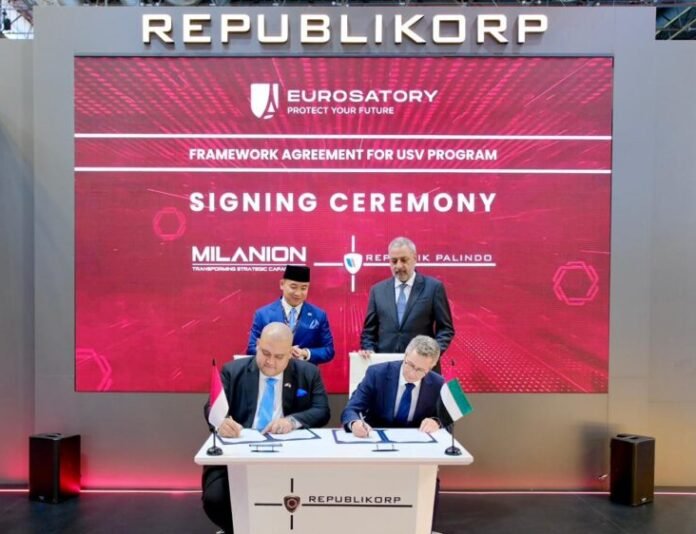
Paris, France. Milanion Group and PT Republik Palindo Internasional (RPAL), a subsidiary of Republikorp, on June 17 announced a significant expansion of their unmanned surface vessel (USV) programme for the Indonesian Navy, signing a new collaboration agreement that builds on a live contract already in implementation.
The latest agreement deepens a strategic partnership first formalised in 2025, when the companies committed to convert Indonesian‑built 20‑metre fast‑attack boats into USVs using Milanion’s Advanced Autonomous Conversion System.

The cooperation focuses on the development of USV capabilities in Indonesia to support national maritime surveillance, security, and operational requirements. As the world’s largest archipelagic nation, with vast maritime territory and strategically important sea lanes, Indonesia requires advanced maritime capabilities to enhance domain awareness and strengthen its response to evolving security challenges.
The signing moves the relationship into a new phase, to cover an additional flotilla of fast‑attack craft earmarked for USV conversion and marking a clear shift toward a scalable unmanned maritime force element within the Indonesian Navy.
Under the original agreement, Milanion and RPAL work with a designated Indonesian shipyard to design, build and supply 20‑metre fast‑attack boats that are then converted into USVs tailored to Indonesian Navy requirements.
The new agreement extends this model, creating a pipeline of additional fast‑attack craft to be delivered as unmanned or optionally manned platforms, depending on mission needs. Together, the initial and expanded tranches constitute a coherent USV‑capable fast‑attack fleet, able to perform maritime domain awareness, coastal patrol, chokepoint security, infrastructure protection and other high‑demand missions across Indonesia’s vast archipelagic domain. By using a conversion‑kit approach on locally designed and built platforms, the partners are giving the Indonesian Navy a practical route to unmanned capability that avoids lengthy clean‑sheet development and keeps industrial value inside Indonesia.

The Milanion-RPAL partnership is built on a sovereign industrial model that deliberately goes beyond simple platform acquisition. Indonesian industry, through RPAL and local shipyards, leads on hull design, construction and key on‑shore activities. Milanion provides the Advanced Autonomous Conversion Kit, mission systems, integration architecture and support to ensure the converted fast‑attack craft meet operational requirements.
RPAL acts as strategic national partner and prime interface, aligning the programme with Indonesia’s defence‑industrial policies and long‑term maritime modernisation plans. The collaboration is structured around technology and knowledge transfer, skills development and long‑term sustainment planning, so Indonesian engineers and technicians can integrate, operate and evolve unmanned maritime capabilities over time, remaining independent of foreign OEMs.

“We are already working to convert Indonesian‑built fast‑attack boats into USVs for the Indonesian Navy – this is a real programme in the water, not a paper concept,” said Davinder Dogra, CEO of Milanion Group.
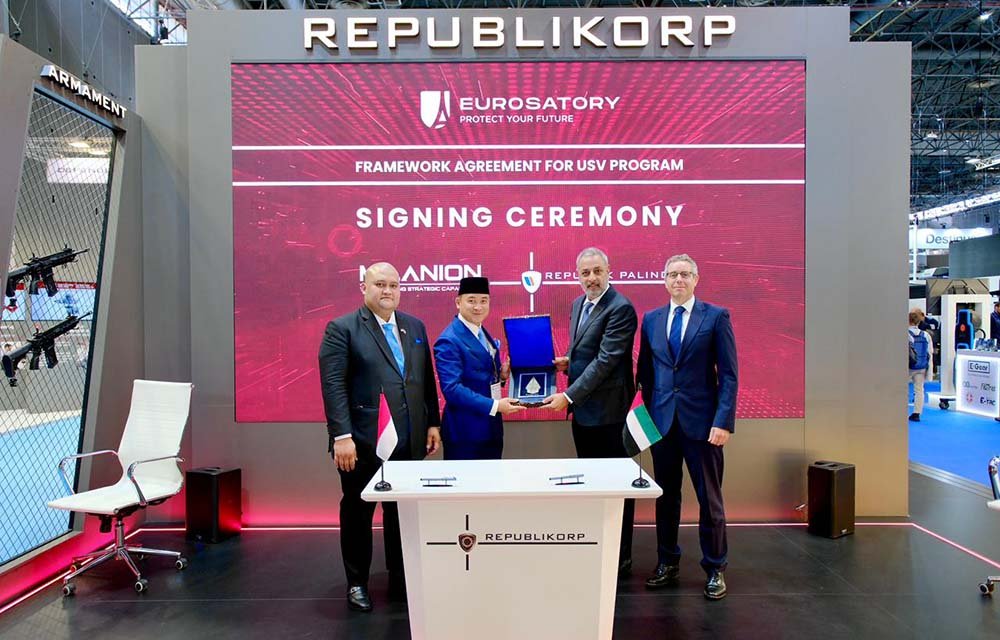
“The decision to expand the programme is a clear signal of confidence in what Milanion and RPAL have built together: a practical, scalable route to sovereign unmanned maritime capability that uses Indonesia’s own shipyards and industrial talent,” Dogra continued.
“This partnership reflects our commitment to advancing Indonesia’s defence industry independence while building strong and balanced international collaboration. Together with Milanion, we see an opportunity to strengthen Indonesia’s maritime capabilities, develop national talent, and contribute to a more resilient defence ecosystem,” said Norman Joesoef, Chairman of Republikorp Group Holding.
Straddling critical sea lanes and responsible for one of the world’s largest archipelagic territories, Indonesia faces persistent demands to monitor and secure its territorial waters. USVs derived from fast‑attack craft provide a flexible capability for that mission set: persistent presence for surveillance and patrol in high‑traffic or remote areas.
Reduced risk to personnel in higher‑threat environments. The ability to operate independently or as part of distributed manned-unmanned teams alongside frigates, corvettes, aircraft and shore‑based assets. The Milanion-RPAL programme gives the Indonesian Navy an upgradeable USV architecture, while remaining anchored in a domestic industrial base that understands the platforms from keel to code.






