


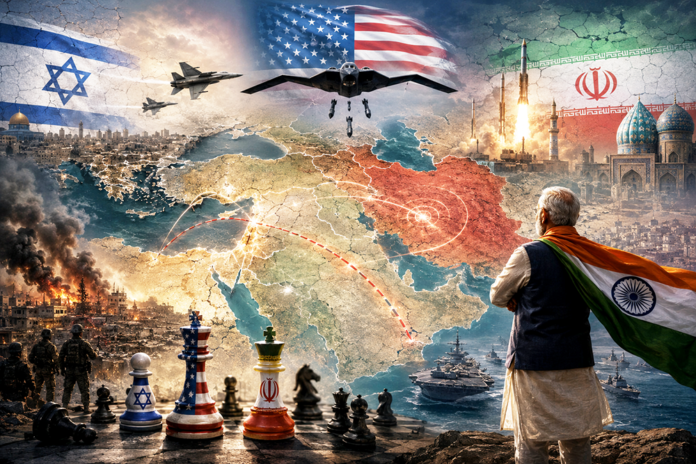
For two decades, the dangerous geography of West Asia was measured by the distance between two cities that rarely spoke and never blinked: Tel Aviv and Tehran. That distance has now collapsed into a single, smouldering corridor of conflict. What began as a shadow war of proxies, sabotage, and assassinations has hardened into open, state-on-state warfare that has killed a Supreme Leader, shut the world’s most important oil chokepoint, and forced every capital from Riyadh to New Delhi to rethink its assumptions about the regional order. The road from Tel Aviv to Tehran is no longer a metaphor for hostility; it is the axis along which the new map of West Asia is being drawn, and India sits squarely in its blast radius.
The decisive turn came in June 2025, when Israel struck Iran directly and the United States joined to hit Iranian nuclear sites, triggering what came to be called the Twelve-Day War. That round ended in an uneasy, American- and Qatari-brokered ceasefire that held for barely eight months. The truce was always a pause, not a peace. On February 28, 2026, Washington and Tel Aviv launched Operation Epic Fury, a coordinated campaign against Iranian nuclear facilities, military infrastructure, and the top leadership itself. In the most consequential single act of the war, the strikes killed Supreme Leader Ali Khamenei, and Tehran’s Assembly of Experts hurriedly elevated his son, Mojtaba, to succeed him. For the first time since 1979, the Islamic Republic’s central pillar of authority was decapitated in a matter of hours, and a brittle dynastic succession was improvised under fire.

The consequences cascaded with frightening speed. Iran responded by closing the Strait of Hormuz, the narrow waterway through which roughly a fifth of the world’s oil moves, and unleashed retaliatory strikes across nine Gulf states. The so-called Axis of Resistance that Tehran had spent forty years assembling—Hezbollah in Lebanon, militias in Iraq and Syria, and the Houthis in Yemen—was hollowed out, its deterrent value exposed as far thinner than the regime had advertised. Even states that had tried to mediate were not spared: Oman, the trusted backchannel between Washington and Tehran, and Qatar, host to indirect talks, both found themselves under missile fire. The lesson for the Gulf monarchies was brutal and clear—n an era of unrestrained escalation, neutrality buys no immunity.
This is the reordered West Asia that India must now navigate, and the reckoning has been anything but distant. India imports more than eighty per cent of its crude oil, nearly half of it from the Gulf, and the closure of Hormuz disrupted roughly 46 to 50 per cent of those crude imports and around 90 per cent of its LPG imports almost overnight. Brent crude vaulted toward the $110–$120 band, and the Finance Ministry’s own monthly review warned that a prolonged conflict could undermine energy security, widen the current account deficit, pressure the rupee, and worsen inflation—and that, in a worst-case systemic shock, the damage to India could exceed that of the 2008 global financial crisis. An economy that had nursed inflation down to 2.75 per cent in January 2026 suddenly found its hard-won macro-stability hostage to events two thousand kilometres away.
The pain did not stay confined to spreadsheets; it reached the kitchen. With 91 per cent of India’s LPG sourced from the Gulf, cooking – gas prices climbed, and refineries were ordered to divert propane and butane to households, while fertiliser plants and power grids—dependent on Qatari LNG—were forced onto rationed, lower-priority supply. The trade fallout rippled outward in unexpected directions: basmati rice shipments to Gulf buyers stalled for want of war-risk insurance, Indian banana consignments rotted at Kandla, apple and almond imports from Iran dried up, and the rupee-rial tea trade with Tehran seized up as banking channels were severed. A war between three other nations was, in effect, taxing the Indian household at the dinner table.
Beyond oil and trade lies a more human exposure that India can never fully insure against: its people. The Gulf is home to the largest concentration of the Indian diaspora anywhere on earth, with millions of Indian workers in Saudi Arabia, the UAE, Qatar, and the smaller emirates, whose remittances are a quiet but vital pillar of the Indian economy and of countless households in Kerala, Uttar Pradesh, and beyond. When Iranian missiles began landing across Gulf states and regional airspace shut down, those millions were suddenly living inside a war zone, their salaries, savings, and physical safety all in jeopardy at once.

India imports more than eighty per cent of its crude oil, nearly half of it from the Gulf, and the closure of Hormuz disrupted roughly 46 to 50 per cent of those crude imports and around 90 per cent of its LPG imports almost overnight
New Delhi was forced to stand up a dedicated control room and evacuation machinery, reprising the logistics of earlier crises in Kuwait, Yemen, and Ukraine. A sustained conflict that hollows out Gulf labour markets would not only choke remittance flows; it could send a reverse tide of returning workers into an Indian job market with nowhere to absorb them. The war in Iran, in other words, is also a war over the livelihoods of ordinary Indian families a continent away.
Nowhere is India’s predicament more painfully symbolic than at Chabahar. For more than a decade, New Delhi treated the Iranian port as the centrepiece of its connectivity strategy—a gateway to Afghanistan and Central Asia that elegantly bypassed Pakistan. India signed a ten-year operating contract in 2024, committed $120 million in equipment and a $250 million credit line, and wove Chabahar into the larger International North-South Transport Corridor dream. Yet as Washington revoked its sanctions waivers, the Union Budget 2026 allocated zero funds to the project, the final exemption expired on April 26, 2026, and India was reduced to exploring a temporary transfer of its own stake. A flagship of Indian strategic ambition is now, by most honest assessments, on life support—a casualty not of an Indian decision but of a war India did not start and could not stop.

That helplessness exposed the central tension in Indian foreign policy: the limits of strategic autonomy when great powers go to war. New Delhi chose a posture of studied neutrality, issuing generalised appeals for de-escalation, condemning attacks on sovereignty and on American bases without ever naming Iran as a victim, and dispatching Prime Minister Modi to work the phones with Gulf leaders and the Israeli premier. It was a careful balancing act between a deepening partnership with Israel, an indispensable energy and connectivity relationship with Iran, a strategic embrace of the United States, and the permanent shadow of Pakistan.
But balance read, to many at home, as evasion. The Opposition accused the government of tilting toward Washington and Tel Aviv and of compromising the country’s energy security to avoid offending its new strategic patrons. Strategic autonomy, the critics argued, had quietly curdled into strategic dependence.
The most stinging blow may have been diplomatic rather than economic. When the guns finally paused on April 8, 2026, the ceasefire between the United States and Iran was brokered not by India—a nation that prides itself on ties to all sides—but by Pakistan, working in tandem with China, which had earlier floated its own five-point peace plan.
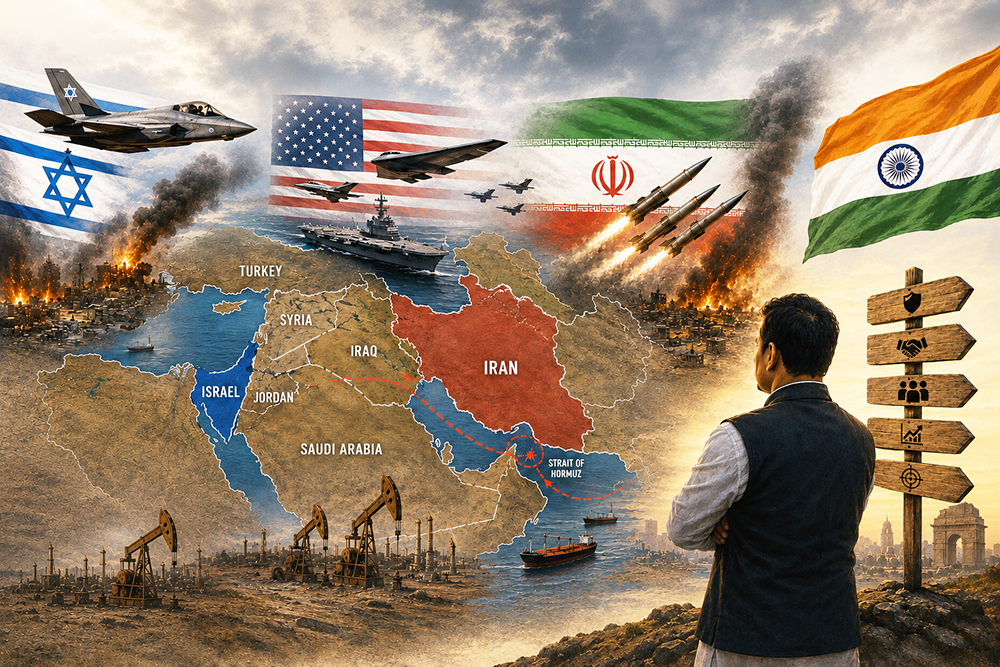
India was left to welcome the ceasefire from the sidelines, issuing statements about freedom of navigation and running a control room to evacuate its nationals. As analysts at The Diplomat warned, the episode signalled two uncomfortable truths: that China is willing to expand its diplomatic footprint in West Asia, and that India can be sidelined in its own extended neighbourhood. For a country that routinely seeks international backing against cross-border terrorism, watching Islamabad cast as regional peacemaker was a bitter reversal of roles.
An over-reliance on Gulf energy, an under-developed strategic petroleum reserve, a connectivity strategy hostage to a single volatile partner, and a diplomatic posture that pleases everyone and persuades no one – these are luxuries of a calmer era
There is a strategic silver lining, but it is thin and conditional. The war has accelerated interest in overland alternatives to maritime chokepoints, above all the India–Middle East–Europe Economic Corridor, which promises to route Indian trade to Europe through the Gulf and Israel while bypassing Hormuz altogether. If the post-war Gulf consolidates around a more Western-aligned, India-friendly architecture, New Delhi could emerge as a logistics and energy hub of genuine consequence. But IMEC runs straight through the very territory that has just been set ablaze, and corridors of commerce cannot be built on foundations of perpetual war.
The deeper lesson from Tel Aviv to Tehran is that India’s age of comfortable hedging is ending. An over-reliance on Gulf energy, an under-developed strategic petroleum reserve, a connectivity strategy hostage to a single volatile partner, and a diplomatic posture that pleases everyone and persuades no one – these are luxuries of a calmer era.
The war in Iran did not merely rearrange the furniture of West Asia; it sent the bill to New Delhi. Whether India responds by diversifying its energy, hardening its corridors, and recovering genuine strategic initiative, or by drifting into the slipstream of larger powers, will decide whether the next crisis finds it shaping the order – or once again paying for it.

The writer is an independent researcher. The views expressed are of the writer and do not necessarily reflect the views of Raksha Anirveda





