


Modern naval warfare is undergoing a fundamental structural shift. As India’s economic growth, maritime trade and strategic imperatives grow increasingly dependent on secure Sea Lines of Communication across the Indian Ocean Region – spanning the Persian Gulf, Arabian Sea, Bay of Bengal and the broader Indo-Pacific – the demand for a versatile, survivable, and economically viable force structure has become paramount. Traditional capital ships like aircraft carriers, destroyers and frigates remain the foundational backbone of blue-water projection; however, hyper-velocity precision strike weapons and saturation tactics have made heavy reliance on a few concentrated, high-cost assets inherently risky.
To address these vulnerabilities, naval doctrines worldwide are embracing distributed lethality by dispersing offensive and defensive firepower across numerous smaller, networked and lower-cost platforms. The proposed 60-metre, 500-tonne missile catamaran embodies this modern philosophy, serving as a highly mobile, heavily armed maritime battery designed to complement India’s existing fleet assets.

Concept Overview and Design Architecture
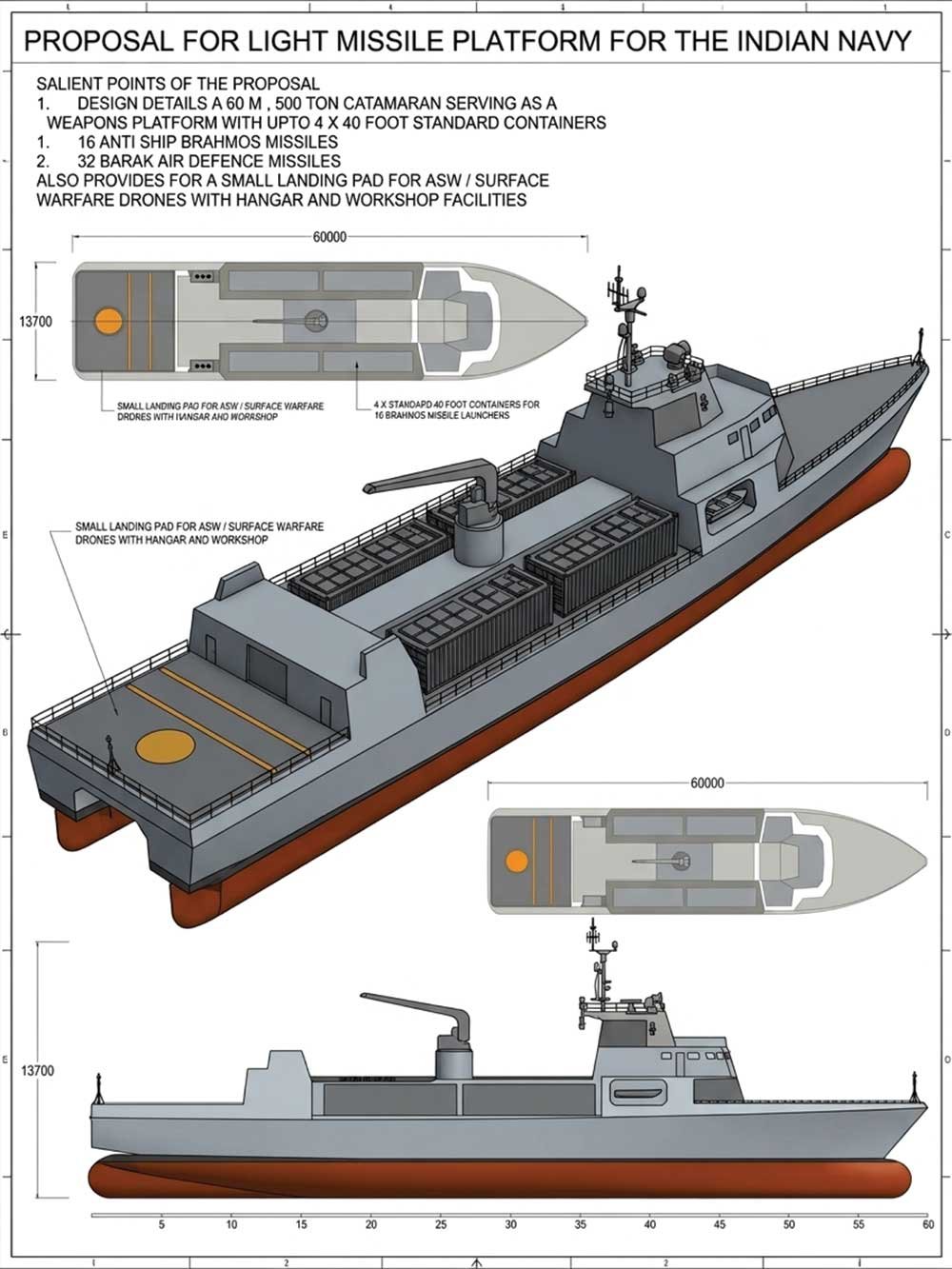
The proposed 500-tonne missile catamaran is engineered as a light combatant capable of delivering the strike volume of surface combatants multiple times its displacement. Built around a high-speed catamaran hull, the vessel leverages a wide beam to overcome the operational constraints that historically plagued traditional monohull missile boats, such as poor sea-keeping, restricted payload space, minimal endurance and inadequate self-defence.
In terms of technical specifications, the platform features an overall length of 60 metres, a beam of approximately 13.7 metres and a displacement of 500 tons. Driven by an efficient waterjet propulsion system, the twin-hull catamaran form allows the vessel to reach sustained speeds between 30 and 35 knots. It is multi-mission capable, serving in missile strike, air-defence, anti-submarine warfare and littoral or island defence roles. Crucially, the vessel accommodates up to four standard 40-foot ISO mission containers, features dedicated aviation facilities including a small unmanned aerial vehicle landing deck, hangar and maintenance workshop, and carries a shipboard 50-tonne Safe Working Load electro-hydraulic knuckle-boom crane mounted along its centreline.
The proposed 60-metre, 500-tonne catamaran shifts the Indian Navy toward distributed lethality, delivering heavy combat capability without relying solely on large, expensive warships
The hydrodynamic selection of a catamaran hull rather than a conventional monohull offers major operational advantages. First, the wider beam offers superior transverse stability, which reduces vessel roll in moderate sea states and provides a steady baseline for launching supersonic missiles, operating high-gain radar sensors, and safely launching or recovering drones. Second, the structural architecture creates an expansive central deck footprint capable of housing the four ISO containers, mission workshops, drone support gear and the flight deck. Third, twin hulls distribute displacement to yield a shallow draft tailored for littoral zones, coastal archipelagos, shallow straits and strategic chokepoints like the Malacca Strait. Finally, its waterjet-driven high speed allows for rapid repositioning, fast strike sorties and immediate post-launch dispersal to evade counter-battery fire.
Firepower and Distributed Lethality
The primary combat power of the missile catamaran stems from its ability to carry dense weapon inventories within standardised, modular footprints. Through four 40-foot containerised mission modules, the ship can be tailored for heavy surface strike, air defence, or hybrid operations carrying electronic warfare equipment, loitering munitions or sonobuoys.

Configured as an offensive sea-going battery armed with 16 BrahMos supersonic anti-ship missiles, a single catamaran wields offensive firepower comparable to or exceeding that of a modern destroyer or frigate. The BrahMos missile’s supersonic cruise speed, low reaction time, sea-skimming flight profile and land-attack capability present an extreme challenge to hostile anti-air networks. By distributing these missiles across small, low-cost hulls, the Indian Navy achieves high weapon counts without placing major fleet assets at risk. While a traditional destroyer carries 16 to 24 BrahMos missiles and a frigate carries 8 to 16, a small four-ship catamaran flotilla can deploy a combined total of 64 BrahMos missiles. This allows a catamaran squadron to launch a coordinated 64-missile saturation salvo from multiple vectors, overwhelming an adversary’s combat systems through sheer volume and multi-axis arrival times.

Alternatively configured with 32 Barak air-defence missiles, the catamaran transitions into a fleet escort and point-defence platform. In high-threat environments, these interceptors shield the vessel and nearby commercial convoys from anti-ship cruise missiles, armed drones, maritime patrol aircraft and loitering munitions. When integrated into a major naval task group, these vessels act as auxiliary missile magazines at sea, absorbing defensive engagements and preserving the vertical launch system cells of primary capital ships.
Modularity and Unmanned Systems Integration
The platform departs from rigid structural design by utilising standard ISO container infrastructure. This modular design lowers acquisition costs, simplifies supply chains and accelerates modernisations. Standardised containerisation allows rapid reconfiguration, enabling vessels to switch roles between anti-surface strike, electronic warfare, loitering munition deployment, or anti-submarine warfare in hours simply by swapping out modules.
It also simplifies logistics, as missile modules can be stored, maintained, and fully certified inside secure ashore bunkers before being mounted onto the deck. Furthermore, the open container deck provides a future growth margin that can accommodate emerging naval technology, including directed-energy weapons, autonomous surface vessel control stations, and swarm-drone launch systems, eliminating the need for mid-life structural hull refits.
Equipped with an aft landing pad, fully enclosed hangar, and maintenance workshop, the catamaran supports unmanned systems across multiple combat domains. Airborne reconnaissance drones flying 100 to 150 kilometres ahead extend the ship’s sensor horizon for intelligence gathering and over-the-horizon targeting, identifying targets and relaying mid-course guidance updates to in-flight missiles.
Despite its light 500-tonne displacement, the platform packs dense firepower by housing up to 16 BrahMos supersonic anti-ship missiles or 32 Barak air-defence missiles in modular containers
For anti-submarine warfare, specialised drones can deploy sonobuoy fields, perform acoustic processing, and transmit submarine tracking data back to the task group. Surface and electronic warfare drones function as decoys, signal relay nodes and precision strike platforms to enable effective manned-unmanned teaming in high-risk zones. Additionally, the vessel features optionally manned capability: during routine peacetime patrols, it operates with a reduced core crew, but in high-threat scenarios, it can transition to remotely supervised autonomous modes to eliminate risks to personnel.
Forward Logistics Concept: Reload Operations at Campbell Bay
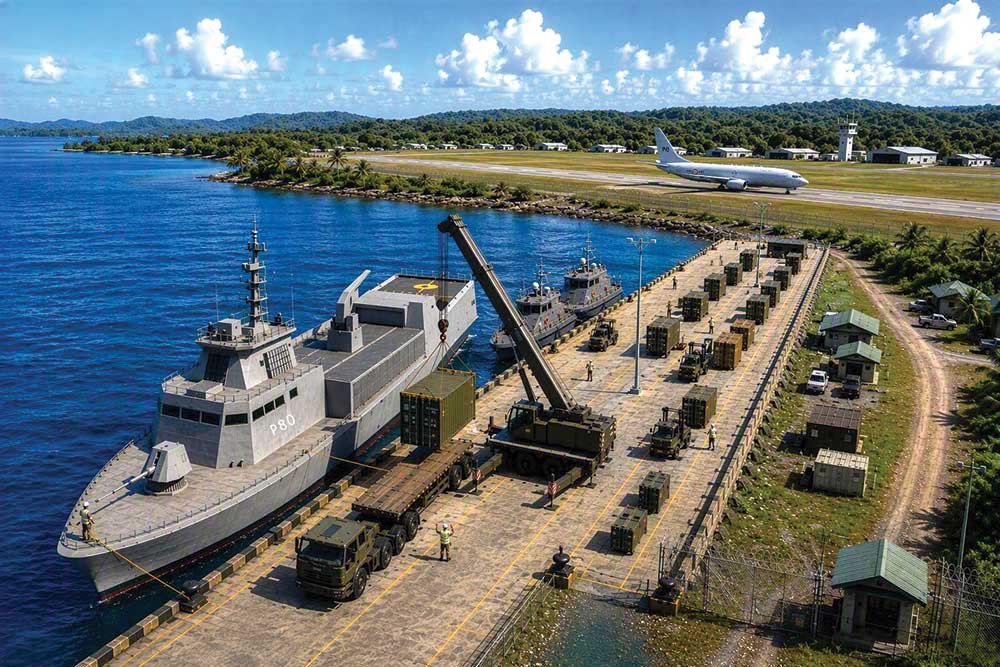
 A major operational highlight of the concept is its capacity for rapid forward rearming away from major mainland naval bases. Situated on Great Nicobar Island directly adjacent to the Malacca Strait’s western entrance, Campbell Bay provides an ideal forward operating node for monitoring critical maritime choke points. Operating from this hub, catamarans utilise container replacement instead of slow, crane-sensitive individual missile hoists, drastically slashing turnaround times.
To remain fully independent of shore-based heavy-lift cranes, the catamaran features a centreline 50-tonne Safe Working Load electro-hydraulic knuckle-boom crane positioned between the bridge and container deck. This crane weighs between 18 and 25 tonnes, offers a maximum lift capacity that easily exceeds the 30-tonne maximum weight of a fully loaded ISO container, provides an outreach range of 3 to 22 metres to reach both port and starboard container locks, and features 360-degree continuous slewing with full container transfer capability in conditions up to Sea State 3.
Using either the onboard crane or port equipment, replacing all four mission containers requires minimal downtime. The process per container includes ten minutes for rigging and hook-up, ten minutes for lifting and transfer to the pier or barge, ten minutes for positioning the replacement module, and fifteen minutes for coupling data and power buses, equating to roughly 45 minutes per container. A full offload and onload cycle for all four containers takes approximately three hours, followed by one to two hours of combat system diagnostic verifications. This yields a total turnaround time of five to seven hours, which can be compressed to four to six hours during emergency wartime protocols while fuel replenishment, drone servicing, stores loading and crew rotations occur concurrently.
Operational Deployments and Strategic Roles
The versatility of the missile catamaran supports a wide variety of operational missions across regional waters. In coastal defence roles near Mumbai, Kochi, Visakhapatnam or Port Blair, catamarans function as mobile coastal missile batteries that quickly shift positions to prevent adversaries from establishing naval dominance near key harbours. For island territory defence in the Andaman and Nicobar or Lakshadweep archipelagos, these ships create dense sea-denial umbrellas across critical maritime choke points.
Equipped with a dedicated landing pad, hangar and workshop, the optionally manned vessel deploys air and surface drones to extend its sensor horizon and execute over-the-horizon targeting
During sea-denial operations, catamarans utilise hit-and-run tactics, low radar cross-section profiles, and drone-relayed targeting to lay in wait near coastal islands and execute surprise missile attacks against high-value enemy formations. Additionally, when equipped with Barak air-defence modules and drones, catamarans execute escort missions to protect replenishment ships, amphibious landing docks, and commercial merchant convoys from air threats without forcing the navy to detach primary destroyers. Serving as networked force multipliers, these vessels link satellites, submarines, aircraft and shore bases to expand overall missile counts at a fraction of traditional fleet costs.
Operational Challenges and Mitigation Strategies
While offering clear advantages in firepower and economics, the 500-tonne design presents operational constraints that require specific countermeasures. Regarding survivability, a 500-ton hull cannot absorb direct anti-ship missile hits like a heavy surface combatant; therefore, its defence relies on high speed, active electronic warfare jammers, soft-kill decoys, point-defence missiles and signatures lowered by stealth shaping.
Environmental limitations also pose a challenge, as severe Indian Ocean monsoon sea states can impair drone handling, missile reloads and crew stamina. To offset this, advanced active motion-damping systems and automated container-latching rigs are integrated to mitigate rough seas. Finally, compact hulls cannot carry massive, long-range radar arrays to overcome sensor horizon limits. To maximise the range of its 16 BrahMos missiles, the vessel relies on network-centric warfare, fusing real-time targeting feeds from satellites, P-8I Poseidon maritime patrol aircraft, submarines, ashore radar grids and offboard drones.
Strategic Vision: The Future Distributed Fleet
The 60-metre, 500-tonne missile catamaran provides the Indian Navy with an innovative approach to expanding its combat power across the Indian Ocean Region. For the procurement cost of a single guided-missile destroyer, the navy could acquire and deploy a large, dispersed squadron of these platforms. By combining the heavy strike capabilities of BrahMos and Barak missiles with modular container architecture, high-speed catamaran hulls, autonomous operations, and organic drone support, this concept offers an effective, resilient and adaptable force structure. As modern naval engagements shift toward networked operations, autonomous systems and distributed lethality, these missile catamarans ensure the Indian Navy maintains persistent maritime presence, robust sea denial and credible deterrence across its key strategic waters.

–The writer is an Architect by profession with 36 years of experience with leading corporates in the Indian real estate industry. However, his passion is matters Naval! Probably due to his family ties with the Indian Navy. He has been drawing warships since the age of 12, and has been following warship design in the Indian Navy for a considerable time. Recently, he completed a study for designing new MCMVs adopting the modular design technology, which is both cost and time effective.
The views expressed are of the writer and do not necessarily reflect that of Raksha Anirveda





