


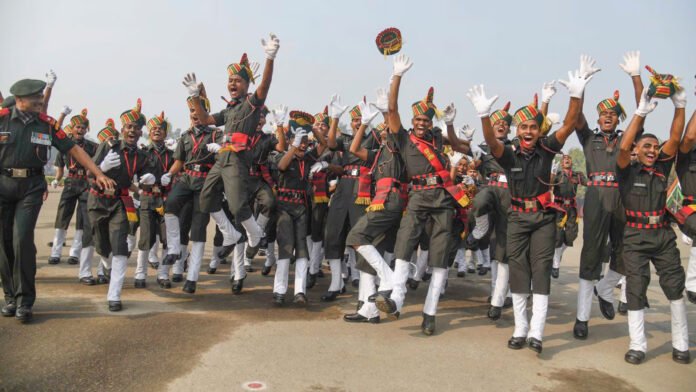
NEW DELHI. The Indian Army has introduced a sweeping new dress code policy, systematically dismantling several residual colonial-era customs and terminology to better align the military’s identity with contemporary sovereign Indian values.
In an extensive overhaul of its visual and ceremonial identity, the Indian Army has officially released a comprehensive 174-page dress regulations manual titled “Army Uniforms-2026”.

Marking the first major update to the force’s uniform guidelines in eight years, the policy introduces indigenous attire, strips away archaic British-era nomenclature, and establishes highly standardised grooming and appearance guidelines across all ranks.
Embracing Indigenous Attire: The Bandi Jacket
The most prominent structural shift in the new policy is the formal introduction of the Bandi jacket- a traditional, closed-neck Indian jacket – into the formal civil dress code for officers. Authorised to be worn over a full-sleeved shirt and paired with sober-coloured formal trousers, the inclusion of the Bandi jacket marks a deliberate departure from strictly Western-style lounge suits and combinations.
For women officers, the regulations have expanded formal choices to include sober-coloured sarees or kurta-salwar combinations paired with ankle-length straight trousers and a dupatta. Conversely, casual variations such as sleeveless kurtas, palazzos, and cigarette pants have been strictly prohibited to preserve a disciplined, uniform aesthetic during official functions.
Retiring the Vestiges of the Raj
In his foreword to the manual, Adjutant General Lieutenant General VPS Kaushik emphasised that the 2026 guidelines represent a calibrated effort to purge non-essential, inherited colonial accoutrements. Key ceremonial rollbacks include:

- Optional Sword Carriage: Reviewing Officers on parade are no longer mandated to carry swords; the practice is now optional and restricted primarily to active parade and contingent commanders during major national events like Republic Day.
- Removal of Pouch Belts: The decorative leather pouch belt has been entirely discarded from Mess Dress, which are typically worn at high-profile state dinners and diplomatic receptions.
- Purging Archaic Language: The manual officially drops outdated colonial vocabulary, explicitly banishing the word “Royal” from all dress-related nomenclature and legacy unit descriptions.
Additionally, the old jersey-based winter uniform (Dress No 3A) will be completely phased out by June 30, 2029, making way for a modernised, standardised winter working outfit featuring a contemporary Battle Jacket.
Strict Standards for Grooming and Turnout
Beyond structural attire, “Army Uniforms-2026” introduces uncompromising regulations regarding personal appearance to reinforce military discipline.

Moustaches are permitted for male personnel but strictly capped at a maximum length of 12 centimeters, visible tattoos and body piercings remain strictly prohibited for all active-duty personnel, no bracelets are allowed while in uniform, with the sole exception of a temporary sacred thread worn on the day of a pooja, lipstick, coloured nail polish, bindis, and nose pins are barred. Sindoor is permitted only if completely hidden beneath official headgear, the use of perfumes and deodorants is prohibited while in uniform, though standard after-shave lotions remain permissible.
The document also explicitly forbids personnel from wearing their uniforms at political gatherings, private parties, protests, or unauthorised media appearances.
Through these combined measures, the Indian Army aims to cultivate a distinct institutional identity rooted in India’s own cultural fabric. While historic regimental battle honours and core traditions remain fully intact, the visual landscape of the world’s second-largest standing army is being fundamentally rewritten to project a modern, self-reliant nation.






