


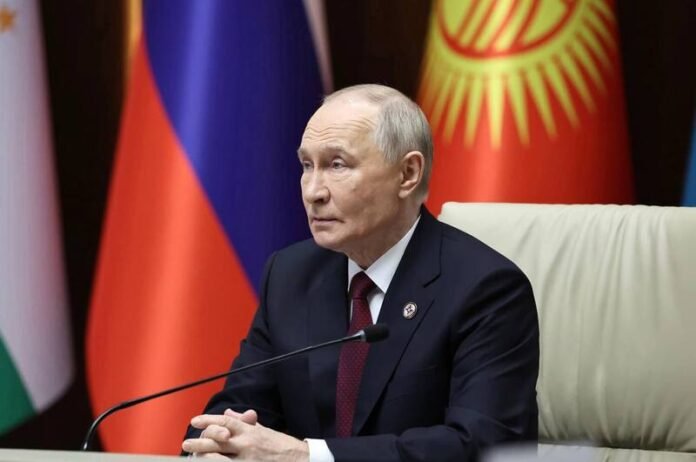
The 2026 exercises of the Collective Security Treaty Organisation (CSTO)- were held in Russia from September 28 to October 3. The CSTO’s members are Armenia, Belarus, Kazakhstan, Kyrgyzstan, Russia and Tajikistan. Its collective forces include military units, police and internal-security formations, emergency-response agencies and command structures from the member states.
The central CSTO exercise was Interaction-2026, conducted alongside the special exercises Search-2026 and Echelon-2026. These exercises were linked with Russia’s larger strategic manoeuvre, officially called Tsentr-2026, or Centre-2026. The distinction is important: the wider Russian exercise involved more than 47,000 personnel, while the CSTO component involved approximately 2,000 servicemen and 350 weapons and military vehicles.

The CSTO exercise practiced responding to a cross-border armed conflict. Participating forces rehearsed reconnaissance, gaining fire superiority, destroying forward positions, blocking advancing forces, restoring border control and eliminating the consequences of combat-related emergencies. The drills also involved unmanned aerial vehicles, robotic systems, special forces and lessons drawn from Russia’s war in Ukraine.
The CSTO-2026 exercises and parallel Tsentr-2026 manoeuvres demonstrated Russia’s dual ability to reinforce regional alliance solidarity while leading a broader, 47,000-strong Eurasian security coalition alongside China
The broader Tsentr-2026 manoeuvre involved Russia, China, Belarus, Kazakhstan, Kyrgyzstan, Mongolia, Pakistan and Tajikistan. More than 47,000 troops trained at 11 firing ranges and in the Caspian Sea. China participated through forces from its Central Theater Command, including personnel from the 82nd Group Army and a combined-arms brigade.
This combination of exercises carried a dual message. The CSTO component was designed to demonstrate alliance solidarity, while Tsentr-2026 projected Russia’s ability to lead a larger Eurasian military coalition involving China and states outside the CSTO.
Implications for Central Asia
For Central Asian republics, CSTO 2026 offered practical benefits. Kazakhstan, Kyrgyzstan and Tajikistan face difficult security problems, including border tensions, militant infiltration, organised crime, trafficking, radicalisation and instability from Afghanistan. Joint training improves communication between national forces and familiarises commanders with common procedures.

The drills also provided smaller militaries with access to Russian experience, equipment and training. The extensive use of drones, counter-drone systems, robotic vehicles and electronic-warfare methods reflected the changing character of modern conflict. Central Asian forces can learn from these systems without possessing the resources to develop comparable capabilities independently.
Yet, the same exercise highlights the political risks of dependence on Russia. CSTO forces practiced localising a cross-border conflict and restoring border control. In theory, this is a collective defensive mission. In practice, Russia remains the alliance’s dominant military power, and Moscow determines much of the organisation’s strategic agenda.

Incorporating tactical lessons from the war in Ukraine, the drills provided Central Asian forces with valuable exposure to advanced drone operations, counter-UAV systems, robotics and electronic warfare capabilities
That imbalance is particularly sensitive for Kazakhstan. Astana maintains close economic, historical and security ties with Moscow, but it also insists on sovereignty and a multi-vector foreign policy. Any military scenario involving the creation of a security zone, the restoration of border control or operations against an unnamed external force can therefore generate concern, especially when Russian forces dominate the exercise.
The absence of Armenia from the participating CSTO contingents is also politically meaningful. Armenia remains a formal member of the organisation, but its relations with Russia and the CSTO have deteriorated sharply. Yerevan’s non-participation underlines that legal membership does not automatically translate into political trust or military cooperation.
The lesson for Central Asian governments is consequently mixed. The CSTO can provide useful military coordination, but it cannot be treated as a neutral or perfectly balanced alliance. Its effectiveness depends heavily on Russian political will, Russian logistics and Russian command capabilities. Regional states are likely to continue participating, while simultaneously expanding ties with China, Turkey, Azerbaijan, India, Europe and the United States.
The significance for the United States
For the United States, CSTO 2026 does not constitute an immediate direct military threat. Washington has no treaty obligation to defend most Central Asian states, and the exercise was primarily focused on Russia’s perceived southern and eastern security environment.
While participation offers crucial counterterrorism and border security benefits, Central Asian republics must continuously balance reliance on dominant Russian military infrastructure against their own national sovereignty
Nevertheless, the drills challenge American influence in Eurasia. They show that Russia retains institutional mechanisms for assembling military contingents from former Soviet republics despite the strain of the war in Ukraine. They also demonstrate that China is increasingly willing to conduct advanced military training alongside Russian and Central Asian forces.
The United States should avoid interpreting the exercise as proof of a unified anti-American bloc. The CSTO members have different interests, and China is not a CSTO member. Belarus is closely aligned with Moscow, while Kazakhstan, Kyrgyzstan and Tajikistan pursue more flexible policies. China seeks regional influence but does not necessarily endorse every Russian interpretation of sovereignty or intervention.
A measured American response should focus on resilience rather than confrontation. Washington could expand cooperation with Central Asian states in border security, counterterrorism, cyber defence, disaster response, satellite imagery and drone protection. Such assistance would strengthen national capabilities without demanding that regional governments formally choose between Washington, Moscow and Beijing.
The United States should also pay close attention to the military lessons incorporated into the exercises. Russian forces reportedly used drones, robotic systems and methods derived from combat in Ukraine. The integration of reconnaissance, precision firepower, unmanned vehicles and electronic warfare provides insight into how Russia is adapting its military doctrine.
Russia-China military friendship
The participation of Chinese troops strengthened the Russia-China relationship at three levels.
Armenia’s deliberate absence from the 2026 drills starkly highlights growing political friction with Moscow, proving that formal treaty membership no longer guarantees operational military consensus
First, it improved practical military familiarity. Chinese and Russian units trained in long-range force projection, operational planning, land-air coordination and live-fire manoeuvres. Chinese officers described the extensive use of unmanned systems as a valuable opportunity to test tactics in a complex battlefield environment.
Second, it strengthened political symbolism. Moscow was able to show that it is not isolated and can host a large multinational exercise involving China, CSTO members and other Asian states. Beijing, meanwhile, demonstrated that it can expand military engagement westward without creating a formal alliance or permanent overseas base.
Third, the exercise reinforced a shared narrative of multipolarity. Russia and China increasingly present their partnership as an alternative to US-led security arrangements. Repeated exercises create habits of cooperation, improve interoperability and enable both militaries to observe each other’s technologies and command systems.
However, CSTO 2026 did not transform the relationship into a formal military alliance. China remains cautious about binding commitments to Russia’s regional agenda. Beijing has substantial economic interests in Central Asia and may prefer stability, open borders and predictable sovereignty arrangements. Russia, by contrast, seeks recognition of its privileged role in the former Soviet space.
China’s active participation in the Tsentr-2026 manoeuvres deepened tactical familiarity and reinforced a shared narrative of multipolarity, though Beijing remains cautious of formal military alliance commitments
The partnership is therefore real but limited. It is strongest in strategic signalling, defence diplomacy and selected operational areas. It remains weaker in joint command, mutual defence obligations and fully integrated combat planning.
Overall, CSTO 2026 demonstrated Russia’s continuing centrality within the post-Soviet security system, but it also revealed that the organisation’s influence is uneven. Belarus, Kazakhstan, Kyrgyzstan, Russia and Tajikistan supplied contingents, while Armenia remained absent from the exercise. China participated in the wider Tsentr-2026 manoeuvre, giving the drills a broader Eurasian character.
For Central Asia, the exercises offer useful military cooperation but reinforce the need for strategic diversification. For the United States, they demand sustained engagement rather than exaggerated alarm. For Russia and China, they represent another step toward closer defence cooperation.
The most important message is therefore not that a new military bloc has fully emerged. It is that Eurasian security is becoming more interconnected, more technologically sophisticated and more dependent on military partnerships in which Russia remains the principal organiser and China the increasingly important partner.

-The writer is a New Delhi-based senior commentator on international and strategic affairs, environmental issues, an interfaith practitioner, and a media consultant. The views expressed are personal and do not necessarily carry the views of Raksha Anirveda





