


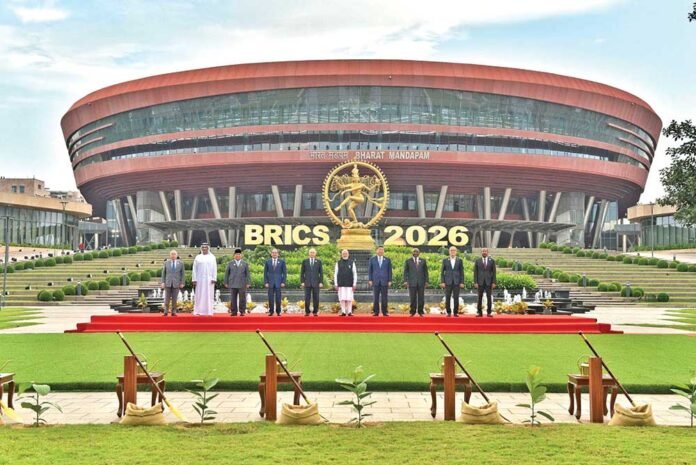
India hosted the 18th BRICS Summit in New Delhi from September 12 to 13, 2026, under its fourth Chairmanship that was guided by the theme “Building for Resilience, Innovation, Cooperation and Sustainability.” It reflected India’s focus on strengthening existing achievements and intensifying institutional effectiveness. With the placement of development, sustainability and innovation at the heart of the agenda, it highlighted the aspirations of the Global South and sought to project BRICS as a constructive and solutions-oriented platform. From a boardroom acronym ‘BRIC’ for four emerging markets in 2001, the ‘BRICS’ has grown into a geopolitical bloc spanning four continents with a far wider grouping.
Over the years, it has incorporated oil states, African economies, Latin American nations, and Southeast Asian partners. Its members currently represent 49.5% of the global population, 40% of global GDP, and 26% of global trade. These figures underline their substantial demographic and economic weight, and their diversity brings together major markets, natural resources, technological capabilities and varied developmental experiences. Through its successive chairmanships, India has contributed to the substantive development of BRICS as an organisation, and its 2026 chairship of the expanded membership builds on this experience.

Theoretical Moorings
Scholars have long debated whether BRICS is a revisionist coalition or a reformist club, a counter-hegemonic block or a parallel order builder. Some even call it a Coalition of the Unlike, where members diverge in regime type, economic size, and alignments, and others call it a proto-institution with work in progress, without a secretariat or binding rules, and still deciding what it wants to become. Stuenkel, in his work The BRICS and the Future of Global Order (2015), reads the grouping as an instrument for enlarging emerging powers’ voice within the existing order rather than toppling it, whereas Nayyar, in his article BRICS, Developing Countries and Global Governance (2016), stresses its advocacy of governance reform on behalf of developing countries.
For India, Harsh V Pant and Julie M Super (2015) question whether the vocabulary of non-alignment still captures New Delhi’s selective, interest-driven partnerships, a stance that Jaishankar, in his work The India Way: Strategies for an Uncertain World (2020), articulates as multi-alignment. Many authors describe Russia’s approach towards BRICS as a combination of ideational and material motives, including status-seeking and using BRICS to offset the damage of Western sanctions. These differing lenses, depending on what interest one represents, do help explain why BRICS has endured despite its internal contradictions. The pattern can be described as a Constructive Ambiguity in that the bloc holds together partly because each member can interpret its purpose differently. India values BRICS as a hedge that widens its room for manoeuvre, whereas Russia prizes it as a bulwark against isolation.
India-Russia Relationship
In his second visit to India since the commencement of the special military operation in Ukraine, Vladimir Putin arrived in Delhi for a three-day visit and held key bilateral talks with Prime Minister Narendra Modi ahead of the BRICS summit. Modi and Putin met for the second time in two weeks, having previously conferred on the sidelines of the Shanghai Cooperation Organisation summit in Bishkek on August 31, where the former had called for a shift from ‘endless war towards the end of war’. As per the statement of India’s Ministry of External Affairs, Prime Minister Modi reiterated that India was ready to help resolve conflicts and ‘assist in peace efforts’.
In his second visit to India since the commencement of the special military operation in Ukraine, Russian President Vladimir Putin arrived in Delhi for a three-day visit and held key bilateral talks with Prime Minister Narendra Modi ahead of the BRICS summit
What has been noticeable for the Russia watchers over the years is that the partnership between New Delhi and Moscow, once conducted almost exclusively through defence contracts and summit rituals, now unfolds inside a multilateral architecture whose membership, ambitions and internal fissures matter as much as the bilateral agendas. This article argues that BRICS has become one of the principal arenas in which India and Russia hedge, negotiate and occasionally contest one another’s visions of order. Its rising relevance is as much a symptom of external pressure as of genuine convergence.

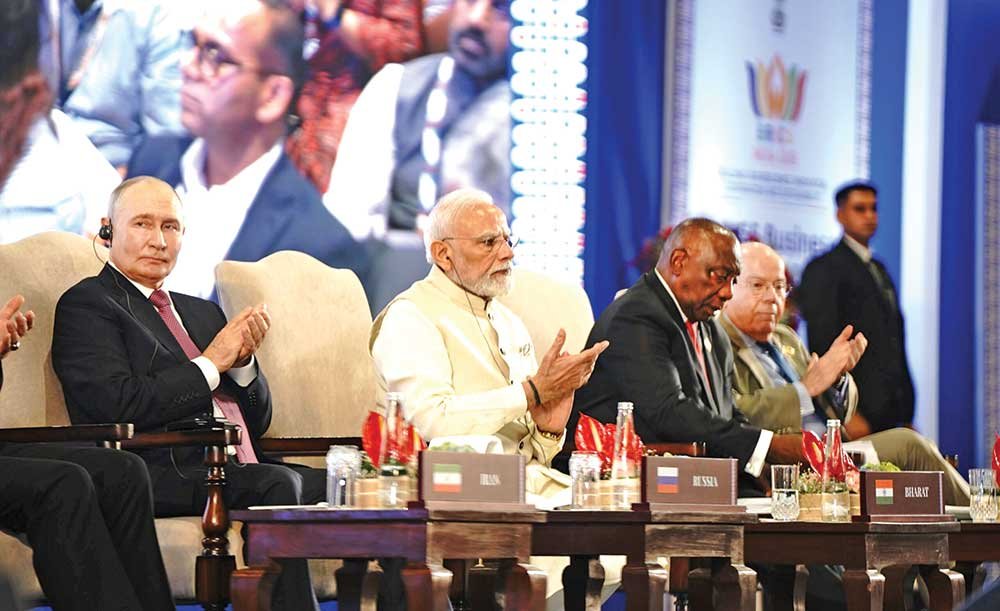
New Delhi 2026: BRICS as Arena
The summit unfolded against the backdrop of two active conflicts and an escalating global tariff war. Amid this, the headline achievement for India during the BRICS summit was ‘Consensus’. India chaired a bloc comprising Iran, Gulf powers, China and Russia, and secured a single unanimously adopted declaration deliberately worded so as not to take sides in the Gulf conflict. This was no small feat, since members are split over the Gulf conflict, with Iran and the UAE on opposite sides. India’s own Chairship tenor was pragmatic, favouring interoperable payment channels for local-currency settlement, amendments to the Contingent Reserve Arrangement, and a Russian-championed Grain Exchange targeted for launch by 2027. The same document recorded explicit Chinese and Russian support for the aspirations of India and Brazil in a reformed UN Security Council, a diplomatic dividend for Delhi.

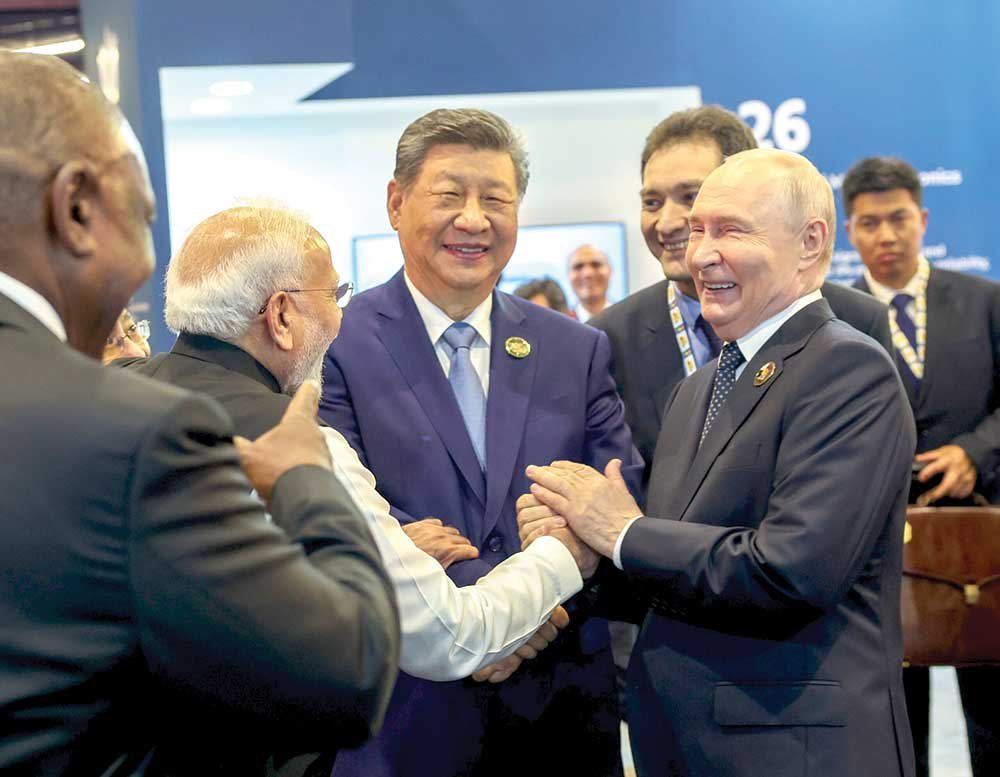
The optics of the summit carried as much weight as its text. Chinese President Xi Jinping’s visit to India, his first in seven years, alongside Russian President Vladimir Putin’s attendance, signalled that despite years of border tension with Beijing and Western pressure on Moscow, India remains a convening power capable of bringing rival and sanctioned leaders to the same table. Images of Modi, Xi and Putin walking together, laughing and planting Banyan saplings on the Bharat Mandapam lawns went viral, projecting an image of unity among nations, often at odds with Washington.
The bilateral dimension between India and Russia was equally visible. Their agenda, according to an Indian source, spanned civil nuclear energy, fertilisers, defence, critical minerals, railways and steel. The two leaders discussed the West Asia crisis and its impact on maritime trade and the security of Indian seafarers. Also, India’s possible role in mediating the end of the Ukrainian conflict came up for discussion.
Sanctions, Tariffs and Oil: Stress Test for India’s Multilateral Engagement
The past year has tested Delhi’s autonomy severely. In February 2026, Washington cut its tariffs on Indian goods from 50 to 18 per cent. The accompanying executive order recorded that India had committed to stop directly or indirectly importing Russian oil. Within a month, events overtook that undertaking. As the Iran war disrupted Gulf supplies, the United States issued India a 30-day waiver to purchase Russian crude. By July, Russia’s share of Indian crude imports had reached a record 51 per cent, though it moderated in August as China stepped up its own purchases. It shows as to how energy insecurity, not ideological affinity, often governs India’s Russia policy. It also shows why Moscow, India and others value BRICS. Members face severe US pressure to limit cooperation with Russia and Iran and to observe non-UN sanctions, particularly on Russian and Iranian oil. BRICS provides a platform for its members that normalises alternative payment channels, providing an alternative to uphold their sovereignty and national interests in difficult times.
Russia-India-China: Convergence within Divergence
The BRICS has been seeking over the years to raise its profile by influencing international rules and institutions, even as its members are split over the Gulf conflict with Iran and the UAE on opposing sides. New Delhi, during its chairship, has been engaged in a diplomatic balancing act as it tries to maintain strong ties with the US, Gulf states, Russia, Iran and Israel, while suffering the impact of shipping and trade disruptions due to the Ukraine and Iran conflicts.
The partnership between India and Russia, once conducted almost exclusively through defence contracts and summit rituals, now unfolds within a multilateral architecture whose membership, ambitions and internal fissures matter as much as the bilateral agendas
Beneath the choreography of unity in the New Delhi BRICS summit, lie divergent conceptions of the bloc. Moscow’s is the most oppositional. Putin, during his interaction with the business forum in New Delhi, said, “Western competitors are trying by any means necessary to regain their former leadership. They even include direct physical attacks or the destruction of industrial and logistical facilities, pipelines, and so forth.” He emphasised that BRICS should build a new platform for global growth free from Western rules. Beijing’s vision is expansive. At the summit, it unveiled a “Greater BRICS Initiative”. Xi Jinping unveiled proposals spanning areas from AI to trade, as Beijing seeks to weld the grouping into a practical platform for Global South development.
According to Xinhua, he proposed five initiatives on “greater BRICS” cooperation in AI, trade and investment facilitation, digital industry, smart manufacturing and talent development. India’s conception is the most cautious. Unlike China and Russia, India does not regard the grouping as anti-Western. For Delhi, BRICS allows it to engage Russia and China without formal alliances while burnishing its image as a voice of the developing world. For India, the grouping’s influence depends on reconciling and managing deep political divergences among members.
Assessment and Outlook
For India, BRICS 2026 brought out four major aspects. First, BRICS is amplifying, not replacing, the bilateral relationships. It presents a venue where Russia can affirm India’s status, as in the Security Council language as stated above, while India extracts financial and logistical instruments that cushion sanctions risk.
Secondly, BRICS is where the triangular tension becomes manageable. Valdai Club analysts even credit Moscow with having acted as a bridge-builder between India and China, an intriguing inversion of the usual fear that Russia’s dependence on Beijing erodes its independence.
Unlike China and Russia, India does not regard BRICS as anti-West. For Delhi, BRICS allows it to engage Russia and China without formal alliances. For India, the grouping’s influence depends on reconciling and managing deep political divergences among members
Thirdly, there are structural limits as consensus decision-making across 11 heterogeneous members produces declarations of the lowest common denominator. India’s insistence on a non-confrontational posture may rub against Russian and Chinese ambitions as the chairship passes to Beijing in 2027. Fourthly, BRICS is unmistakably operationalising its organisations in the shifting global power structures and working towards moving from summit forums to operative institutions.
Going forward, some concrete indicators to watch for India would be: the implementation of local-currency settlement, movement towards the $100 billion trade target between India and Russia, a reduced Indian trade deficit with China and Russia, enhanced intra-bloc trade among the BRICS nations, and whether India’s oil dependence on Russia proves durable once Gulf supplies normalise.
The most plausible trajectory is a partnership that grows more institutionalised and less sentimental, anchored in interest rather than nostalgia and mediated through BRICS along with continued bilateral exchanges. Its ultimate worth to both capitals will hinge on whether the bloc can deliver practical instruments and robust and effective institutions rather than merely eloquent communiqués.

The writer, Kirti Chakra, AVSM, VSM, is an Indian Army veteran. He has also served as the Indian Military Attaché in Moscow. He is the Founding Director and CEO of ThorSec Global. An accomplished scholar, he specialises in Geopolitics with a focus on Russian Studies and is currently pursuing his PhD in the field, further enriching his depth of knowledge and global perspective. He can be reached at deepakmehra67@yahoo.co.uk and deepak.mehra@thorsecglobal.com. The views expressed are of the writer and do not necessarily reflect that of Raksha Anirveda





