


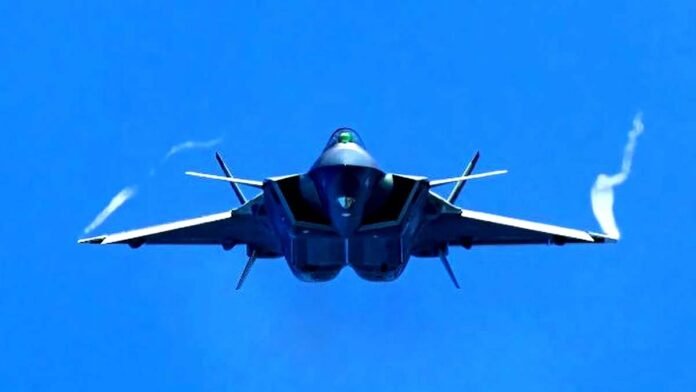
New Delhi: With the indigenous AMCA slated to be in service around 2035, India is weighing the acquisition of Russia’s Su-57 stealth fighters as an interim solution to bridge its airpower gap. Due to continued delays in the AMCA programme, and combined with China’s expanding J-20 fleet and Pakistan’s expected induction of the J-35, make the Su-57 a potential stopgap to maintain regional parity.
India’s Advanced Medium Combat Aircraft (AMCA) project represents the country’s most ambitious aerospace initiative, designed as a fifth-generation, twin-engine stealth fighter optimised for both the Air Force and Navy.

Spearheaded by the Aeronautical Development Agency under DRDO, the AMCA incorporates stealth features, internal weapons bays, advanced avionics, and super cruise capability. Unlike earlier flagship aircraft programmes dominated by Hindustan Aeronautics Limited, the AMCA marks a structural shift by involving private sector consortia to accelerate timelines and reduce supply chain vulnerabilities. Despite this, the aircraft is unlikely to be inducted before 2035, leaving a critical capability gap in the interim.
Russian President Vladimir Putin has revived Moscow’s offer to supply and jointly produce the Su-57 with India, emphasising that the aircraft could have originally been a joint project under the now-defunct Fifth Generation Fighter Aircraft (FGFA) programme. India withdrew from FGFA in 2021 citing high costs and concerns over technology transfer, but the Su-57 has since matured into Russia’s first operational fifth-generation fighter. It features stealth characteristics, thrust-vectoring engines for high manoeuvrability, advanced sensor fusion, and long-range strike capability.
Russia has also demonstrated the aircraft in combat during the Ukraine conflict, though production numbers remain limited compared to Western platforms like the F-35.
India is reportedly considering the procurement of at least two squadrons, or around 36 Su-57s, subject to technical evaluation. Hindustan Aeronautics Limited has indicated that nearly half of its existing facilities could be adapted for local Su-57 production, leveraging infrastructure from the Su-30MKI programme.

Russia has offered full technology transfer, integration of Indian subsystems, and even a two-seat variant capable of controlling drone swarms, aligning with India’s interest in manned-unmanned teaming concepts. Such provisions could make the deal more attractive by supporting India’s long-term industrial and operational sovereignty.
The urgency stems from regional developments. China has already inducted over 350 J-20 fighters and plans to field 1,500 by 2035, while also exporting the J-35 to Pakistan.

This would significantly alter the regional balance, especially given India’s shrinking squadron strength. Interim measures such as expanding Rafale purchases are being explored, but the Su-57 remains the only non-Western fifth-generation option available in the near term.
The American F-35 is considered unlikely due to restrictions on autonomy and political sensitivities, leaving Russia’s offer as the most realistic pathway.
India’s decision will hinge on balancing strategic autonomy, cost, and operational requirements. While the Su-57 could provide a rapid boost to stealth capabilities, concerns persist over its limited production run, questions about its stealth performance, and the risk of sanctions under US legislation such as CAATSA.
At the same time, Russia’s willingness to provide unrestricted technology transfer and align with India’s Make-in-India vision could tip the scales in favour of collaboration.
Ultimately, the Su-57 proposal is not merely about aircraft acquisition but about sustaining India’s deterrence posture until the AMCA matures. If accepted, it would reinforce the India-Russia defence partnership while ensuring that the Indian Air Force does not face a critical capability gap in the next decade.






