


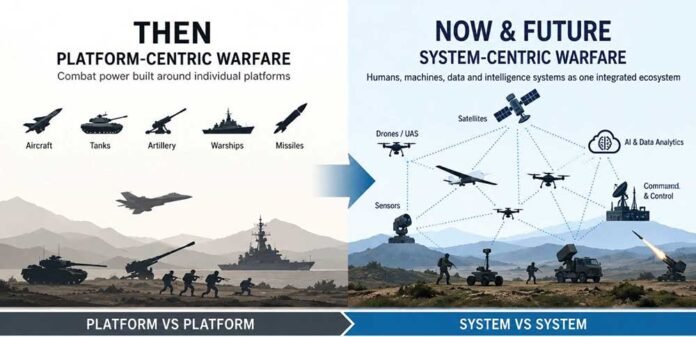
The character of warfare is evolving faster than traditional military acquisition cycles can absorb. For decades, combat power centred on sophisticated platforms, aircraft, tanks, artillery, warships and missiles. This platform-centric model is increasingly giving way to non-contact, networked, autonomous and data-driven warfare, where advantage depends on interconnected systems and human–machine collaboration. Recent conflicts, including Russia–Ukraine, have highlighted the growing role of drones and unmanned systems in ISR, targeting, strike, electronic warfare and logistics. India’s Operation Sindoor in May 2025 further highlighted the integration of precision strike, intelligence, drones, counter-UAS, electronic warfare and layered air defence. The weapon is therefore increasingly just one node in a larger kill chain linking sensors, communications, AI, command systems, autonomous platforms and precision effects.
This is driving the shift from “platform versus platform” to “system versus system.” A platform’s effectiveness increasingly depends on its wider ecosystem of sensors, data links, unmanned systems, AI, electronic warfare and precision weapons. At the tactical level, machines can detect and classify targets, AI can assist prioritisation, autonomous systems can act, and sensors can assess outcomes, while humans retain command and responsibility. Drones are only the visible beginning of this transformation. For India, the greater opportunity lies in building the architecture that connects drones with sensors, AI, communications, electronic warfare, precision weapons, command systems and human decision-makers, creating an integrated ecosystem capable of sensing, understanding, deciding and acting as one system.

The emerging battlefield is therefore likely to be characterised by:
- Stand-off and deep-strike operations rather than physical penetration of the adversary’s defended space.
- Persistent ISR through satellites, UAVs, sensors and distributed networks.
- System-on-system warfare, where networks and integrated architectures compete against each other.
- Human–machine teaming, with machines performing sensing, processing and increasingly autonomous tasks while humans retain command authority.
- AI-enabled decision superiority, compressing the sensor-to-shooter and observe–orient–decide–act cycles.
- Mass deployment of relatively low-cost autonomous systems, alongside sophisticated high-end platforms.
- Electronic and cyber warfare aimed at disrupting the adversary’s ability to sense, communicate, navigate and coordinate.
- Layered counter-UAS and air-defence systems, making both offence and defence increasingly networked.
- Distributed and resilient command-and-control, capable of operating despite communications degradation or loss of individual nodes.
- Rapid technology iteration, where software, algorithms and payloads may evolve faster than traditional acquisition programmes can accommodate.
The implications for military modernisation are profound. Traditional acquisition cycles spanning a decade or more are increasingly mismatched with technologies where software, AI models, sensors, electronic warfare and unmanned systems evolve within months. Acquisition must therefore shift from simply acquiring platforms to building continuously evolving capability ecosystems. Future operations will still require soldiers to hold terrain and secure objectives, but remote sensing, precision fires, autonomous systems, cyber, electronic warfare and stand-off weapons will increasingly shape the pathway to physical engagement. Military advantage will depend on integrating AI, data, communications, sensors, autonomous systems and human decision-making into resilient, adaptive architectures.
For India, the priority is to build a robotics-ready force where drones, UGVs, autonomous platforms, sensors, AI and personnel operate as an integrated human–machine ecosystem. Given India’s diverse environments, this requires secure, sovereign, interoperable and resilient intelligence architectures capable of functioning across contested and disconnected conditions. The objective is not to replace human judgement, but to enable machines to extend the military’s ability to sense, understand, manoeuvre and deliver effects, while humans retain intent, judgement and command.
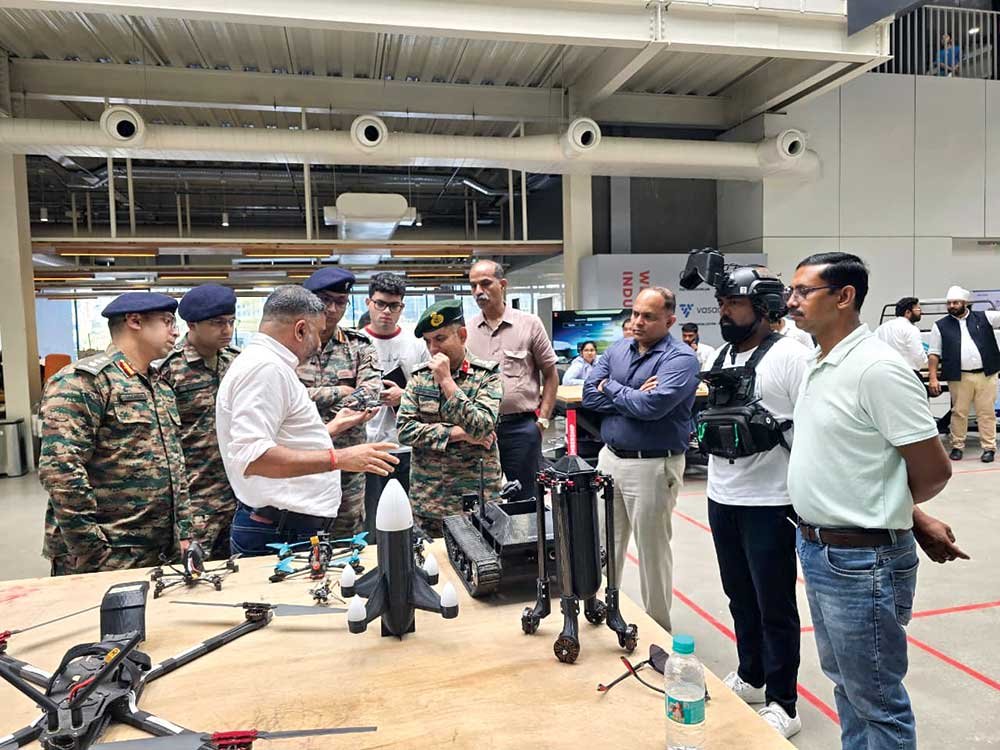
Drone is Not the Revolution, The Network is
The first generation of military unmanned systems largely focused on answering a relatively straightforward question: Can we place a sensor, payload or weapon on an unmanned platform and operate it remotely? The next generation of warfare demands a far more consequential question: Can multiple unmanned systems collectively perceive and understand an operational environment, share information, coordinate their actions and assist commanders in making faster and better-informed decisions? This represents a fundamental shift from the platform to the network.

The implications for military modernisation are profound. Traditional acquisition cycles spanning a decade or more are mismatched with technologies where software, AI models, sensors, electronic warfare and unmanned systems evolve within months. Acquisition must shift from simply acquiring platforms to building continuously evolving capability ecosystems
A single surveillance drone transmitting video to a human operator remains, fundamentally, an unmanned platform. In contrast, a network of drones and other robotic systems that can share observations, automatically detect and classify objects, correlate information across multiple sensors, compare observations with historical data, identify anomalies and changes, prioritise potential threats, and continuously update a common operational picture begins to resemble an intelligent robotic ecosystem. Such a system does not merely extend the physical reach of a soldier or commander; it extends the force’s ability to perceive, analyse and respond across a complex battlespace.
The distinction is therefore critical: a drone generates data; an intelligent network generates understanding. The real transformation will occur when data from drones, unmanned ground systems, satellites, radars, cameras, electronic sensors and other sources can be fused through secure communications and AI into a coherent operational picture. This is where artificial intelligence becomes central, not as a replacement for the human commander, but as the intelligence layer that enables machines and humans to collectively make sense of an increasingly complex and rapidly changing battlefield.

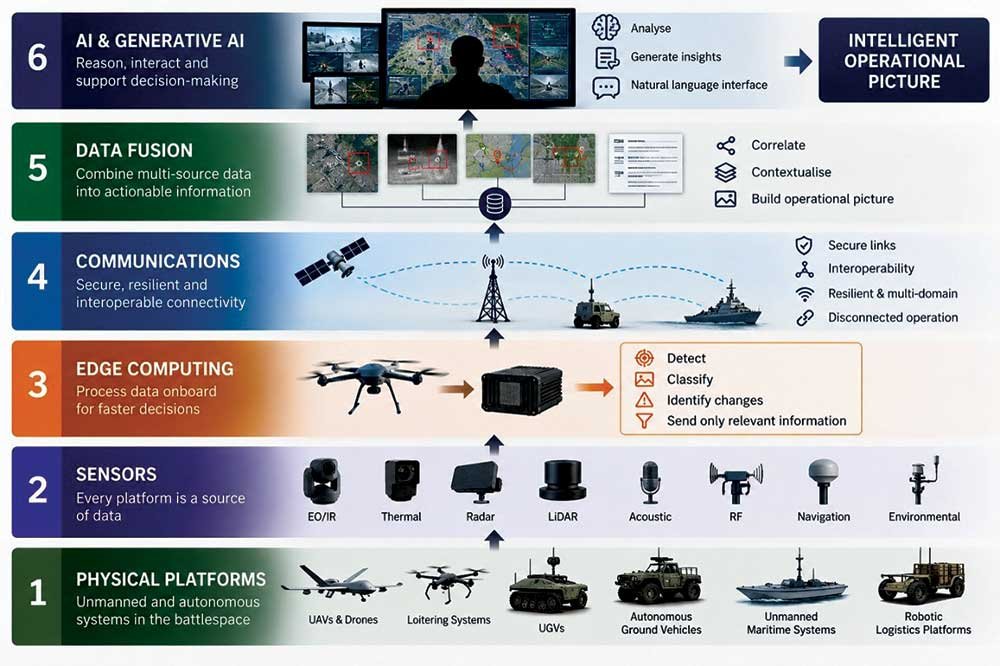
Future military formations are likely to operate not as collections of individual platforms, but as interconnected layers of physical systems, sensors, computing, communications, data and intelligence. Combat effectiveness will increasingly depend not only on the capabilities of individual platforms, but on how effectively the entire ecosystem can sense, communicate, process, understand and act as an integrated system.
At the physical layer, UAVs, drones, loitering systems, UGVs, autonomous ground and maritime platforms, robotic logistics systems and surveillance systems extend operational reach and persistence while reducing personnel exposure. Above this is the sensor layer, comprising EO/IR, thermal, radar, LiDAR, acoustic, RF, navigation and environmental sensors. As every platform becomes a source of information, the challenge shifts from collecting data to making sense of it at operational speed.
This makes edge computing and edge AI critical. In contested or communications-denied environments, drones and UGVs may need to process information onboard — detecting objects, identifying changes and prioritising relevant events — rather than continuously transmitting raw data. Instead, intelligent platforms can transmit detections, alerts and prioritised information, reducing bandwidth requirements and accelerating
decision cycles.
The communications layer must connect these distributed systems securely and reliably despite interference or degraded connectivity. Resilient networks, tactical data links, interoperability, intelligent bandwidth management and store-and-forward architectures will therefore become increasingly important.
The next stage is data fusion, where observations from different sensors and platforms are correlated across time and location. A thermal signature, drone observation, ground-sensor alert and historical intelligence report may each be inconclusive individually, but together can create a stronger operational picture. The objective is therefore not simply to collect more data, but to correlate, contextualise and convert distributed observations into intelligence.
At higher layers, AI, Generative AI and agentic AI can detect patterns, analyse imagery, correlate information across documents, video, maps and databases, and present intelligence through natural-language interfaces. Instead of manually navigating multiple systems, commanders can interact directly with the operational information environment to identify relationships, anomalies and relevant context.
This represents a fundamental shift from platform-centric to intelligence-centric warfare. A drone operating alone is a capability; a fleet of drones connected to sensors, edge AI, communications, data fusion and command systems becomes part of an intelligent operational network. The ultimate objective is a continuous cycle of sense → connect → compute → fuse → understand → decide → act → learn, executed with greater speed, resilience and effectiveness.
From Platform-Centric to Intelligence-Centric Warfare
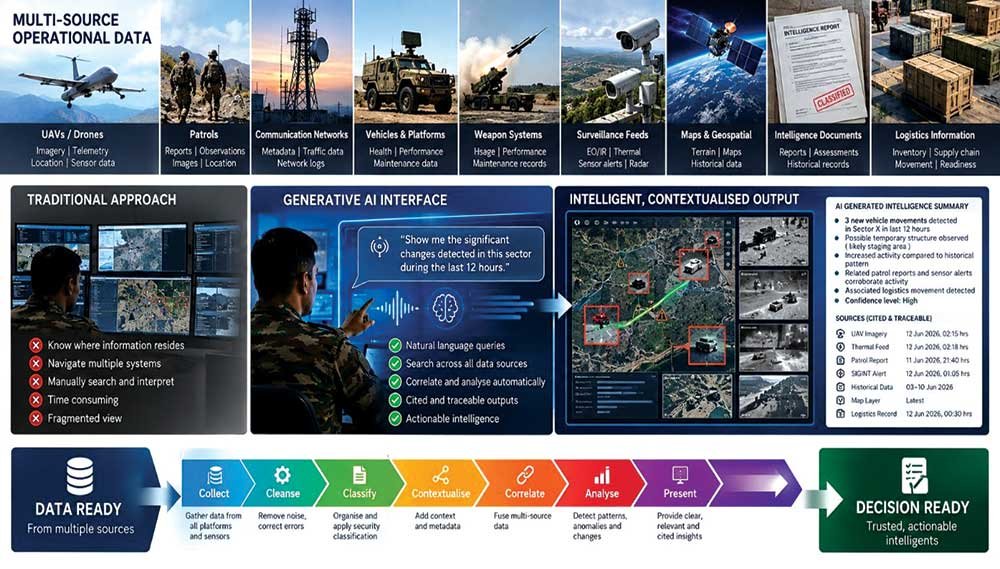
Traditional military information systems generally require personnel to know where information resides, which system contains it, and how to retrieve and interpret it. Generative AI can fundamentally transform this interaction by allowing commanders and operators to engage with the information ecosystem through natural language rather than navigating multiple databases, dashboards and document repositories. A commander could simply ask, “Show me the significant changes detected in this sector during the last 12 hours,” and an intelligent system could potentially correlate drone imagery, surveillance feeds, sensor alerts, patrol reports, intelligence documents, maps, historical observations, maintenance records and logistics information to generate a contextualised, cited and traceable intelligence summary. The significance, therefore, extends far beyond conversational AI. The real opportunity lies in creating a decision-intelligence layer across the entire information ecosystem, enabling fragmented data to be transformed into actionable knowledge while maintaining traceability to the underlying sources.
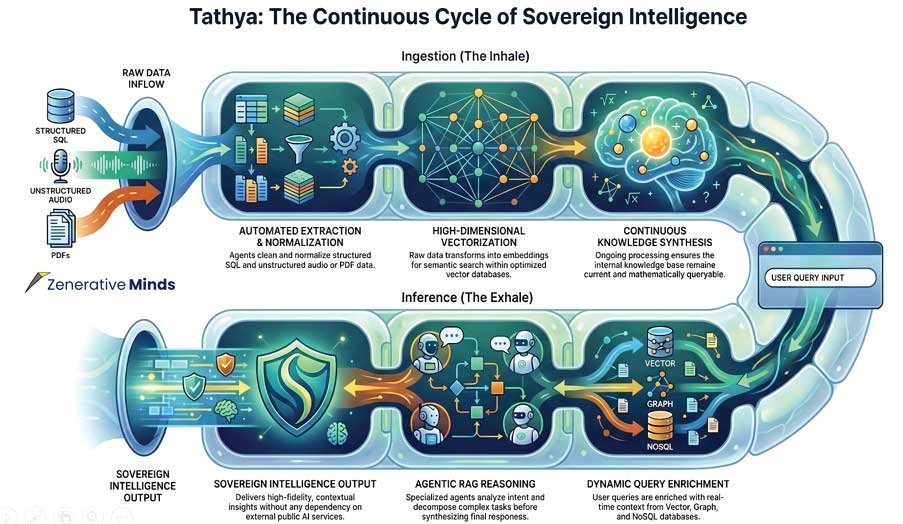
Developed by Zenerative Minds as part of an iDEX project, the platform, ZM-Tathya, is designed to enable users to interact with and derive intelligence from large, multimodal datasets through an intuitive, context-aware interface. The company has also begun filing eight patents covering innovations associated with the platform and its underlying technologies
Significant progress has already been made in developing a sovereign, data-intelligent Generative AI operating system for India, designed to transform complex and diverse data into actionable insights in a manner aligned with the information needs of commanders and decision-makers. Developed by Hyderabad-based Zenerative Minds as part of an iDEX project, the platform, ZM-Tathya, is designed to enable users to interact with and derive intelligence from large, multimodal datasets through an intuitive, context-aware interface. The company has also initiated the process of filing eight patents covering innovations associated with the platform and its underlying technologies.
Data Becomes the Strategic Resource
The future battlefield will generate unprecedented volumes of data. Every UAV sortie can produce imagery, telemetry, location information and sensor observations; every patrol can generate reports; communication networks continuously create metadata; and vehicles, weapons and other platforms can generate detailed health, performance and maintenance information. The challenge is therefore no longer simply “How do we collect data?” but rather “How do we transform this enormous volume of data into trusted, actionable decisions?” This is where the transition from Data Ready to Decision Ready becomes critical. Raw data, by itself, has limited operational value. It must be systematically collected, cleansed, classified, contextualised, correlated, analysed and presented before it can become meaningful, trusted and decision-ready intelligence. The competitive advantage will increasingly belong to forces that can compress this journey from data to understanding to decision at operational speed.
Why Data Quality Will Determine AI Quality
The effectiveness of any military AI system will ultimately depend on the quality, structure and reliability of the data ecosystem that supports it. Consider a surveillance environment in which Drone A detects an object at 1030 hours, Drone B identifies a similar object at 1045 hours, a ground unit reports unusual activity at 1100 hours, and a historical intelligence report contains information about the same location. If these sources use different coordinate systems, timestamps, naming conventions, classification structures or data formats, an AI system may struggle to recognise that these observations are related. Future military AI architectures will therefore require a strong and disciplined data foundation, incorporating common data standards, rich metadata, data lineage and provenance, accurate time synchronisation, entity resolution, secure and role-based data access, classification-aware processing, and mechanisms for monitoring data freshness and integrity. The objective should be to ensure that an AI system does not merely answer “What does the data say?”, but can also establish “Where did this information come from, how current is it, what evidence supports it, and how confident should we be?” In defence, where decisions may have significant operational consequences, this distinction between an answer and a trusted, traceable intelligence assessment is fundamental.
The Rise of the AI Agent
The next evolution of military AI is likely to move beyond individual AI applications towards agentic AI, in which multiple specialised AI agents collaborate to perform a complex operational task. Rather than relying on a single model to process everything, a distributed team of agents could perform specialised functions across the intelligence cycle: a Collection Agent could identify and retrieve relevant information from sensors and databases; a Vision Agent could analyse imagery and detect objects or changes; a Correlation Agent could connect observations across multiple sources; a Knowledge Agent could retrieve relevant historical documents and intelligence; an Analysis Agent could synthesise available evidence; a Verification Agent could examine sources, contradictions and confidence levels; and a Briefing Agent could convert the resulting assessment into a concise, decision-oriented operational brief. Such an architecture is not intended to remove humans from the decision loop. Its purpose is to augment human intelligence and reduce cognitive burden, allowing commanders and operational personnel to spend less time searching, collating and interpreting fragmented information and more time applying judgement, assessing options and making decisions.
Sovereignty is Not Optional
Military AI raises a strategic question beyond technological capability: who controls the intelligence infrastructure on which operational decision-making depends? As armed forces increasingly rely on AI for sensing, data fusion, analysis, and decision support, dependence on foreign cloud services, external APIs, or proprietary platforms can challenge operational sovereignty, data security, and the continuity of mission-critical capabilities. Sensitive defence information cannot always leave the operational environment, nor can critical AI capabilities be dependent on persistent access to external infrastructure. India therefore needs to build an architecture capable of supporting on-premises and private-cloud AI, air-gapped deployments, edge inference, indigenous or sovereign models, secure data pipelines, locally controlled knowledge bases and controlled model updates. The objective is not to isolate the Indian defence ecosystem from global technology, but to ensure that critical operational data, intelligence and AI-enabled decision capabilities remain under Indian control, particularly in contested or disconnected environments.
The Battlefield Operating System of the Future
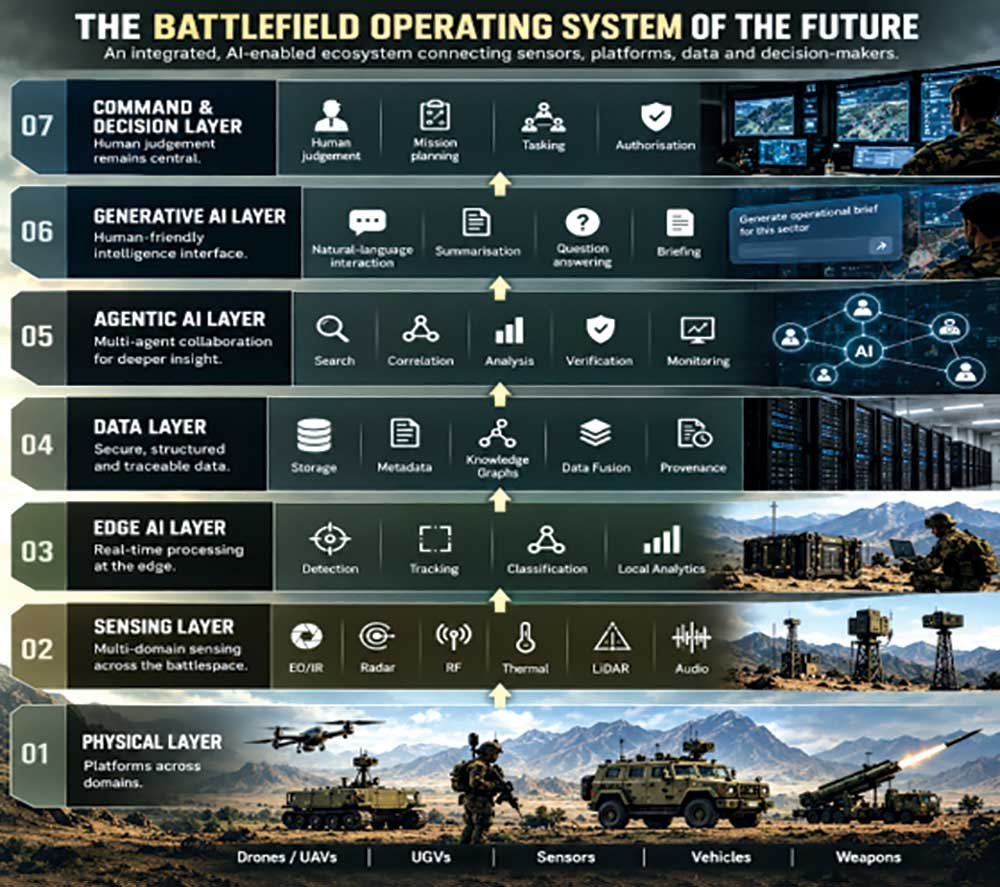
The most consequential military technology of the future may not be a single drone, robot, weapon or sensor, but the intelligence layer that connects them all. A future battlefield operating system could bring together a physical layer comprising drones, UGVs, sensors, vehicles and weapons; a sensing layer incorporating EO/IR, radar, RF, thermal, LiDAR and acoustic systems; and an edge-AI layer providing real-time detection, tracking, classification and local analytics. Above this would sit a secure data layer integrating storage, metadata, knowledge graphs, data fusion and provenance, followed by an agentic AI layer capable of search, correlation, analysis, verification and continuous monitoring. Generative AI would provide the human-facing interface through natural-language interaction, summarisation, question answering and operational briefing, while the command-and-decision layer would retain human judgement, mission planning, tasking and authorisation. The real transformation will occur when these layers function as a single, secure and interoperable ecosystem, enabling the force to move seamlessly from sensing and data collection to understanding, decision and action, while keeping humans firmly in command of critical decisions.
A future battlefield operating system could bring together a physical layer comprising drones, UGVs, sensors, vehicles and weapons; a sensing layer incorporating EO/IR, radar, RF, thermal, LiDAR and acoustic systems; and an edge-AI layer providing real-time detection, tracking, classification and local analytics
From Command and Control to Command, Control and Intelligence
Traditional Command and Control (C2) systems have primarily focused on moving information across command levels, but the future battlefield demands a fundamentally different capability: understanding. A modern military information system must go beyond displaying alerts and reports to determine which information matters, whether multiple observations are related, what has changed, how reliable the assessment is, what historical evidence supports it, what information is missing and what requires immediate attention. This creates a new paradigm of Command, Control and Intelligence, in which AI becomes the connective tissue between the enormous volume of battlefield data and human decision-making. For India, this transition must be built around operational reality first and technology second.
 The country’s diverse operating environments, from high-altitude terrain and extreme weather to deserts, maritime areas, dense urban spaces and communications-contested environments, demand systems that can function under unreliable connectivity, electromagnetic interference, dust, heat and cold, and within secure or air-gapped networks. AI and robotic systems must therefore be tested not merely in laboratories, but under realistic operational conditions with realistic data, communications constraints and battlefield uncertainty.
This requires a deliberate focus on sovereign AI infrastructure capable of operating across secure, private and disconnected environments; treating data pipelines, standards, metadata and knowledge systems as critical defence infrastructure; developing modular and interoperable robotic platforms with standardised interfaces wherever operationally appropriate; pushing intelligence closer to the sensor through edge computing; and building effective human-machine teams in which technology augments the judgement and effectiveness of soldiers, operators and commanders rather than pursuing automation for its own sake.
The next military advantage will increasingly belong to the force that can connect sensors, process data, learn rapidly and convert intelligence into action through the shortest and most resilient decision cycle. Drones are only the beginning of a broader transformation towards robotic, autonomous and AI-enabled military ecosystems, where machines sense, communicate and analyse while humans retain command and responsibility. For India, this creates an opportunity to build a sovereign ecosystem integrating AI, Generative AI, robotics, computer vision, autonomous systems, edge computing and secure data infrastructure. The transition is therefore from drone warfare to robotics-enabled warfare, with data and the speed of turning intelligence into decisions at its core.

The writer is a visionary Military Veteran, Technology Leader and Scaling Entrepreneur. An iDEX winner and alumnus of NDA, IIT Kanpur and IIM Indore, he works at the intersection of Sovereign AI, Drones, Robotics and Defence innovation, and is a strategic consultant, thought leader, columnist and speaker. The views expressed are of the writer and do not necessarily reflect the views of Raksha Anirveda





