


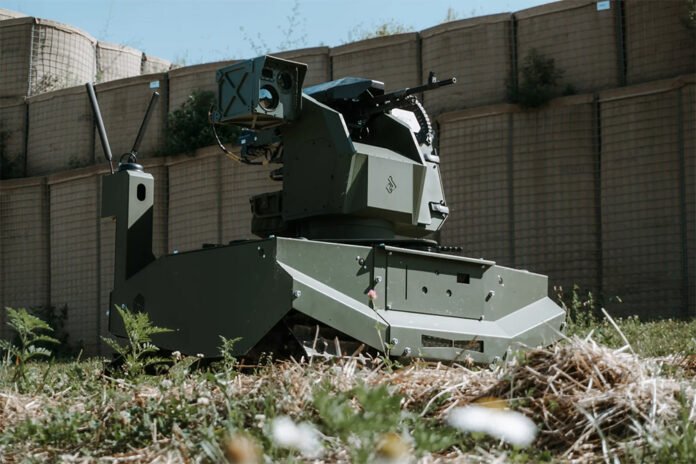
London: European defence company ARX Robotics has introduced its new combat robot, designed in cooperation with the Ukrainian Armed Forces and based on their specific recommendations to solve key operational challenges in battle.
The Germany-based company launched its latest unmanned ground vehicle, the Combat Gereon, during the DSEI trade show here last week. The system, which combines the existing Gereon RCS platform with AI-enabled autonomous functions, was displayed here armed with the LOKI remote weapon station from Slovenian company Valhalla Turrets.

The variant was developed in partnership with the Ukrainian company Frontline, the Ukrainian military and frontline-experienced testers, ARX Robotics chief executive officer Marc Wietfeld said. The company boss detailed three key suggestions provided by the Ukrainian forces relating to the system’s dimensions and operations to make it more adaptable to real combat conditions.
“Some [examples] included reducing the UGV’s size and weight to allow easy integration into front-line logistics; simplifying controls so that operators with minimal training can use it effectively under combat stress; and increasing modularity to enable quick field repair and adaptation to changing mission needs,” Wietfeld said.
The use of combat robots across the battlefield in Ukraine has proliferated, with machines taking over tasks previously assigned to soldiers. The dynamic has translated into an increase in companies engaged in the development of UGVs, which now stands at over 100, per the Ukrainian Ministry of Digital Transformation website.
Earlier this year, the European Defence Agency’s innovation hub launched an initiative to test aerial drones and UGVs to assess their fit in resupply and logistics missions. While several European manufacturers already produce war robots, Wietfield said the main drawbacks of many of these platforms revolve around their size, cost and complexity.

“The main weaknesses of many European combat UGVs are their large form factor and heavy weight, which prevent integration into front-line logistics – they are [also] often complex, expensive, and based on sensitive technology not designed for sustained battlefield use,” he said. He added that several of them require up to three operators, which can be an inefficient use of personnel, as many countries already face manpower shortages.






