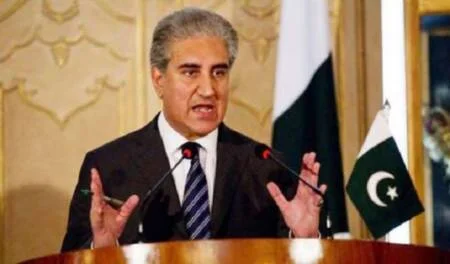
New Delhi: In an embarrassment for the Imran Khan-led government, Pakistan Foreign Minister Shah Mahmood Qureshi conceded that abrogation of Article 370 is India’s internal matter. As per a clip shared by Pakistani journalist Naila Inayat, Qureshi is heard making this admission in an exclusive interview with Samaa TV. In fact, he also pointed out that the revocation of the special status of Jammu and Kashmir has been challenged in the Supreme Court.
Moreover, he claimed that a huge section in India was of the belief that this move did not prove to be beneficial for India. The PTI leader also stressed that all outstanding issues can be settled only through dialogue as war will be “suicidal”. This comes as a clear departure from the consistent stance adopted by Pakistan that there cannot be normalization of ties until the Centre restores Article 370.

Pakistan Foreign Minister Shah Mahmood Qureshi remarked, “Article 370 is their (India’s) internal issue. The people of Kashmir are saying that you had made a promise…It is their frustration. The matter is still pending in the Supreme Court and people have challenged it. There has been a strong reaction in Kashmir to the steps which have been undertaken- whether it is 35A or 370 or the cruelty inflicted there. Today, there is a huge section in India which agrees that they have lost more and gained less because of these steps.”
“There is no option other than dialogue. These are two nuclear powers with outstanding issues which need to be resolved either today, tomorrow, or the day after. War is not an option. War will be suicidal,” he added.
A Presidential notification combined with requisite legislation passed by both the House of Parliament in August 2019 led to Article 370 becoming virtually redundant. This implied that the special status of Jammu and Kashmir (J&K) was scrapped. Furthermore, the region was bifurcated into the Union Territories of J&K and Ladakh. Thereafter, restrictions on the movement of people and communication were imposed in the state, which was gradually lifted over the months.
During his maiden visit to Sri Lanka on February 24, Pakistan PM Imran Khan called for resolving differences with India via dialogue. Claiming that he had unsuccessfully attempted to diffuse tensions in the bilateral relationship after assuming power in 2018, he emphasised the need to improve trading ties with India. In a joint statement issued a day later, the Director Generals of Military Operations of both countries agreed to strictly observe all agreements and stop firing from February 25.

Softening the brash tone further, Imran Khan told participants at the recently held Islamabad Security Dialogue that India can benefit from more trade and connectivity to Central Asia if both nations resolve their issues. Speaking at the same event, Pakistan Army Chief General Qamar Javed Bajwa maintained that it is time to bury the past and move forward. However, there was a setback when the Pakistan Cabinet rejected the proposal of the Economic Coordination Committee to import sugar, cotton and yarn from India.